
# Choosing a Baked Kibble OEM: NY/T 5429—2026 Process, Controls, and Cost Guide
In April 2026, MOARA Announcement No. 1018 approved agricultural industry standard NY/T 5429—2026, Technical Specification for Baking Processing of Complete Pet Food, effective October 1, 2026. It is China's first agricultural industry recommended standard covering baked-process complete pet food, drafted under Fubei Pet (Shanghai) with participants including the CAAS Feed Research Institute and Gambol Pet Group. The framework covers terminology, process flow, technical requirements, and verification methods. For brands and procurement teams entering the baked kibble category, the standard provides a reference basis for judging manufacturing capability.
Baked Kibble vs Extruded Kibble vs Air-Dried Treats
| Dimension | Baked kibble | Extruded dry food | Air-dried treats |
|---|---|---|---|
| Processing temperature | Relatively low-temperature baking | High-temperature high-pressure extrusion | Long low-temperature air drying |
| Pellet structure | Dense, fewer pores | Loose and porous | Jerky/strip form |
| Typical selling point | High fresh-meat inclusion, crisp texture | Mature volume production, controllable cost | Pure meat treat, palatability |
| Applicable category | Complete dog/cat staple food | Complete staple food | Treat/reward |
Note: the standard applies to baking production and processing of complete dog and cat food; air-dried jerky treat processes fall outside its scope.
Baked Kibble Process Flow Mapped to the Standard
1. Ingredient Prep and Batching
- Verify ingredient catalog compliance, specifications, and indicators against the formula;
- Fresh meat, meat meal, grain/grain-free ingredients, fat, and additives are metered separately;
- Batching records bind to batches for traceability.
2. Grinding and Mixing
- Ingredients are ground to specified particle size for uniform mixing;
- Dry powders, fats, and liquid components are added in steps to avoid clumping;
- Mixing uniformity records are retained.
3. Forming
- Baked kibble is typically formed by pressing or molding, unlike extrusion;
- Forming controls pellet size, weight deviation, and appearance consistency.
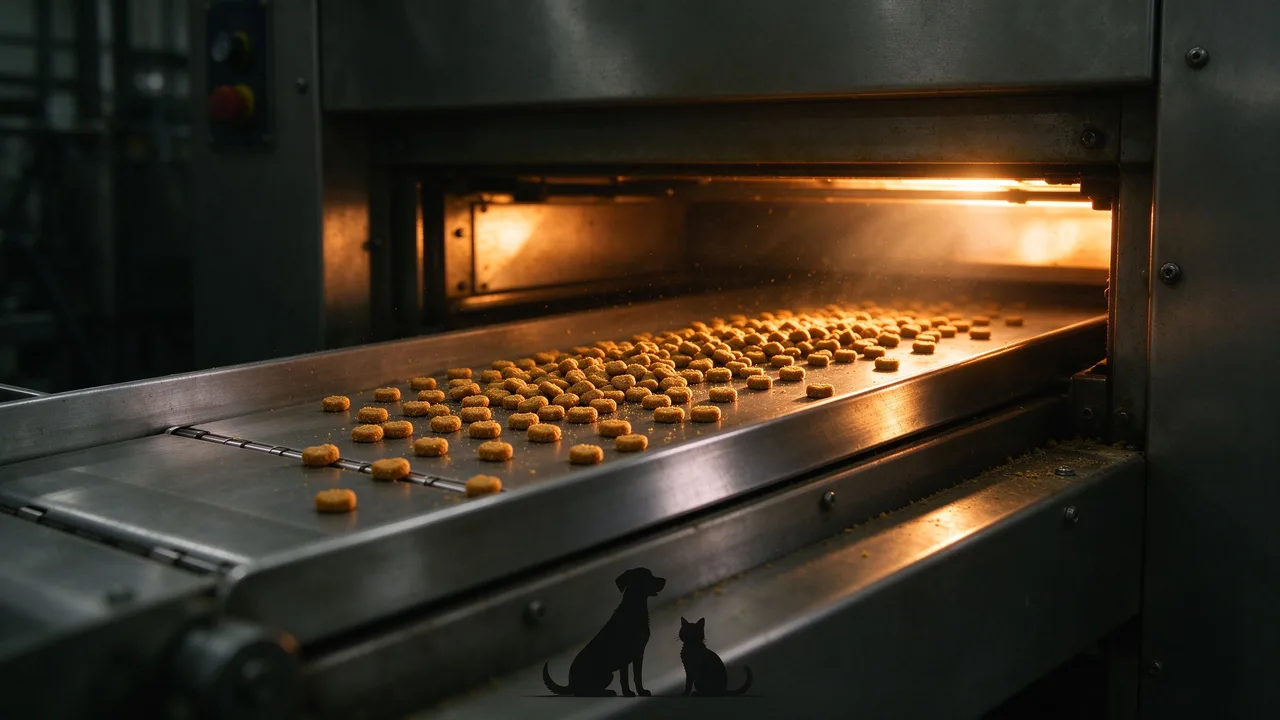
4. Baking (Key Process)
- Baking follows controlled temperature and time curves per the standard, avoiding local scorching or residual moisture;
- Segmented temperature baking is common: dehydration first, then setting and coloring;
- Finished moisture and water activity are monitored through the process.
5. Cooling and Post-Processing
- Cool to room temperature before packaging to prevent condensation inside bags;
- Optional oil spraying, coating, or topping (e.g., freeze-dried pieces evaluated separately from the baking step);
- Sieve out fines.
6. Packaging and Retention
- High-barrier packaging controls moisture uptake and oxidation;
- Finished product tested per batch for moisture, crude protein, crude fat, and other guarantees;
- Batch retention samples and outgoing records archived.
Key Process Controls to Check in a Factory
1. **Formula review capability**: ingredients checked against catalog and specs, complete batch records;
2. **Baking curve control**: segmented temperature equipment with recordable, adjustable parameters;
3. **Moisture control**: routine finished moisture and water activity testing;
4. **Pellet consistency**: outgoing inspection of weight deviation, appearance, crumb rate;
5. **Batch traceability**: two-way traceability from raw material lot to production batch to distribution;
6. **Standard-compliance files**: process documents and inspection record samples aligned with NY/T 5429—2026.
General Cost and MOQ Composition
Cost Factors
- Fresh meat ratio: higher fresh-meat inclusion raises raw material cost and baking dehydration energy use;
- Baking process: low-temperature long-time baking energy and throughput affect unit cost;
- Packaging requirements: high-barrier or nitrogen-flushed bags cost more than standard kibble bags;
- Pellet specs and flavor SKU count: line-change cleaning and mold adjustment are amortized across volume.
Common MOQ Ranges (industry common range; factory-specific)
| Product type | Common MOQ | Notes |
|---|---|---|
| Baked complete food, single flavor | 2-5 tons per formula | Determined by baking line capacity and line-change cost |
| Multi-flavor combo | Per-flavor MOQ | Separate batching, baking, and packaging per flavor |
| Coated or freeze-dried-topped | Stacked on base MOQ | Post-processing costed separately |
New brands should sample first to validate forming, crispness, and moisture indicators before setting first production volume.
Common Co-Packer Questions
1: Does "baked" on the package equal baked process?
Not necessarily. Judge by actual process flow and standard-compliance records; during audit review the buyer should inspect baking equipment and parameter records, not packaging wording alone.
2: Does baked kibble always retain more nutrition than extruded?
Process characteristics differ; actual nutrition follows formula design and test reports. Labels must not make nutrition claims beyond test evidence.
3: Can baked kibble share an extrusion line?
Baking needs dedicated forming and baking stages; mixed-line use compromises process consistency. Confirm line ownership during factory audit.
Bottom Line
After NY/T 5429—2026 took effect, baked kibble moved from a concept category to one with a process standard to benchmark. When choosing a co-packer, focus on baking curve control, moisture testing, batch traceability, and standard-compliance files, not just sample taste.
Brands needing baked kibble formula sampling or process evaluation can work with **Mixiaoqi (Guangzhou) Pet Technology Co., Ltd. pet food OEM/ODM** on baked formula design, small-batch trial production, and outgoing indicator testing arrangements, in person or online.
---
FAQ
**Q: Is NY/T 5429—2026 a mandatory standard?**
A: It is a recommended agricultural industry standard (NY/T), not mandatory, but its framework can be used as a reference checklist during procurement factory audits.
**Q: Do baked treat snacks fall under this standard?**
A: The standard covers baked processing of complete dog/cat food; air-dried jerky snacks are evaluated under their own process and corresponding standards.
**Q: How much should the first baked kibble order be?**
A: Sample first to validate forming and moisture; single flavor commonly starts at 2-5 tons, subject to factory baking line capacity and pack format.
Developing a fresh pet food product?
Share your target market, product direction, format and expected volume — we will help structure a project plan.
Submit a project brief