
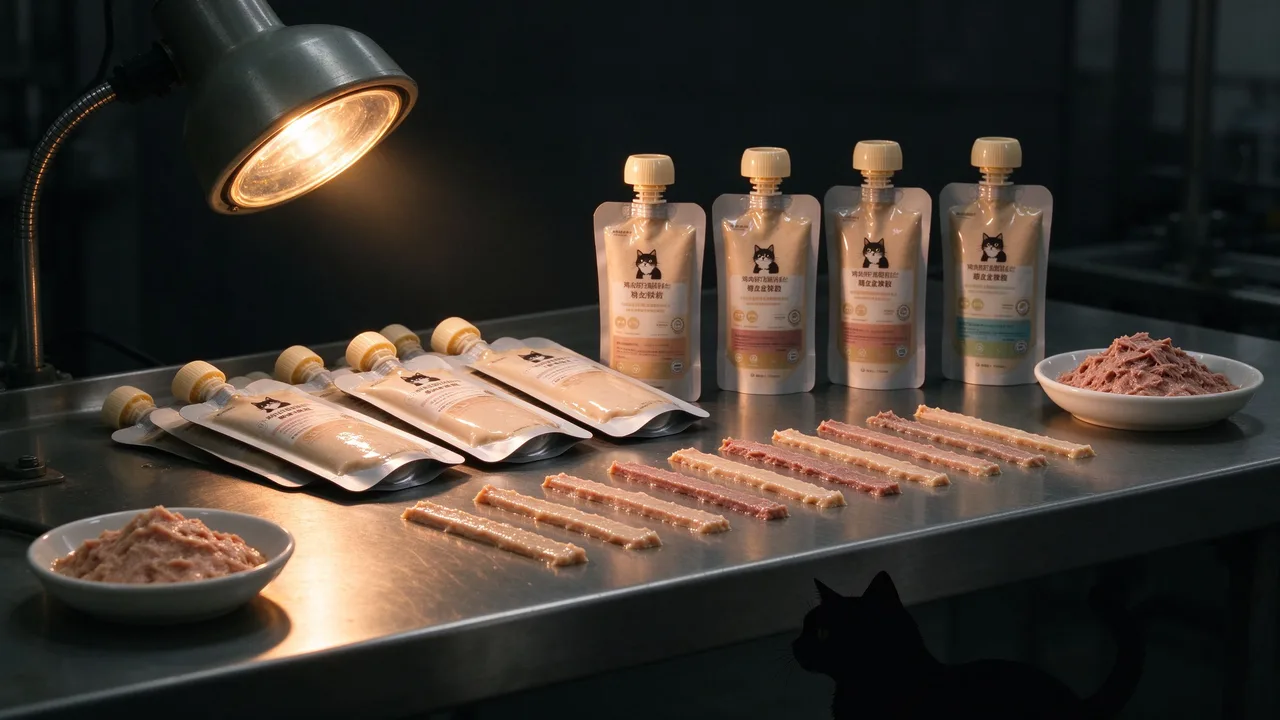
# Lickable Cat Strip and Puree Pouch OEM Guide: Formula Forming, Filling, Sterilization, MOQ
Cat strips (lickable cat strip / creamy puree pouch) are a fast-growing cat treat category, usually 10-15g small pouches or sticks of meat puree or pâté. They differ from staple wet cans in formula system, filling method, and packaging: strips emphasize fine texture, palatability, and single-serve independent packs. This guide covers cat strip OEM formula forming, filling and sterilization, co-packer checks, MOQ ranges, and label compliance for brands planning a strip line.
Common Cat Strip Forms
| Form | Packaging | Characteristics |
|---|---|---|
| Meat puree/pâté strip | 10-15g soft pouch or stand-up mini pouch | Fine texture, squeezed directly; flavors mainly chicken, tuna, duck, salmon |
| Shredded/chunk puree | Small pouch with visible shreds or chunks | Solids and gravy ratio must be declared; harder to form than pure puree |
| Single-protein strip | Small pouch, one animal protein | Clear ingredient list, aimed at flavor-sensitive cats |
| Multi-stick combo pack | 5-stick, 10-stick outer pack | Inner pouch plus outer bag; combo flavors scheduled separately |
Formula and Forming Controls
1. Meat Source and Protein System
Strip meat sources are mainly chicken breast, tuna, duck, and salmon. Single-protein formulas require only one animal protein on the ingredient list, with source evidence and batch test records.
2. Moisture, Fat, and Texture Balance
Liquid puree relies on moisture, fat, and binder systems for a smooth texture. Formula adjustments must account for crude protein, crude fat, moisture guarantees, and squeeze behavior: too thin separates, too thick hurts filling and palatability.
3. Fineness and Uniformity
Puree must be refined and homogenized; particle size directly affects texture and squeeze flow. Shred/chunk products control fines rate and solids ratio.
4. Filling and Sealing
Fill weight, seal integrity, and leak rate for small pouches/sticks are outgoing inspection focus points; liquid products demand higher seal strength than solid treats.
5. Sterilization and Shelf Life
Strips usually use high-temperature secondary sterilization for commercial sterility, with common 12-24 month shelf life. The sterilization curve is validated separately by packaging material and net weight; parameters are rechecked when flavors share packaging.
Cat Strip Co-Packer Checklist
1. **Puree forming experience**: can it produce puree and shred samples matching target texture and squeeze behavior;
2. **Filling equipment**: fill accuracy, seal inspection, and leak control on small pouch/stick lines;
3. **Sterilization capability**: secondary retort equipment, parameter records, heat validation per package;
4. **Formula development**: flexibility on meat, binder, and gravy recipes, with guarantee-value calculation;
5. **Ingredient traceability**: animal-origin evidence, batch testing, retention records;
6. **Packaging support**: inner film rolls, outer combo packs, multi-flavor mixed packing;
7. **Label compliance**: catalog ordering, solids declaration, species and life stage, export label language;
8. **Flexible scheduling**: multi-flavor small-batch mixed runs, line-change cleaning records.
Common MOQ Ranges (Industry Reference; Factory-Specific)
| Product type | Common MOQ reference | Influencing factors |
|---|---|---|
| Pure puree, single flavor | About 20,000-65,000 sticks per formula, or by carton | Film roll MOQ, filling batch, sterilization batch |
| Shred/chunk, single flavor | Quoted by spec | Solids forming, fines control |
| Multi-flavor combo | Per-flavor MOQ then combined | Line-change cleaning, inner/outer packaging |
| Export order | Plus destination label and filing requirements | Label language, ingredient declaration, export documents |
Actual MOQ depends on net weight, packaging form, packaging MOQ, and sterilization batch; lock first-order specs, flavor count, and lead time during sampling.
Label and Claim Compliance
- Ingredients ordered by added weight; trace ingredients not placed first;
- Shred/chunk products declare solids ratio;
- Strips are treats, not staple food; label states the treat attribute;
- Wording limited to texture, moisture, and daily variety, with no extension to disease prevention, treatment, or specific organ-function claims;
- Probiotics, fiber, and similar ingredients described at the daily nutrition level only, with no efficacy promise;
- Export products checked against destination label rules (English label, AAFCO/FEDIAF wording as applicable).
Common Misconceptions
1: Strip Formula Can Be Ported From a Staple Can
Strips are small-pouch liquid squeeze format; texture, filling, and packaging differ from cans, so staple can formulas cannot be reused directly.
2: More Flavors Lower the MOQ
More flavors mean more line changes, ingredient batches, and sterilization runs; combo packing does not reduce per-flavor MOQ. Start with two or three core flavors.
3: Small Pouches Need No Barrier Validation
Liquid puree contains fat and moisture; insufficient film barrier affects shelf life and flavor, so packaging must match the shelf-life plan.
Bottom Line
Cat strip OEM differentiation lies in puree forming, small-pouch filling and sealing, and sterilization shelf-life control. When selecting a factory, first verify target texture samples, then check fill accuracy, sterilization validation, solids declaration, and export label capability. Start with two or three core flavors in puree or single-protein form, then expand SKUs after texture, guarantees, and packaging are validated.
Brands needing strip/puree pouch sampling or cost modeling can work with **Mixiaoqi (Guangzhou) Pet Technology Co., Ltd. pet food OEM/ODM** on puree and shred formula development, pouch filling and sterilization evaluation, multi-flavor small-batch trials, and export label checklist coordination, online or on site.
---
FAQ
**Q: Can cat strip OEM start with sampling?**
A: Yes; sample first to confirm texture, squeeze behavior, and guarantees, then lock packaging specs, flavor count, and MOQ.
**Q: What is a typical strip shelf life?**
A: Retorted small-pouch strips commonly run 12-24 months, subject to packaging barrier, sterilization validation, and formula calculation.
**Q: What matters for export strip labels?**
A: Check destination label language, ingredient declaration, and treat-attribute wording; retain animal-origin source documents by batch.
Developing a fresh pet food product?
Share your target market, product direction, format and expected volume — we will help structure a project plan.
Submit a project brief