
# A State-Backed Media Brand Enters Cat Food: What Co-Packers Must Deliver
On November 9, the e-commerce arm of China Media Group launched its own pet food brand with two complete-and-balanced cat foods: a classic recipe and a fresh-meat recipe. The brand line is "companionship is the best affection." When the story was picked up across Chinese media on November 14, the discussion was less about price and more about why a state-backed media group would enter cat food at all.
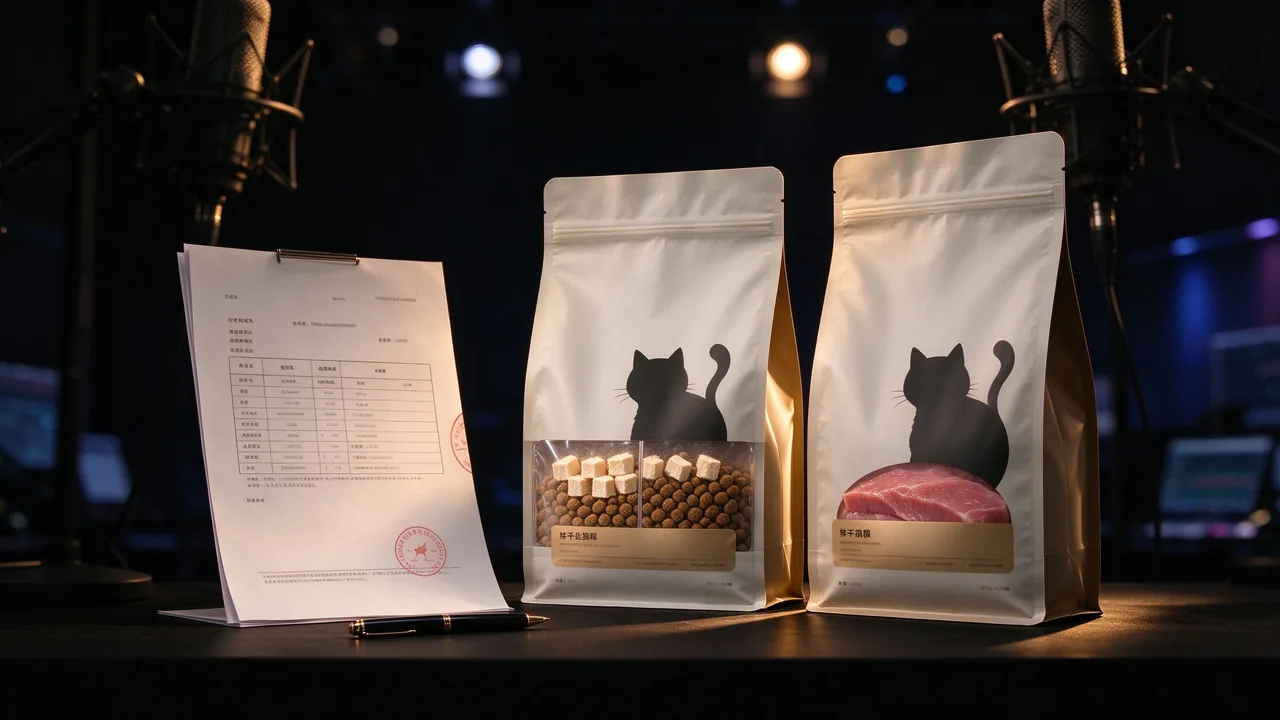
The answer is on the product page. The classic SKU builds on 25% fresh salmon and 22% fresh chicken, paired with freeze-dried pieces. Crude protein tested at 36.31%, above the 34% guaranteed minimum on the label. One phrase keeps appearing in the coverage: records you can check.
Those three elements, fresh meat ratio, tested values and retrievable records, are exactly where co-packers get questioned hardest and stumble most often.
1. Trust brands and traffic brands do not ask for the same things
Traffic-driven brands want a hook first: a new concept, striking packaging, fast launches. The co-packer's job is to make the concept exist.
Trust-driven brands want stability first: one formula version, not a new one every month; test reports that map to a specific batch; records that can be pulled the same day a question arises. Their credibility comes from institutional backing, and a single mismatch between report and product damages it directly.
That means a co-packer supplies more than capacity. It supplies evidence: batch records, change notification and audit access.
2. Fresh meat plus freeze-dried: two processes, one line
At 25% fresh salmon and 22% fresh chicken, total fresh meat input is 47%, which is not a small number for an extruder. Fresh meat brings water into the barrel and raises the drying load. Salmon is higher in fat than chicken, so oxidation risk rises. Add freeze-dried pieces and the blending ratio and downstream handling start to affect uniformity in every bag.
The hard part of a blend product is not feasibility. It is repeatability: the ratio of freeze-dried pieces to kibble, mixing time and layer separation during filling. If any of them drift, the consumer sees it the moment the bag is opened. These products usually need dedicated scheduling so they do not share cleaning windows with standard formulas.
3. Label values and tested values: reports must match the batch
Crude protein on the label is a guaranteed minimum, so a higher test result is normal. What needs management is the stability of the deviation. One batch at 36% and the next at 33%, both above the minimum, still turns "checkable" into "questionable."
Three things need watching: whether third-party testing and release testing use the same batch basis; how long retained samples are kept; and whether stability is re-validated after any formula adjustment. Many plants keep only a finished-product test report, with no retained sample and no formula version log, and cannot answer when challenged.
4. Two extra requests from trust-driven clients
First, content assets: production line footage, audit photos, a plain explanation of the testing flow. These brands have to show how the product is made on their own channels, and whether the plant can support filming affects how deep the partnership goes.
Second, compliance boundaries: what can be claimed and what cannot. A co-packer that flags "this statement has no basis" during formulation saves far more money than one that fixes packaging afterward.
5. A negotiation checklist for brands
- Testing frequency: release testing every batch, or sampling by lot? How often for microbiological and nutrient panels?
- Retention: how long are finished samples kept beyond shelf life?
- Formula lock: how are version numbers managed, and how many days' written notice before a change?
- Line rules: are blend and freeze-dried products scheduled separately, and how is cleaning verified?
- Audit access: how many times a year, and can clients or third parties join?
When Mixiaoqi pet food OEM/ODM takes on a trust-driven brand, batch records, sample retention and change notification go into the quality agreement, and the client can audit by batch. These brands are not selling a bag of food. They are selling the willingness to be checked.
FAQ
**Q1: How do media companies or platforms produce their own pet food brands?**
Mostly through contract manufacturing. The brand owns formula definition, packaging design and content, while the co-packer handles formula execution, production, testing and records. A few build their own lines, but most validate the market with co-packing first.
**Q2: Crude protein tests at 36.31% against a 34% label. Is that compliant?**
The label figure is a guaranteed minimum, so a higher result is normal. What matters is stability and traceable records. Wild swings between batches of the same SKU are the real problem.
**Q3: What should a trust-driven brand look for in a co-packer?**
Three things: batch records that can be pulled on demand, advance notice of formula changes, and the same batch basis for third-party and release testing. Trust is built on reports, and destroyed when reports do not match the product.
Developing a fresh pet food product?
Share your target market, product direction, format and expected volume — we will help structure a project plan.
Submit a project brief