
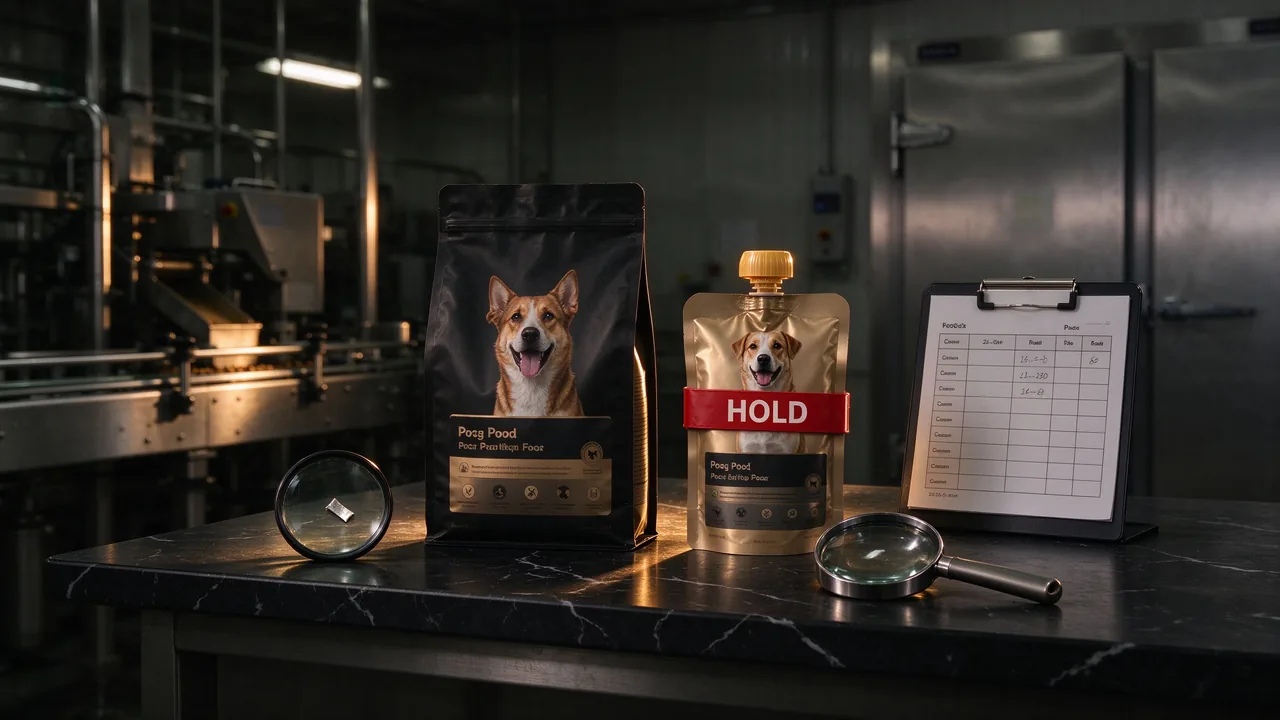
# Two Pet Food Recalls in One Day: Foreign Material and Raw Food Are Where It Breaks
On November 13, two pet food recalls surfaced almost simultaneously in Europe and North America.
Hungary's national food chain safety office, Nebih, announced a recall of Rocco Sensitive turkey and potato wet pouches in 6 x 800 g packs because they may contain small foreign material. The product is made by Partner in Petfood BV in the Netherlands and sold by the German retailer Zooplus, and consumers were told to stop feeding it.
Also reported the same day was a recall by Raaw Energy in the United States: five raw dog foods possibly contaminated with Salmonella and Listeria monocytogenes, with notices issued between November 5 and 7. The brand had already suspended production in May 2026 after contamination reports at its New Jersey facility.
Two incidents, two entirely different failure modes: one physical, one microbiological. They happen to be the two problems in pet food co-packing that are hardest to fix after the fact. The moment a consumer sees foreign material, the brand has lost the chance to explain. Once raw food tests positive for a pathogen, the recall usually covers the whole line.
1. Foreign material: usually a source-control failure, not a detection failure
Small foreign material in wet pouches most often comes from four places: equipment wear such as bearing, gasket and blade fragments; torn screens; packaging remnants such as foil or seal-film edges; and material carry-over such as bone chips, plastic twine or wire.
Only the last two can be stopped by inline detection. The first two are equipment condition problems that detectors cannot fix. A metal detector finds metal, not a rubber gasket. X-ray finds high-density material, not plastic whose density is close to the product.
So the first layer of foreign material control is not buying equipment. It is inspection and wear-part management: check and log screens every shift, replace blades and gaskets on a service life rather than after failure, put seals on the inspection sheet, check packaging knives every batch. The second layer is magnets, metal detection and X-ray, and those need sensitivity verification, not just installation.
2. Raw food: no heat step, so cold chain and release carry the load
Raw dog food skips thermal processing, which means microorganisms in the ingredients never get a kill step. Control therefore moves upstream to three points: ingredient acceptance, cold chain continuity and batch release.
Ingredient acceptance should review the supplier's microbiological results and transport temperature records, not just freshness. The cold chain must be documented end to end, including unloading wait time. Batch release should treat pathogen testing as a condition, not a spot check. Any link judged by "should be fine" is a recall waiting for a date.
3. Private label: who owns what across borders
The Rocco recall has a structure worth noting: production in the Netherlands, sale in Germany, notification in Hungary. The retailer is the brand on the label, the co-packer is the actual producer, and the regulator faces the market where the product is sold.
In that structure, recall cost allocation has to be written into the contract: who notifies, who pays for delisting and destruction, who leads corrective action, who verifies it, and how many days each step allows. Many co-packing contracts say only that "product quality is the supplier's responsibility," which is almost unenforceable in a cross-border recall.
4. Four things an export plant should have ready
1. Batch granularity: within one hour, list which ingredients went into a batch, which customers received it, and how much stock remains.
2. An English recall template: product name, batch, cause, risk description, disposition instructions, pre-written so only fields need filling.
3. A recall drill: at least once a year, timed from notification to batch lock. If it takes more than four hours, the process needs work.
4. Product liability insurance: covering export markets, with coverage matched to annual shipment volume.
5. Four questions a brand can ask in an audit
- Can I see the replacement records for screens and wear parts?
- How often is metal detector sensitivity verified, and where are the test pieces placed?
- Where are the raw material transport temperature records for raw products?
- When was the last recall drill, and how long did batch lock take?
When Mixiaoqi pet food OEM/ODM takes on raw or wet orders, the foreign material source list, cold chain records and batch release criteria go into the quality agreement, and a recall drill runs before the first production batch. Not to satisfy an auditor, but because the cost of these failures is always higher than prevention.
FAQ
**Q1: What usually causes foreign material in wet pet food?**
Four sources dominate: equipment wear such as bearing, gasket and blade fragments; torn screens; packaging film remnants; and material carry-over such as bone chips, plastic twine or wire. The first two are controlled by inspection and wear-part management, the last two by magnets, metal detection and X-ray.
**Q2: Should raw pet food require pathogen testing before release?**
Salmonella and Listeria testing should be a batch release condition rather than a random check. Raw food has no heat step, so ingredients and the cold chain are the only barriers. Every point of slack in release criteria multiplies recall risk.
**Q3: Should a co-packer pay for a cross-border recall?**
It depends on the contract. A common split: recalls caused by process control failure sit with the co-packer; recalls caused by formulation, labeling or transport and storage sit with the brand. Notification, delisting, destruction and corrective action deadlines and costs should all be written into the quality agreement.
Developing a fresh pet food product?
Share your target market, product direction, format and expected volume — we will help structure a project plan.
Submit a project brief