
# Extruded Dry Kibble OEM Guide: Twin-Screw Extrusion Parameters, Pellet Forming, Quality Controls
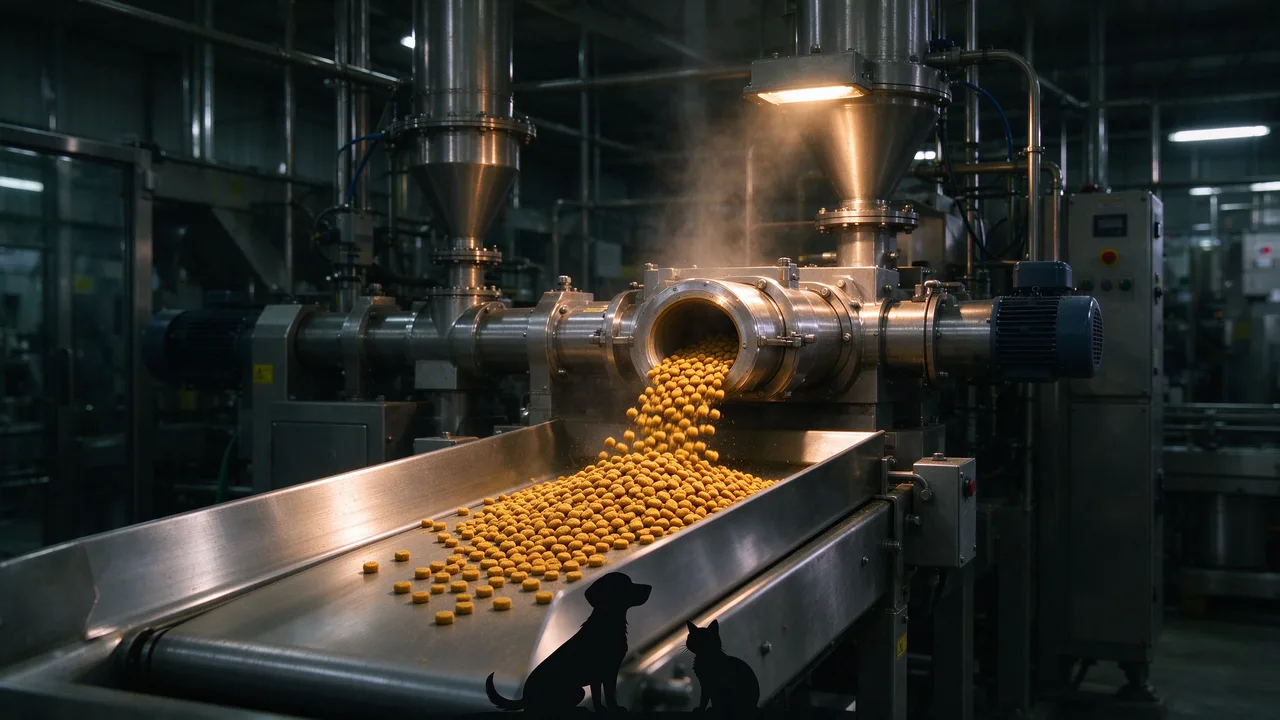
Extruded kibble is the mainstream shelf-stable staple form for dogs and cats, with the core stage in a twin-screw extruder: ingredients cook and form under heat, pressure, and mechanical shear, then expand into a porous crunchy pellet when pressure drops at the die. Process parameters directly affect pellet density, crunch, rehydration, and nutrient retention. This guide walks through key controls, typical parameter ranges, and co-packer checks along the kibble line for brands planning a dry food contract line.
Complete Extruded Kibble Process
1. **Ingredient handling**: meat meal, grains, and protein powders weighed by formula and finely ground to spec;
2. **Mixing**: ribbon/paddle mixer blends meals, fats, and premix uniformly;
3. **Conditioning**: steam preconditioner adds moisture and heat to start starch gelatinization and stabilize extrusion;
4. **Extrusion**: twin-screw extruder cooks and forms the dough, which expands as it exits the die under pressure release;
5. **Drying**: hot-air dryer brings pellet moisture down to safe storage levels;
6. **Fat and flavor coating**: oil, flavor, or nutrient top-dressing applied to the pellet surface;
7. **Cooling**: cooling to near ambient to control moisture pick-up;
8. **Sieving and packaging**: fines and crumbs removed before weigh-packing.
Typical Process Parameter Ranges (Industry Typical; Factory Formula and Equipment Specific)
| Parameter | Typical range | Impact on product |
|---|---|---|
| Feed moisture | About 25%-30% | Controls expansion and pellet texture |
| Barrel temperature | About 90-160°C | Temperature affects starch gelatinization and cooking speed |
| Die pressure | About 30-60 bar | Pressure and shear define pellet pore structure |
| Screw speed | About 300-500 rpm | Speed affects shear intensity and pellet fineness |
| Conditioning steam | Adjusted by formula | Improves throughput, reduces wear, evens gelatinization |
Parameters are tuned jointly with meat-meal ratio, grain type, and target pellet density; high-protein, low-grain formulas demand higher extrusion stability and a narrower parameter window.
Quality Controls by Stage
1. Grinding Particle Size
Uneven particle size causes mixing deviation and local under-cooking during extrusion; screen specs must match the formula. High-meat formulas place higher demands on fat dispersion and particle control.
2. Mixing Uniformity
Trace ingredients (vitamins, minerals) are pre-mixed before entering the main mix to avoid uneven distribution; mixing time and ingredient order follow fixed procedures.
3. Conditioning Gelatinization
Insufficient moisture and steam in conditioning leave starch under-gelatinized, producing loose pellets and poor rehydration; conditioning also stabilizes throughput and reduces screw wear.
4. Extrusion Forming
Die aperture, output speed, and screw speed together determine pellet shape and size; interchangeable dies produce round, bone, triangle, and other shapes; die cutting keeps pellet length consistent.
5. Drying and Moisture
Post-drying moisture must reach the safe storage range: too dry makes pellets brittle and crumbly, too wet carries spoilage risk during storage; drying curves are validated per pellet spec.
6. Coating and Cooling
Oil and flavor are applied after pellet cooling; coating adhesion and uniformity affect palatability. Insufficient cooling before packing causes moisture pick-up and caking.
7. Sieving and Outgoing
Fines and crumbs are sieved out; pellet density, crumb rate, moisture, and guarantees are sampled before packing, with batch retention for traceability.
Extruded Kibble Co-Packer Checklist
1. **Equipment configuration**: twin-screw extruder, conditioner, drying-cooling line, coater specs and capacity;
2. **Formula adaptation experience**: extrusion records for high-protein, low-grain, single-meat formulas;
3. **Parameter control**: stage parameter records, batch traceability, and abnormal adjustment procedures;
4. **Ingredients and testing**: ingredient acceptance, moisture/protein/fat testing, mycotoxin and foreign-material records;
5. **Pellet consistency**: sample-confirmed standards for shape, size, density, and crumb rate;
6. **Packaging support**: pellet spec, bag type, net weight, and combo pack capability;
7. **Label compliance**: catalog ordering, guarantees, applicable species and life-stage review;
8. **Flexible scheduling**: small-batch multi-formula trials, line-change cleaning, and batch management.
Common Process Issues and Direction
| Issue | Possible cause | Check direction |
|---|---|---|
| Weak expansion, hard pellets | Conditioning moisture/temperature low, die pressure low | Recheck conditioning and barrel temperature curve |
| Loose, brittle pellets | Under-gelatinized, over-dried, under-cooled | Check gelatinization, drying curve, cooling time |
| High crumb rate | Cutting parameters, sieving, conveying impact | Adjust die cutting, check sieving and cushioning |
| Uneven pellet density | Poor mixing, fluctuating feed | Verify mixing uniformity and feed stability |
| Post-storage caking | Under-cooled, moisture pick-up | Recheck cooling-end moisture and packaging barrier |
Common Misconceptions
1: Extrusion Is Just "Pressing Powder Into Pellets"
Extrusion is a cooking-and-forming process; the parameter window affects gelatinization, pellet structure, and nutrient retention, not simple shaping.
2: High-Protein Formulas Can Reuse Grain Formula Parameters
High-meat, low-grain material properties differ and need a separate extrusion window; reusing grain parameters easily causes loose pellets or unstable expansion.
3: A Good Sample Means Stable Mass Production
Pilot and production lines differ in capacity, shear, and moisture control; production stability relies on batch records and continuous-run data, not the first sample alone.
Bottom Line
Extruded kibble OEM differentiation lies in formula-matched parameter tuning and whole-line quality control. When selecting a factory, first check equipment configuration and extrusion records across formulas, then verify parameter traceability, pellet consistency standards, testing system, and small-batch trial capability. Start with one formula and fixed pellet spec to validate moisture, crumb rate, and guarantees before expanding flavors and specs.
Brands needing extruded kibble sampling or process evaluation can work with **Mixiaoqi pet food OEM/ODM** in Guangzhou on dog and cat formula development, pellet spec and die selection, parameter tuning trials, and outgoing testing process coordination, advancing from the first dry SKU.
---
FAQ
**Q: What indicators should kibble OEM sampling review?**
A: Pellet shape and size, density, crunch, crumb rate, moisture, and crude protein/fat guarantees; confirm item by item against a sample standard.
**Q: Is high-protein extrusion difficult?**
A: High-meat, low-grain material properties differ from grain formulas, with a narrower parameter window; the factory should have adjustment records for comparable formulas.
**Q: What is the difference between extruded and baked kibble?**
A: Extrusion cooks under high heat and pressure into porous crunchy pellets; baking forms denser pellets at lower temperature. The two use different equipment and parameter systems and cannot share one line.
Developing a fresh pet food product?
Share your target market, product direction, format and expected volume — we will help structure a project plan.
Submit a project brief