
# Freeze-Dried Coating Kibble OEM: Process, Cost and MOQ Breakdown
On November 5, 2026, Austrian premium cat food brand Cat's Love announced a full relaunch: its new dry food line uses freeze-dried coating technology, with kibble coated in freeze-dried turkey powder to boost aroma and palatability, alongside new ragout, filet, and light paté wet lines. On the supply side, Bridge PetCare and other Chinese factories already offer kibble mixed with 8% five-variety freeze-dried pieces; Nestlé Purina invested $45 million in a dedicated vacuum freeze-drying tunnel at its North American plant in November 2025. Kibble plus freeze-dried is a clear premiumization direction for complete pet food.
Three "Freeze-Dried Kibble" Formats First
| Format | Freeze-dried form | Bonding method | Process complexity |
|---|---|---|---|
| Coating | Freeze-dried meat powder/crumbs | Coated onto extruded kibble surface | Medium |
| Top-mix | Whole freeze-dried pieces/chunks | Blended with kibble before bagging | Low |
| Freeze-dried center | Pieces embedded inside kibble | Embedded during forming/extrusion | High |
Most domestic brands use the first two: coating via a powder drum; top-mix blended before packaging. Embedded-center processes demand higher equipment and formula stability, with fewer mass-production cases.
Process Route Breakdown
1. Extruded Kibble Base
Conventional extrusion: raw material grinding → ingredient mixing → extrusion forming → drying → cooling → optional oil/flavor coating. Base meat content, hardness, and fat level determine how well coating adheres.
2. Freeze-Dried Ingredient Prep
- Freeze-dried meat (chicken, duck, turkey, salmon, etc.) is ground into powder after vacuum freeze-drying, or cut into whole pieces;
- Freeze-dried ingredients must control moisture (typically ≤5%), otherwise shelf life and oil stability suffer;
- Powder goes to coating; whole pieces go to top-mix.
3. Coating Step
- Kibble is first sprayed with a small amount of oil as binder;
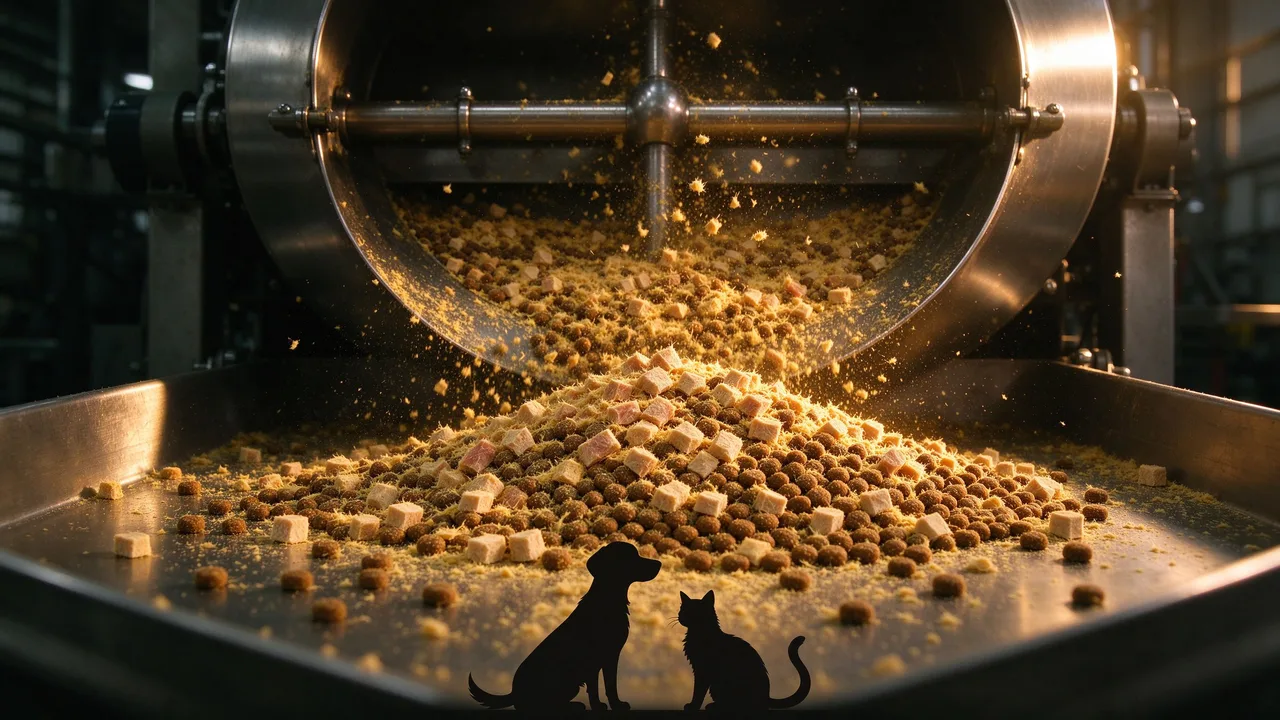
- Moves into a rotary coating drum where freeze-dried powder adheres evenly;
- Coating ratio controlled (commonly 2%-5%) to avoid excess powder loss and crumb buildup in the bag.
4. Top-Mix Blending Step
- Finished kibble and measured freeze-dried pieces blend at low speed in a mixer;
- Freeze-dried ratio controlled (commonly 5%-12%); over-mixing breaks pieces;
- Sieve out fines before bagging.
5. Packaging and Shelf Life
Freeze-dried ingredients are highly hygroscopic, so packaging needs good barrier film or nitrogen flushing. Finished water activity control is the key to preventing powder loss and moisture uptake over shelf life.
Formula Design
A typical top-mix cat formula:
- Extruded base: fresh chicken, chicken meal, rice/grain-free starch, egg powder, fish oil, vitamins and minerals;
- Freeze-dried mix: freeze-dried chicken, egg yolk, salmon pieces;
- Additives: taurine, omega-3 sources, prebiotics (per approved feed additive catalog).
Design points:
1. Base must pass nutrient guarantees: crude protein, fat, moisture calculated for the full bag including freeze-dried pieces;
2. Labeled freeze-dried percentage must match actual feed ratio;
3. Palatability layering: top-mix improves taste, base carries complete nutrition — don't let freeze-dried pieces mask a low-protein base.
Cost and MOQ
Cost Structure
- Extruded base: regular kibble level;
- Freeze-dried ingredient cost: rises sharply with content; whole freeze-dried pieces cost far more than meat powder;
- Process cost: coating adds a powdering step; top-mix adds blending and sieving;
- Packaging cost: high-barrier or nitrogen-flushed bags cost more than standard kibble bags.
Typical MOQ Ranges (industry common range; factory-specific)
| Product type | Common MOQ | Notes |
|---|---|---|
| Top-mix kibble | 1-3 tons per formula | Shared extrusion line; pieces blended in |
| Coated kibble | 2-5 tons per formula | Adds coating step; line-changeover cleaning needs volume to amortize |
| Freeze-dried center | 5+ tons | Equipment adaptation and setup costs higher |
First samples usually run small-batch trial production to validate appearance, powder-loss rate, and palatability before scaling.
Co-Packer Capabilities to Verify
1. In-house freeze-drying line or stable freeze-dried ingredient supply;
2. Coating/blending equipment parameters (coating ratio stability, powder-loss control);
3. Finished water activity testing capability;
4. Nutrient guarantee test reports;
5. Packaging barrier and nitrogen-flushing capability.
Bottom Line
Freeze-dried coating and top-mix are executable premiumization directions for kibble, with simpler routes and more controllable cost than pure freeze-dried food. Before entering the category, decide coating vs top-mix first, then calculate cost and MOQ from process complexity and freeze-dried ratio — don't rely on vague "freeze-dried content" claims in a quote.
For brands evaluating coated or top-mix kibble sampling, **Mixiaoqi pet food OEM/ODM** in Guangzhou supports base formula, freeze-dried ratio design, and small-batch trial production, staged from sampling to mass production.
---
FAQ
**Q: What is the difference between coating and top-mix?**
A: Coating adheres freeze-dried powder to the kibble surface; top-mix blends whole freeze-dried pieces into the kibble. Equipment and cost differ.
**Q: Does freeze-dried kibble have the same shelf life as regular kibble?**
A: Freeze-dried ingredients are hygroscopic; it needs high-barrier or nitrogen-flushed packaging, and water activity control determines shelf life.
**Q: How much should a new brand order for the first freeze-dried kibble run?**
A: Start with small-batch samples to validate powder loss and palatability; top-mix commonly starts at 1-3 tons, coating at 2-5 tons, subject to factory line conditions.
Developing a fresh pet food product?
Share your target market, product direction, format and expected volume — we will help structure a project plan.
Submit a project brief