
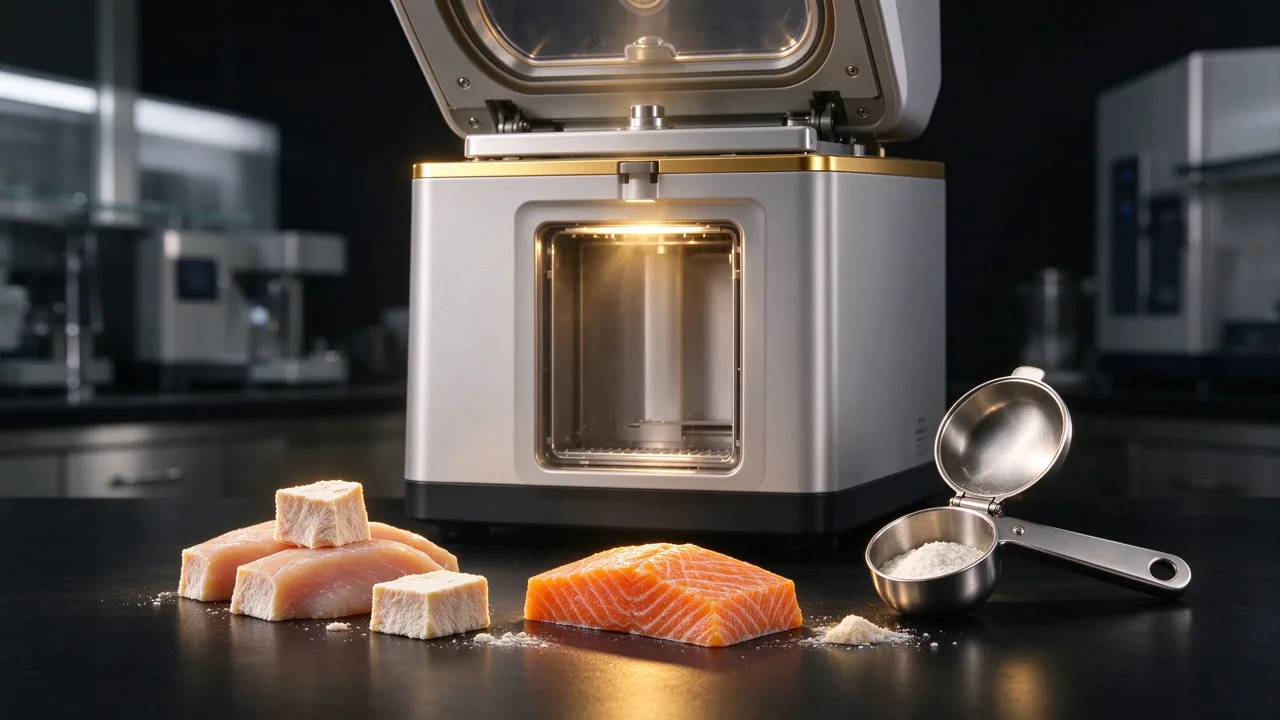
Since May 1, 2026, NY/T 4839-2025 General Requirements for Freeze-Dried Pet Food has been in force. Six months in, **freeze-dried pet food contract manufacturing** has moved from "we do it by experience" to "we do it to a standard."
If you are evaluating **freeze-dried pet food manufacturers** or already sampling with a co-packer, these six metrics must be aligned at the contract and sample stage. Otherwise, compliance problems surface only after scale-up.
1. Ingredients: Fresh Frozen Meat, Not Re-Thawed Stock
The standard requires:
- Fresh or frozen fresh meat stored at -18°C or below—not room-temperature jerky, not re-thawed stock;
- Species must match the label (chicken is chicken, not duck passed off as chicken);
- Seafood must declare species of origin.
Whether the freeze-dried co-packer runs a dedicated fresh-meat cold room and physically separates it from jerky lines is the first filter.
2. Process: Traceable Lyophilization Curves
Core process parameters:
- Pre-freezing temperature typically -35°C to -40°C;
- Sublimation-stage vacuum ≤ 100 Pa;
- End point measured by **water activity (Aw)**, typically ≤ 0.6.
The standard requires lot-by-lot process curve records. A reliable **freeze-dried pet food co-packer** shows you the actual lyophilization curve, not just a claim that "our freeze-drying is thorough."
3. Moisture and Aw: Both Matter
Many brands only test moisture content (usually ≤ 5%). The standard is more concerned with **water activity**, which predicts microbial growth and shelf life beyond 18 months:
- Moisture ≤ 5%;
- Water activity Aw ≤ 0.60;
- Both tested on every outgoing lot.
4. Rehydration: ≥90% Within 3 Minutes
Whether freeze-dried pieces can substitute raw or stand in for fresh food depends on rehydration:
- In 25°C water, ≥90% rehydration within 3 minutes;
- No obvious sediment, no oil separation after rehydration.
This is the hidden weak point. The freeze dryer is easy to buy; the curve is hard to tune. Poorly tuned pieces rehydrate into mush.
5. Hygiene: Total Count, Coliforms, Salmonella
Hard indicators retained from pet feed hygiene rules:
- Total plate count ≤ 100,000 CFU/g;
- Coliforms ≤ 100 CFU/g;
- Salmonella absent;
- Moisture ≤ 5%.
The co-packer must supply **lot-level outgoing test reports**, not just an annual type-test report.
6. Labeling: Do Not Write "Raw Freeze-Dried" Casually
Key labeling changes:
- Do not loosely write "freeze-dried raw meat" unless the product also meets raw food requirements;
- The standard category is "freeze-dried pet food";
- Ingredient names must follow the feed catalog;
- Drying method (vacuum freeze-drying) and storage conditions must be declared.
Closing
Freeze-dried is booming, but post-standard the competition is no longer "who can do freeze-dried"—it is "who can do it consistently to the standard." Ingredient traceability, process curves, Aw, rehydration, hygiene and labeling should be locked at sampling.
> Brands evaluating freeze-dried can contact **Mixiaoqi pet food OEM/ODM** (Mixiaoqi Guangzhou Pet Technology Co., Ltd.). We sample to the full NY/T 4839 checklist, with lot-level process curves and outgoing test reports.
Developing a fresh pet food product?
Share your target market, product direction, format and expected volume — we will help structure a project plan.
Submit a project brief