
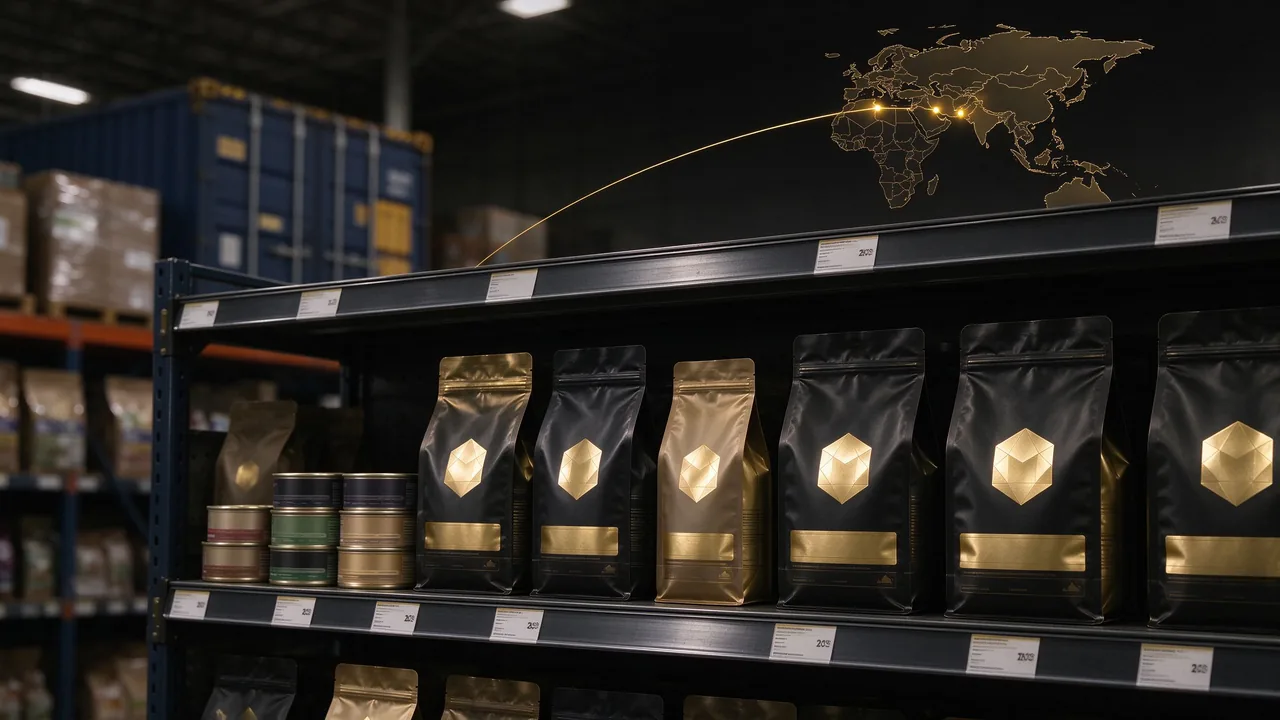
# Europe's Largest Pet Retailer Moves Sourcing to Hong Kong: Private Label Near Half, Co-Development Is the New Ticket
On November 13, a report on Fressnapf circulated widely in the Chinese pet industry. The German pet retail group operates nearly 3,000 stores across 15 European countries, leads nine of those markets, holds an average share of about 17% in its core markets, and employs more than 20,000 people. In the first half of 2026 it reported RMB 14.25 billion in revenue and RMB 1.185 billion in operating profit. For fiscal 2025, revenue was EUR 3.7 billion, up 2.5%, and operating profit was EUR 380 million, up about 11%.
The numbers are not the part Chinese co-packers should focus on. Two other facts matter more. First, private label has become the core of the business: seven private brands sold EUR 1.94 billion in 2023, equal to 48.4% of retail sales that year, the exclusive brand portfolio now reaches 16, and pet food contributes roughly 75% of revenue and profit. Second, in November 2025 Fressnapf opened an Asia sourcing office in Hong Kong, led by someone with a long Asia sourcing background at UK retailer Pets at Home, with a stated purpose of getting closer to suppliers and shortening time to market for new products.
Sourcing has moved forward, and that changes who a co-packer talks to. It used to be an importer or wholesaler passing messages along. Now it is the retailer's sourcing, quality and packaging teams in the same meeting. Three demands arrive at once.
1. The audit window moves forward: retail certification becomes the entry ticket
When a retailer buys direct, the first step is auditing the supplier list itself. Unlike orders routed through an importer, a retail audit typically covers four areas: food safety systems such as BRCGS, IFS or FSSC 22000; social compliance such as SMETA; packaging and sustainability, including recyclability, PCR content and paper sourcing; and capacity plus business continuity.
This kind of audit is evidence-based. Certificates are only the entry ticket. On site, reviewers look at batch records, corrective and preventive actions, supplier audit records and packaging compliance files. Documents also need to work in English. Otherwise a single corrective action can take two weeks of back-and-forth and break the project timeline.
For a plant, this means treating the document pack as a product: a certificate list, a testing capability list, representative product specifications, a packaging sustainability statement, and social compliance reports, assembled into a reusable English package. For each new client, only the project-specific section changes.
2. From build-to-print to co-development: proposals are scarcer than capacity
One detail in the report matters: Fressnapf's sourcing team does not just look for factories. It participates in product development, quality management and packaging design. In other words, the retailer no longer wants "make what I specify." It wants "propose something that can go on the shelf."
That is a co-development order, and it usually has four parts: formula and nutritional targets, including a cost range; process and line fit, which differs across extrusion, baking, freeze-drying and wet food; packaging structure and shelf presentation; and the regulatory path for the target market. Miss any one and the buyer cannot take it upstairs.
Many plants handle the first three and stall on the fourth: they do not know which label or registration documents the target market requires. The proposal dies halfway on a regulatory question. Put a fixed compliance page in the template: destination country, product category, labeling requirements and required certificates.
| Step | Order through an importer | Direct retail sourcing |
| --- | --- | --- |
| Who sets the standard | Importer relays it | Retailer sourcing and quality teams set it |
| Audit | Sometimes waived or simplified | Certification plus site audit, usually every two years |
| Development responsibility | Build to print | Plant proposes formula, packaging and regulatory path |
| Order profile | Small and frequent | Larger runs but more SKUs |
| Payment and claims | Buffered by importer | Direct, with more detailed terms |
3. The margin reality: fewer intermediaries does not mean richer co-packers
The report includes a striking contrast. Yuanfei Pet reported RMB 911 million in first-half 2026 revenue, of which RMB 733 million came from overseas, up 18.22%, and pet treats reached RMB 547 million, up 32.56%. Yet net profit attributable to shareholders fell 46.19% to RMB 39.91 million. Revenue rose while profit dropped, under pressure from raw materials, labor, currency and customer price cuts.
The lesson for co-packers is direct: direct retail sourcing removes intermediaries, not cost pressure. Retailers shift sampling, tooling, certification maintenance and packaging design costs toward the plant, trading "future orders" for "free development now."
A practical response is to price development separately: sampling by round, tooling by set, certification maintenance amortized annually, and partial credit once the first order reaches an agreed volume. That signals commitment without funding an uncertain order.
4. Three things a co-packer can do now
1. Build a three-page English NPD template: concept and cost range on page one, process and line on page two, compliance and documents on page three. Fix the template, swap the content.
2. Standardize the audit pack: certificates, testing capability, packaging sustainability, social compliance, capacity and scheduling, all in English and ready to send.
3. List development fees and credit conditions separately in the quotation to avoid disputes later.
European pet retail consolidation continues: Arcaplanet in Italy was acquired in 2024 with more than 560 stores and over EUR 700 million in annual sales, three regional chains were added in November 2025, and another chain followed in May 2026. The more concentrated purchasing becomes, the more professional, and the fewer, the counterparties.
For plants willing to build real proposal capability, this is an opportunity rather than a threat. When Mixiaoqi pet food OEM/ODM talks to overseas retail buyers, the first package is an audit-ready document set, a sampling schedule and a compliance path, not a low price. In co-development, the plant that can explain how the product gets made earns the right to quote again.
FAQ
**Q1: Can we take European retail orders without BRCGS?**
Directly, it is difficult. A plant can subcontract through a certified facility while starting its own certification, but in the long run retail sourcing treats certification as an entry ticket, and without it the supplier list stays closed.
**Q2: How should formula ownership work in co-development?**
Agree before the project starts: concepts and formulas provided by the client stay with the client, platform formulas developed independently by the plant stay with the plant, and jointly improved results are split according to contribution. Put it in an annex rather than a verbal promise.
**Q3: How are development fees usually charged?**
Common practice is a sampling fee per round, a tooling fee per set of molds, and partial credit once the first order reaches an agreed volume. Specific amounts depend on process complexity, so a single price list rarely fits every project.
Developing a fresh pet food product?
Share your target market, product direction, format and expected volume — we will help structure a project plan.
Submit a project brief