
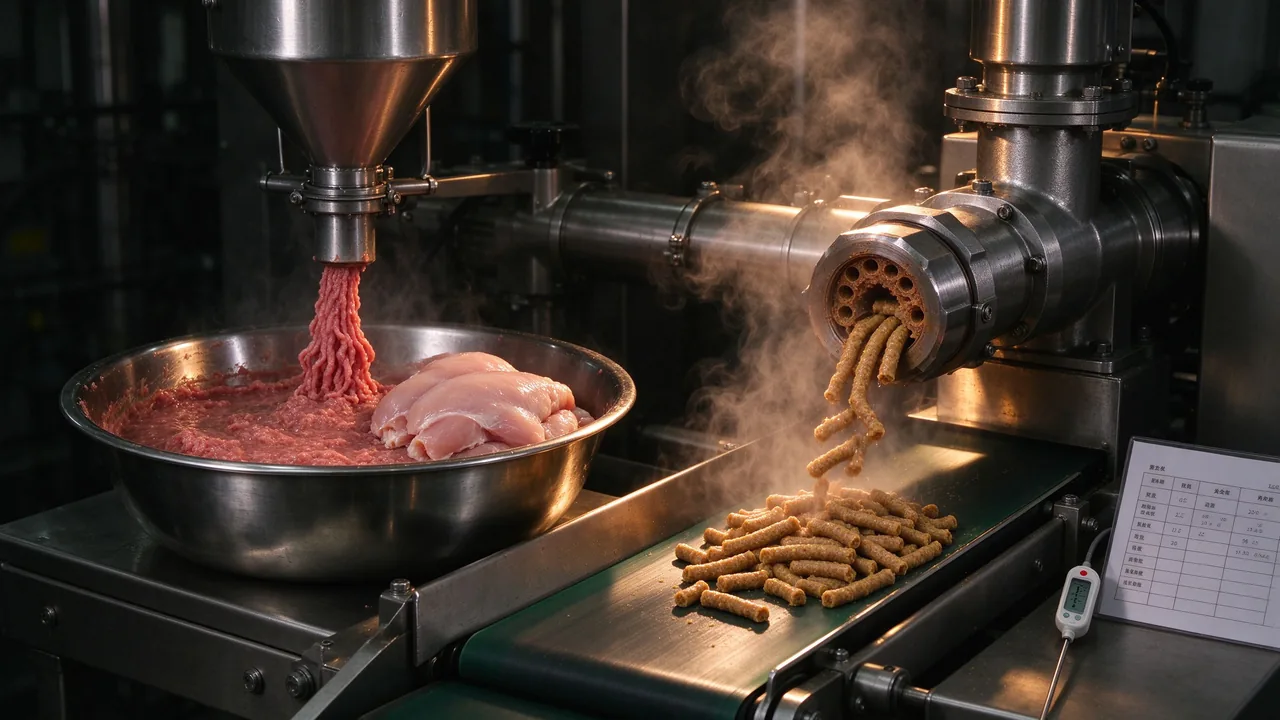
# High-Fresh-Meat Pet Food Manufacturing: Ratio, Extrusion Window and True Cost
Seventy percent fresh meat is one of the most common claims in pet food, and one of the easiest numbers to get wrong. When a brand brings that number to a co-packer, it usually gets one of two answers: yes we can, or no we cannot. The difference is rarely equipment size. It is how the plant understands fresh meat inclusion.
Fresh meat is not simply an ingredient. It is a water-bearing ingredient. Chicken breast is about 75% water, so a formula with 70% fresh meat brings a large amount of water into the extruder. Whether it can run depends on whether you are willing to pay the drying cost for that water.
1. Start with dry-matter math
A formula that says 70% fresh meat refers to weight at input, not protein in the finished product. With 70% fresh meat and 30% dry ingredients, finished moisture is far above a standard kibble, and the dryer must bring it back below 10%.
On a dry-matter basis, fresh meat at 70% water and 30% dry matter means 70 kg of fresh meat supplies only 21 kg of dry matter. That is why high-fresh-meat products often need meat meal or protein concentrate to hit their protein targets. It is not corner-cutting, it is arithmetic.
Quotations must be calculated on dry matter, or the higher the fresh meat ratio, the more the plant loses. That is the real reason many co-packers decline high-fresh-meat orders: not process capability, but a price that was never calculated correctly.
2. The extrusion window: more water, less heat, enough shear
Three parameters dominate extrusion of high-fresh-meat formulas:
- Moisture: higher in-barrel moisture means gelatinization needs more heat and capacity falls. A common drop is 20% to 40% below a standard formula, depending on equipment and inclusion rate.
- Energy: cold meat slurry removes barrel heat, so mechanical energy input or steam must be adjusted.
- Shear: fresh muscle fibers need enough shear to emulsify, and the die and screw configuration must be redesigned rather than copied from a standard formula.
A practical diagnostic: if the sample kibble has a rough surface, high bulk density and breaks apart quickly on rehydration, the cause is usually insufficient shear or poor moisture control, not "not enough fresh meat."
3. Four gates when fresh meat arrives
1. Temperature: delivered at 0 to 4 C, with unloading wait under 30 minutes.
2. Time: ground meat used within 24 hours, otherwise downgraded or discarded.
3. Batch: record origin plus fat and protein checks for each lot, because lot variation changes extrusion behavior.
4. Foreign material: magnets before and after the grinder; bone chips and plastic twine are frequent complaints.
4. Cost structure: the expense is drying, not the ingredient
The cost increase in high-fresh-meat products comes from three places: drying energy, lost capacity, and cold chain plus spoilage. Whether the raw material itself is expensive matters less.
When brands compare quotes only on processing cost per ton, a high-fresh-meat quote always looks expensive. The better comparison is cost per kilogram of finished protein, with drying and losses included.
| Cost item | Standard kibble | High-fresh-meat formula |
| --- | --- | --- |
| Ingredient | Meat meal, market-priced | Fresh meat plus meal to reach protein, higher cold chain cost |
| Drying energy | Baseline | Materially higher, driven by in-barrel moisture |
| Capacity | Baseline | Down 20% to 40% |
| Losses | Lower | Higher losses in grinding and cleaning |
5. What to check in a plant audit
- Does the fresh meat receiving room have independent temperature control and cleaning records?
- Can the grinder and piping be dismantled for cleaning, and how is cleaning verified?
- Is moisture monitored inline in the dryer, or only checked at the end?
- Are high-fresh-meat products scheduled separately to avoid interference with standard formulas?
When Mixiaoqi pet food OEM/ODM handles a high-fresh-meat sample request, the formula and price are recalculated on dry matter first, then the extrusion window and drying capacity are confirmed, and only then does the conversation turn to whether 70% is achievable. Reverse that order and mass production will fail.
FAQ
**Q1: If the formula says 70% fresh meat, is the finished product 70% protein?**
No. Fresh meat is about 65% to 75% water, so 70% fresh meat supplies only a bit over 20% dry matter. Protein is topped up with meat meal or protein concentrate. Formula inclusion and finished nutrient values are two different measures.
**Q2: Why does capacity drop on high-fresh-meat formulas?**
Fresh meat brings water into the extruder, gelatinization needs more heat, and the dryer must evaporate more moisture. Typical capacity loss is 20% to 40%, depending on equipment and inclusion rate.
**Q3: Does high-fresh-meat product require cold chain?**
The raw meat needs 0 to 4 C delivery, and ground meat should be used within 24 hours. If the finished product is a normal-activity kibble, ambient storage is fine, but a break in the raw material chain affects microbial load and shelf life.
Developing a fresh pet food product?
Share your target market, product direction, format and expected volume — we will help structure a project plan.
Submit a project brief