
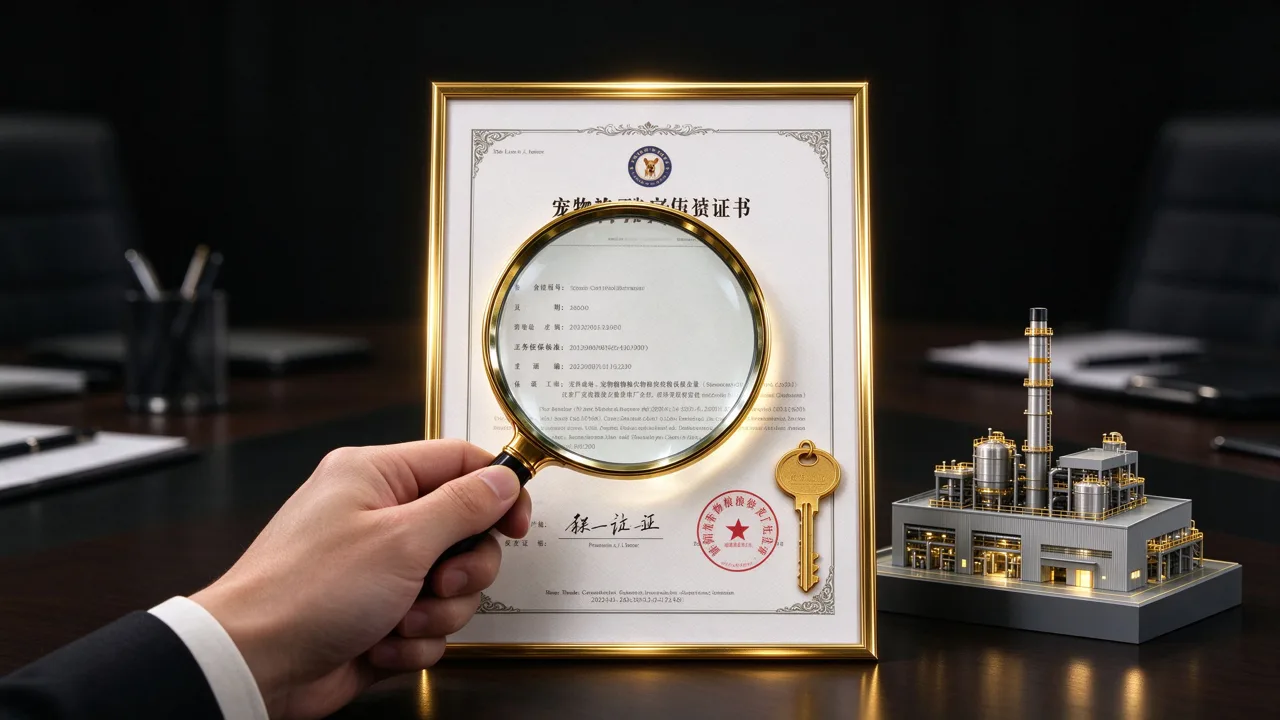
A Beijing news report described an industry issue: resellers marketing food under the name of a major co-packer (Hansong / Shuaike), at prices well below the real factory gate. Shuaike has co-manufactured for over 1,000 brands as of 2025, so brands are easily misled by information asymmetry.
When brands ask **how to choose a pet food co-packer**, the first step is not price comparison—it is confirming the factory on the other end of the chat actually is the company it claims. Do these five checks.
1. Business License and SC Production License, Cross-Checked
Many sales reps say "we are Hansong / Zhongyu / Taichong," but the contract entity on the quote may be a trading company. Brands must:
- Request scanned copies of the **business license** and **SC food production license**;
- Cross-check company name, unified social credit code and business scope on the national enterprise registry;
- Confirm the production address matches the factory address you plan to visit.
If the contract entity and production entity differ (Company A signs, Factory B produces), write the commissioning relationship and quality liability into the contract.
2. Video Call or On-Site Audit
Documents can be edited; a live floor cannot. Require:
- A video walkthrough of the gate, workshop and equipment nameplates;
- Nameplates showing equipment model and factory name matching the SC license;
- On-site audit when feasible—look at the production schedule for your brand's orders.
The hardest way to answer **how to verify a pet food co-packer** is to walk the floor.
3. Same-Category References and Customer Introductions
Top co-man run hundreds of brands at once but won't leak names freely. Ask for:
- Photos of same-category (e.g. fresh-steamed cat food) runs;
- 1–2 references of similarly sized customers, introduced by the factory;
- A specialist answer to "how many fresh-steamed clients are you running right now."
4. Price That Is Suspiciously Low Always Hides Something
In the Beijing report, borrowed-brand product was priced well below real gate price. When you get a quote:
- Benchmark it against same-category market quotes;
- If it is more than 15% lower, ask why (cheaper meat source? higher moisture? downgraded packaging?);
- Look at total economics—protein, moisture, pack spec, MOQ and sampling fee—not just price per jin.
5. Retained Samples and Batch Traceability
A real co-packer gives every batch a number and can trace it back to records. On receipt:
- Retain samples per batch;
- Require batch codes printed on packaging;
- On issues, trace ingredient and process records by batch.
A factory unwilling to build a batch code system is not a serious co-manufacturer.
Closing
**Which pet food co-packer is good** only matters once you confirm you are talking to a real factory, not a borrowed-brand trader. Business license, SC license, on-site audit, same-category references, price sanity, batch traceability—walk these six steps before discussing price and formula.
> Brands screening co-packers can score each candidate against these six steps, or visit **Mixiaoqi pet food OEM/ODM** (Mixiaoqi Guangzhou Pet Technology Co., Ltd.)—SC license and production schedules are open for review.
Developing a fresh pet food product?
Share your target market, product direction, format and expected volume — we will help structure a project plan.
Submit a project brief