
# Mars' £161 Million UK Pet Food Plant Upgrade: Recyclable Packaging and AI Inspection Are Becoming the New Bar for Co-Packers
On November 10, 2026, Mars announced a £161 million (roughly US$216 million) investment to modernize its Melton Mowbray pet food factory in England, with the program running through 2031. This is not a routine capacity story. It puts recyclable pet food packaging and in-line AI quality inspection at the center of a major capacity upgrade — and in doing so, turns two former differentiators into baseline expectations for contract manufacturers.
For Chinese pet food OEM/ODM plants and the brands that source from them, the announcement is worth reading line by line. It previews the audit checklist large customers will bring to factories over the next three to five years.
What the investment actually changes
- Money: £161 million (about US$216 million). Mars has now committed £661 million to its UK manufacturing and operational network since 2021.
- Role: Melton Mowbray was Mars' first pet care site and the birthplace of WHISKAS and PEDIGREE. It turns 75 this year and will become Mars' primary UK pouched pet food factory.
- Output: 95% of production serves UK households and 5% is exported to Europe. Mars says WHISKAS feeds about 6.6 million cats in the UK, more than half the national cat population.
- Technology: new high-speed pouch lines running fully recyclable mono-polypropylene (mono-PP) packaging; AI-powered quality cameras that catch defects earlier; smart optical sorting designed to cut production waste by more than 50%; and utility upgrades that reduce energy use.
- People and emissions: more than 30 new technical and engineering roles in the first year, apprenticeships expanding from 26 to 33 permanent positions by 2027, all supporting Mars' goals of halving greenhouse gas emissions by 2030 and reaching net zero by 2050.
- Same-day context: Mars also announced US$1.4 billion of US manufacturing and operations investment for 2027, and says it has invested more than US$9 billion in US manufacturing over the past decade.
Taken together, the direction is clear: the largest players are no longer competing only on tonnage. They are competing on whether packaging, inspection and energy can be run as one system.
Three technical threads, one direction
1. Mono-material pouch lines make recyclability real
Multi-layer laminates — PET/AL/PE or PET/PE — perform well and cost little, but the layers are bonded together and are hard to separate at the recycling stage. Under the EU's recyclability assessment, such structures are typically rated non-recyclable or low-recyclability. Mono-PP replaces them with an all-polypropylene structure that can flow into the PP stream as a whole pouch. That is how an international brand moves recyclability from a marketing line into a line changeover.
The trade-off is explicit: oxygen barrier drops. An aluminum-foil laminate can push oxygen transmission below 1, while all-PP structures often land in the single digits to tens depending on whether MDO-PP or an AlOx coating is used. Once the barrier drops, four things have to be recalculated: nitrogen flushing, residual oxygen, seal strength and shelf life.
2. AI cameras and optical sorting move quality control upstream
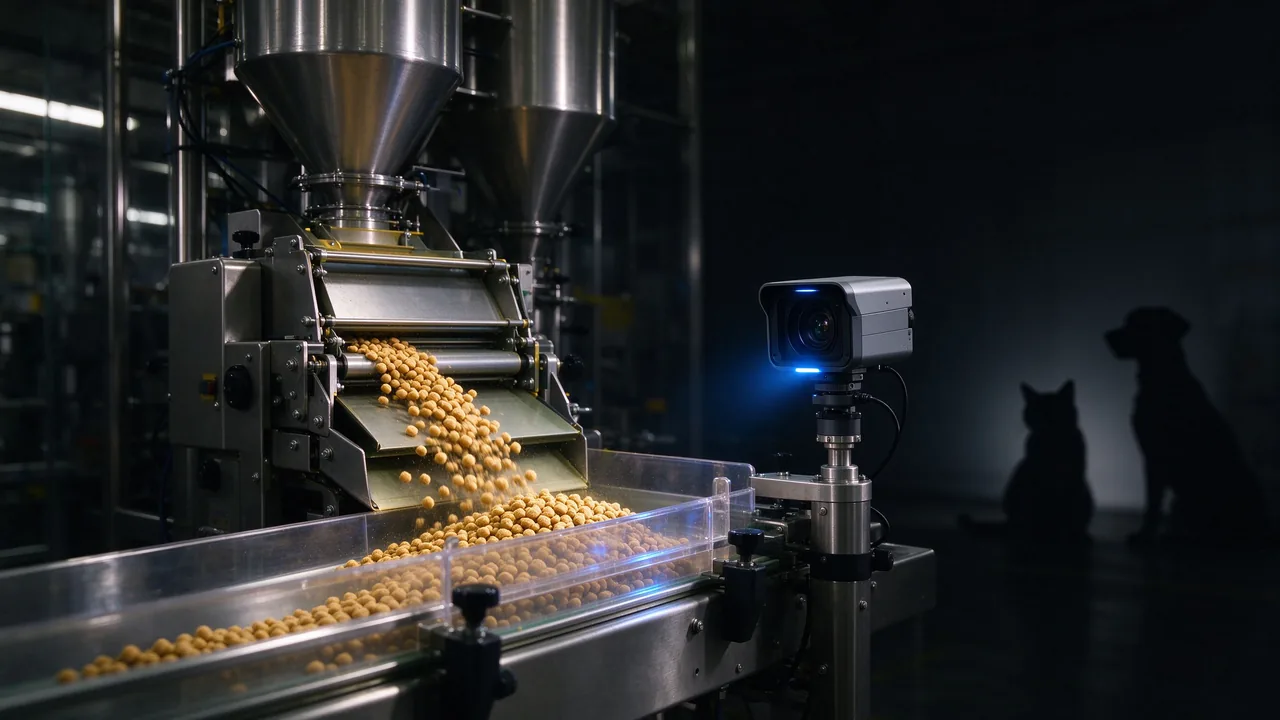
Mars is pairing AI quality cameras with smart optical sorting: cameras identify color, shape and surface defects in real time, and the sorter removes off-spec pieces before they travel further. The stated result is a reduction in production waste of more than 50%.
The lesson for co-packers is not "buy an AI system." It is that three prerequisites come first: a stable lighting and camera station on the line, a defect sample library large enough to set thresholds, and a reject-verification mechanism so an alarm never becomes a no-op. Without those, an AI camera is just an expensive monitor.
3. Energy and emissions are turning into hidden line items in the quote
The program includes utility upgrades tied to a 50% emissions cut by 2030. European buyers increasingly ask for energy and carbon data per unit of output, especially on pouch lines shipping to the UK. A plant that does not record electricity, gas and compressed air consumption by batch has no basis for a green premium later.
Why this becomes a threshold for co-packers
The EU Packaging and Packaging Waste Regulation (PPWR, EU 2025/40) has applied since August 12, 2026, replacing a directive that had been in place for nearly three decades. It turns recyclable design, packaging minimization, recycled content and recyclability assessment from intentions into legal obligations.
The UK sits outside the EU, but two practical routes carry the requirements into Chinese factories: major UK retailers benchmark their packaging commitments against PPWR, and brands selling into Europe standardize SKUs by writing PPWR language directly into manufacturing contracts.
As a result, audit questions shift from "do you have certificates" to "what is the film structure of this pouch, how was its recyclability graded, what residual oxygen do you measure, where is the seal strength report, and can you show me sensitivity and reject records for your in-line inspection."
Four things co-packers can do now
1. Build a packaging BOM and recyclability assessment sheet. For each pouch format, record film structure, layer materials and thickness, ink and adhesive types, and mark recyclability grade and gaps to close for each target market. This sheet saves rounds of redesign later at the quoting stage.
2. Re-validate barrier and seals after any material change. Do not carry over old parameters: residual oxygen targets, heat-seal windows, seal strength and burst pressure all need to be re-run. Pouches moving from foil laminate to mono-PP usually need shelf life confirmed again.
3. Place in-line inspection and verify rejects. Decide which station gets metal detection, X-ray and AI vision, verify sensitivity with test pieces, and confirm that the reject mechanism actually pushes every bad unit into the reject bin — with records, not just an equipment list.
4. Put defect and waste data into numbers. Track defect type, count, cause and disposition by shift. It is the basis for waste reduction and the only credible evidence when a customer asks for continuous improvement.
Five new questions brand owners will ask on audits
- Is this pouch mono-material or a laminate, and which standard did you use for the recyclability assessment?
- After the material change, what residual oxygen do you hold, and do you record it per batch?
- Are seal strength and burst test reports issued per pouch format or per batch?
- How often is in-line inspection sensitivity verified, and does a reject failure trigger an alarm and stop?
- Can you provide energy consumption and waste rate per batch?
A co-packer who can answer three of these five will have a clear edge in next year's sourcing rounds.
The takeaway
The real value in this announcement is that Mars moved sustainable packaging and in-line inspection from marketing language into capital expenditure on the line. For contract manufacturers, two things follow: customer requirements get more specific, and the basis for pricing becomes more transparent.
If you are sourcing for an export brand or a new domestic label and want a plant that can connect pouch structure, nitrogen filling and in-line inspection end to end, Mixiaoqi pet food OEM/ODM can start from pouch sampling and filling validation — so the recyclable pack is proven before volume, not reworked after.
Developing a fresh pet food product?
Share your target market, product direction, format and expected volume — we will help structure a project plan.
Submit a project brief