
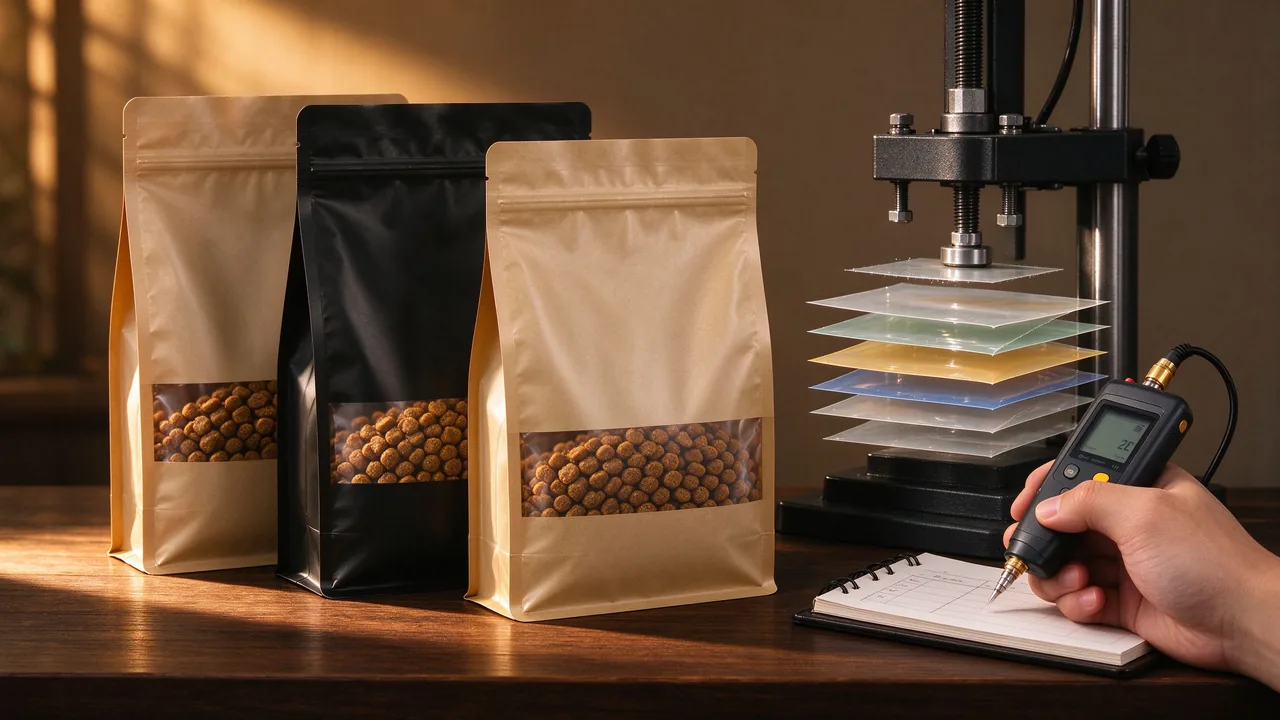
# How to Move a Pet Food Pouch to Mono-Material Recyclable Packaging: Structure, Barrier, Nitrogen and Seal Validation
For the past decade, the safe answer in custom pet food pouch work has been a laminate: PET/AL/PE or PET/PE. Good oxygen barrier, good stiffness, good print, controllable cost. That answer runs into trouble the moment a customer targets the EU or UK, because layers of different materials bonded together are hard to separate at the recycling stage and score poorly on recyclability assessments.
Mono-PP — an all-polypropylene structure — has become the mainstream alternative. It lets the whole pouch flow into the PP recycling stream, but it comes with a hard constraint: less oxygen barrier. This article breaks down the four steps most often skipped when converting: film structure selection, residual oxygen control, seal validation, and shelf life re-confirmation.
First, separate three meanings of "recyclable"
- Technically recyclable: the material could be recycled in theory, but no local stream exists, so the practical value is zero.
- Industrially recyclable: accepted by industrial recycling systems, common for mono PE and mono PP.
- Household recyclable: consumers can drop it in a home collection bin, which demands the strictest material simplicity.
When a customer says "recyclable," ask which meaning and which market. The same pouch designed for household recycling in Germany may only qualify as industrially recyclable in a market with thin infrastructure. Without a clear assessment basis, every downstream test is wasted effort.
Choosing the mono-PP film structure
All-PP does not mean a single layer. Common practice uses multilayer co-extrusion or lamination in which every layer belongs to the PP family, so the recycling stream stays clean.
| Structure approach | Barrier level (reference) | Best fit | Risk |
| --- | --- | --- | --- |
| BOPP print layer + CPP sealant | Low | Short shelf life, fast-turning dry food | High pressure on residual oxygen, shorter shelf life |
| MDO-PP strength layer + CPP | Medium | Mainstream kibble and treat bags | Balance MDO thickness against stiffness |
| PP structure with AlOx coating | Good | Medium to long shelf life, aroma retention | Coating uniformity and flex resistance need validation |
| PP with EVOH barrier layer | High | High-fat, long shelf life | Too much EVOH can hurt the recyclability rating |
The right sequence is: set shelf life and residual oxygen targets first, then barrier level, then print and cost. Doing it the other way usually means two or three rounds of re-sampling.
Compensating for the lost barrier
1. Nitrogen flushing and residual oxygen
The core metric for gas-flushed dry food pouches is residual oxygen. A common target is below 2%, with high-fat or long-shelf-life products pushed toward 1%. What determines the result is not whether nitrogen is used, but four variables:
- Headspace ratio: fuller fill means smaller headspace and easier oxygen reduction.
- Gas exchange efficiency: nozzle position, airflow angle, and the vacuum-then-fill sequence set the actual exchange rate.
- Line speed match: larger pouches and faster lines leave less time per bag, so residual oxygen fluctuates more.
- Seal timing: the longer the gap between flushing and sealing, the more air flows back.
Build residual oxygen testing into first-piece checks, hourly sampling and every film roll change, recorded by batch — not a single measurement at start-up.
2. Heat-seal window and seal strength
Seals are where conversions fail most often. PP has a narrower sealing window than PE: a little cold and it does not bond, a little hot and the edge curls or turns brittle. Run a three-parameter matrix before production — temperature, pressure, dwell time — with peel and visual evaluation for each combination, then take the middle of the viable range as the production window.
Seal validation should include at least three tests:
- Seal strength: tensile peel, commonly referenced at 20 N/15mm or above, set by pouch format and customer standard.
- Burst test: pressurize the whole pouch to failure and check whether the rupture lands on the seal, which identifies the weakest point.
- Leak test: vacuum or dye penetration, targeting seal wrinkles, product in the seal area and pinholes.
3. Drop and transport
Mono-material pouches are usually less stiff than foil laminates, so stacking and drop performance change. At sampling stage, run loaded drop tests, pallet stacking and simulated transport vibration to confirm the format does not burst or collapse in logistics.
Re-confirming shelf life
Old conclusions do not carry over. The standard approach is accelerated testing plus periodic real-time checks:
- Conditions: 37°C/75% RH or 40°C/75% RH depending on the product, with sampling at 0, 1, 2, 3 and 6 months.
- Measurements: moisture, peroxide value, free fatty acids, sensory attributes (odor, color, kibble hardness), plus delamination and seal strength of the packaging itself.
- Extrapolation: keep a safety margin when converting accelerated data to ambient shelf life; for high-fat formulas, run ambient parallel samples as well.
If the customer specifies a residual oxygen ceiling across shelf life, measure oxygen inside the pouch at every accelerated sampling point, not just product metrics.
Six steps in a conversion trial
1. Confirm target market and the recyclability basis (household or industrial).
2. Propose two or three film structures with theoretical barrier values and cost ranges.
3. Make a small pouch batch and confirm print, stiffness, openability and seal appearance.
4. Trial on the filling line: residual oxygen, seal strength, burst and leak.
5. Run drop, stacking and simulated transport.
6. Complete accelerated testing plus ambient parallels, then release to volume production.
Common traps
- Changing film without changing filling parameters: residual oxygen runs high, and the fix becomes more oxygen absorbers at higher cost.
- Running the old heat-seal temperature on the new film: brittle seals and batch failures in transit.
- Using the wrong recyclability standard: the customer audits against PPWR while the supplier cites a local association method, and the two do not align.
- Ignoring inks and adhesives: the film is mono-material, but an incompatible ink or adhesive layer drags the whole pouch rating down.
The takeaway
Recyclable packaging is not a film swap. It is a system re-calculation across structure, filling, sealing and shelf life. Prove those steps at sampling and volume production will not be dragged down by residual oxygen and burst rates.
Mixiaoqi pet food OEM/ODM can run film structure, nitrogen parameters and seal validation on the same line during pouch sampling, so the brand receives not just a sample bag but a reproducible filling specification.
Developing a fresh pet food product?
Share your target market, product direction, format and expected volume — we will help structure a project plan.
Submit a project brief