
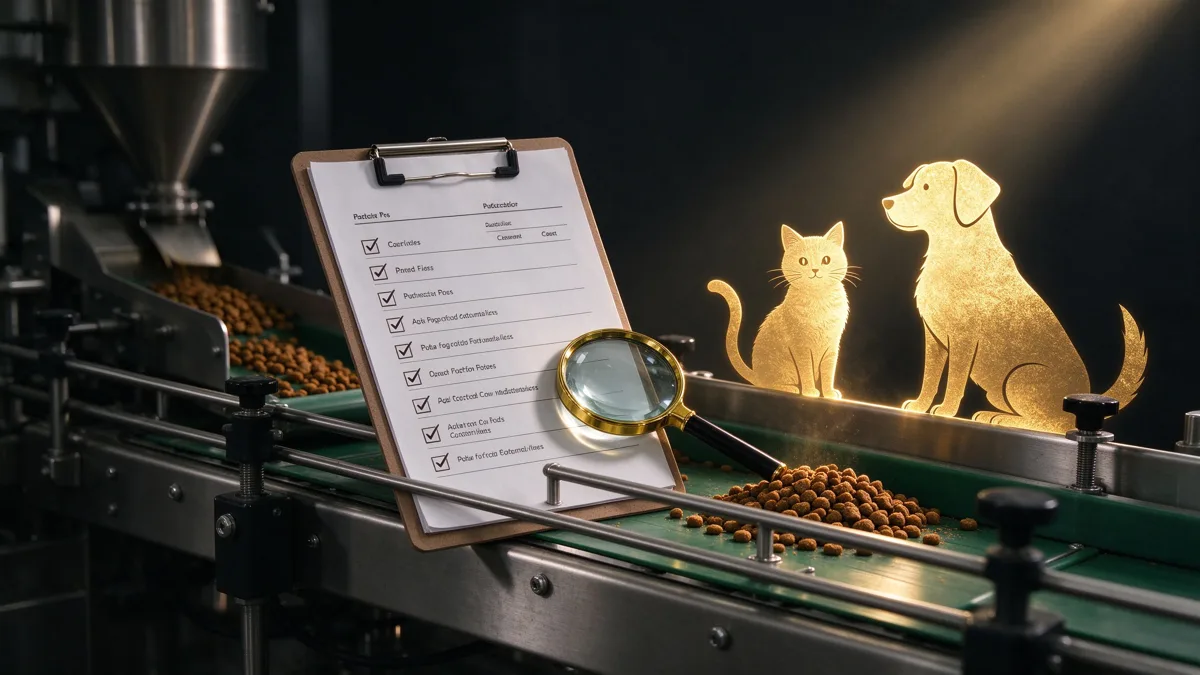
# How to Choose a Pet Food OEM Manufacturer: A Factory Audit Checklist
Most new brands start by comparing quotes and asking for samples. But what actually determines whether your product stays consistent for a year or more is what happens on the production floor. Here is the audit checklist we recommend you walk through on your first factory visit.
1. Licenses: Are they legally allowed to make your product?
Pet food falls under feed production regulation in China, so the co-packer must hold a valid feed production license, and its business scope must cover your category (kibble, wet food, treats, supplement paste cannot be produced outside the licensed range).
Verify three things:
- The license is current and its production scope matches your category;
- Export qualifications if you plan to sell cross-border;
- Any past penalties or product recalls in the last three years.
2. The Production Floor: More Truthful Than Samples
Samples can be prepared specially, but the production line cannot. The fact that you must change into cleanroom garb and pass an air shower is already a signal of hygiene discipline.
Look for:
- Physical separation between raw material preparation and filling/packaging;
- Documented cleaning and changeover records between brands;
- Temperature, humidity, dust and pest control;
- For fresh or wet food, pay special attention to the cooking and cooling areas.
3. QC System: From Incoming Raw Material to Retention Samples
A reliable co-man embeds quality control into every step rather than only inspecting the finished bag.
Ask directly:
- Does every incoming raw material batch come with a test report (protein, moisture, ash, aflatoxin, heavy metals)?
- Are critical control points (temperature, pressure, moisture) logged online during production?
- What finished-product tests are run, and can a COA ship with the order?
- **Retention samples**: is every batch retained, and for how long (we recommend at least 6 months past shelf life)?
4. Sampling and Small-Batch Attitude
The sampling stage is where you see whether the factory takes you seriously:
- Can they reformulate to your recipe, or only repackage an existing line?
- Are MOQ, sampling lead time and revision fees transparent?
- Will you talk to a salesperson or a配方 engineer who can explain ingredient substitutions?
5. Four Questions That Reveal Real Capability
Ask these directly on the floor:
1. "When was the last raw material change, and how do you notify brand owners?"
2. "If moisture is out of spec on my batch, what is your internal handling process?"
3. "How many brands do you co-pack simultaneously, and how long does changeover take?"
4. "Can I see a recent batch's outgoing inspection report?"
Vague answers, or "we've always done it this way," are usually a pass.
Closing
**How to choose a pet food OEM manufacturer** is not about picking the cheapest quote. It is about picking a partner that can hold quality steady. Check the licenses, walk the floor, read the records, and watch how they communicate. After these four steps, you will know whether this co-manufacturer is a long-term fit.
> If you are comparing private label pet food manufacturers, bring your recipe and target volume and we can prepare a sampling and small-batch pilot proposal.
Developing a fresh pet food product?
Share your target market, product direction, format and expected volume — we will help structure a project plan.
Submit a project brief