
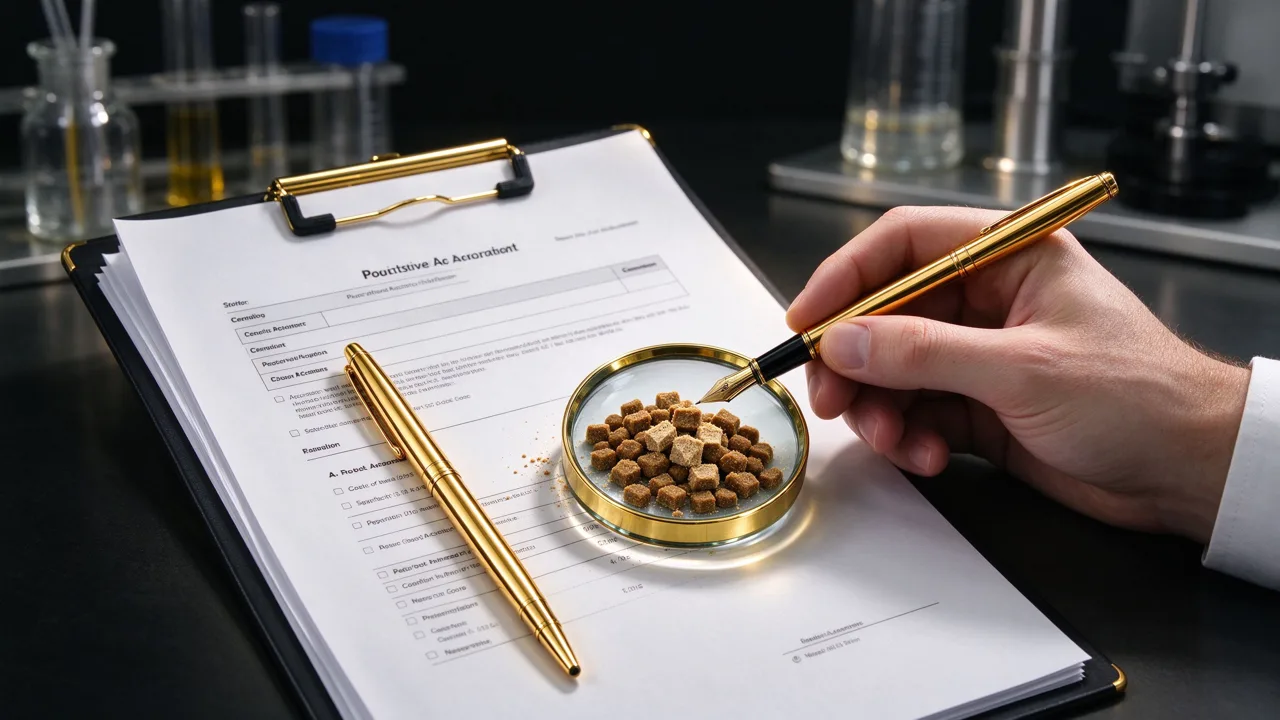
A mid-October industry piece put it bluntly: co-manufacturing offers brands a fast path to market, but adds a layer of collaboration management. If both sides only reconcile finished-goods results at outgoing inspection and ignore ingredient changes and process records, quality disputes surface too late.
That hits the pain point of many new brands. A **pet food co-manufacturing quality agreement** is not boilerplate in an appendix. It is the day-to-day operating manual. For a first-time brand, these 7 clauses must be written in.
1. Ingredient Changes Require Written Advance Notice
If the co-man switches chicken suppliers or oil sources without telling the brand, formula data, nutrition values and palatability all drift. The agreement must state:
- Any change in major ingredients (meat source, oil, protein source, core additives) requires **15 working days' written notice**;
- The first batch after a change must be retained and retested nutritionally;
- The brand may reject unannounced-change batches.
2. Process Records (Batch Dossiers) Must Be Traceable
For every batch, the co-man must produce:
- Incoming ingredient inspection reports;
- Process parameters (temperature, time, moisture);
- Outgoing test reports (moisture, ash, plate count, coliforms);
- Retained samples (typically kept until 3 months after shelf life).
When brands ask **what certifications pet food co-packers need**, the answer is not one piece of paper—it is a retrievable batch dossier.
3. Handling of Nonconforming Product
Who decides rework, who decides disposal, who bears the cost must be clear:
- Co-man causes (process deviation, hygiene failure) → co-man bears rework cost and brand losses;
- Ingredient causes (bad meat) → depends on whether sourcing was by the co-man or brand;
- Logistics causes → freight liability, not the factory's.
4. Retention Samples and Arbitration Lab
Agree on:
- Dual retention samples per batch—one at the factory, one at the brand;
- In disputes, both sides send samples to a **mutually agreed third-party lab**;
- Arbitration costs paid by the losing side.
5. Line-Changeover Cleaning Confirmation
A co-man running multiple clients and formulas creates allergen and cross-contamination risk at changeovers. The agreement must state:
- CIP (clean-in-place) records for every changeover;
- High-sensitivity formulas (grain-free, chicken-free) scheduled first;
- Swab testing when required.
6. Packaging and Label Version Control
Packaging revisions, labeling regulation updates, seasonal formula tweaks—who initiates, who approves, who archives:
- Labeling approval sits with the brand; the co-man prints to approved samples;
- Obsolete packaging destruction records are archived;
- Liability for misprinted packaging.
7. Annual Audit and Unannounced Inspections
The co-man must accept:
- At least one on-site brand audit per year;
- Unannounced visits (24 hours' reasonable notice);
- Remediation deadlines and re-audits for findings.
Closing
The more detailed the **pet food OEM quality agreement**, the less you argue later. New brands are often too polite to raise these on a first engagement, but without written quality clauses there is no recourse after a complaint or safety issue.
> Brands evaluating OEM/ODM can start the conversation with a full quality agreement negotiation—**Mixiaoqi pet food OEM/ODM** (Mixiaoqi Guangzhou Pet Technology Co., Ltd.) proactively lists these 7 clauses, instead of waiting for the brand to ask.
Developing a fresh pet food product?
Share your target market, product direction, format and expected volume — we will help structure a project plan.
Submit a project brief