
# Allergen Control in Pet Food: From Formula Matrix to Changeover Verification
Single-protein, grain-free and limited-ingredient products have multiplied across cat and dog food. The selling point is easy to state and much harder to execute: the same mill, the same extrusion line and the same drying trays run a chicken-and-fish formula, then switch to a duck-based single-protein product. Between the two batches sits not a word like "cleaned" but a documented, verifiable control process.
The goal of allergen control is not to eliminate allergens, which the ingredients themselves contain. It is to prevent proteins that should not be there from entering the finished product undeclared. That requires a closed loop: formula matrix, warehouse zoning, line sequencing, changeover verification and on-pack statements. Miss one link and the marketing claim loses its footing.
1. Start with an ingredient-level allergen list
Common allergen sources in pet food are more numerous than many teams assume. Beyond chicken, beef and fish, watch for dairy, egg, soy and wheat gluten, plus less common proteins such as lamb and duck that still appear in formulas.
| Allergen source | Common carriers | Where it is missed |
| --- | --- | --- |
| Chicken | Fresh chicken, chicken meal, chicken fat, hydrolyzed chicken | Chicken fat with incomplete refining still carries protein |
| Beef | Beef, beef meal, beef liver | Beef-derived material inside blended meat meal |
| Fish | Fish meal, fish oil, fish hydrolysate | Fish oil and fish meal sharing piping |
| Wheat/gluten | Wheat flour, wheat middlings, gluten | Shared extrusion line, settled dust |
| Dairy | Whey powder, milk powder, cheese powder | Small addition not captured in the matrix |
| Egg | Egg powder, liquid egg | Used in palatability coatings |
| Soy | Soybean meal, soy protein, lecithin | Lecithin dismissed as a processing aid |
Build the list at ingredient level, not formula level. A formula that says "poultry" may contain chicken, duck or a blended poultry meal, and those three are not the same allergen declaration.
2. Formula matrix: one allergen map per SKU
Create a matrix for every SKU with four columns: ingredient name, allergen contained, supplier declaration number and share of the formula. The matrix serves three purposes:
1. When R&D changes a formula, it shows immediately whether allergens changed.
2. When procurement changes a supplier, it indicates whether revalidation is needed.
3. During a customer audit, it proves where the allergens in this product come from.
The matrix is not a one-time document. Every formula, supplier or specification change requires a new version and an archived record. Many plants have formula sheets but no allergen matrix, which is how a formula changes while the label or the line schedule does not.
3. Warehouse and line: make zoning visible
Zoning on paper is easy; making it visible on the floor is the hard part. Three practical actions:
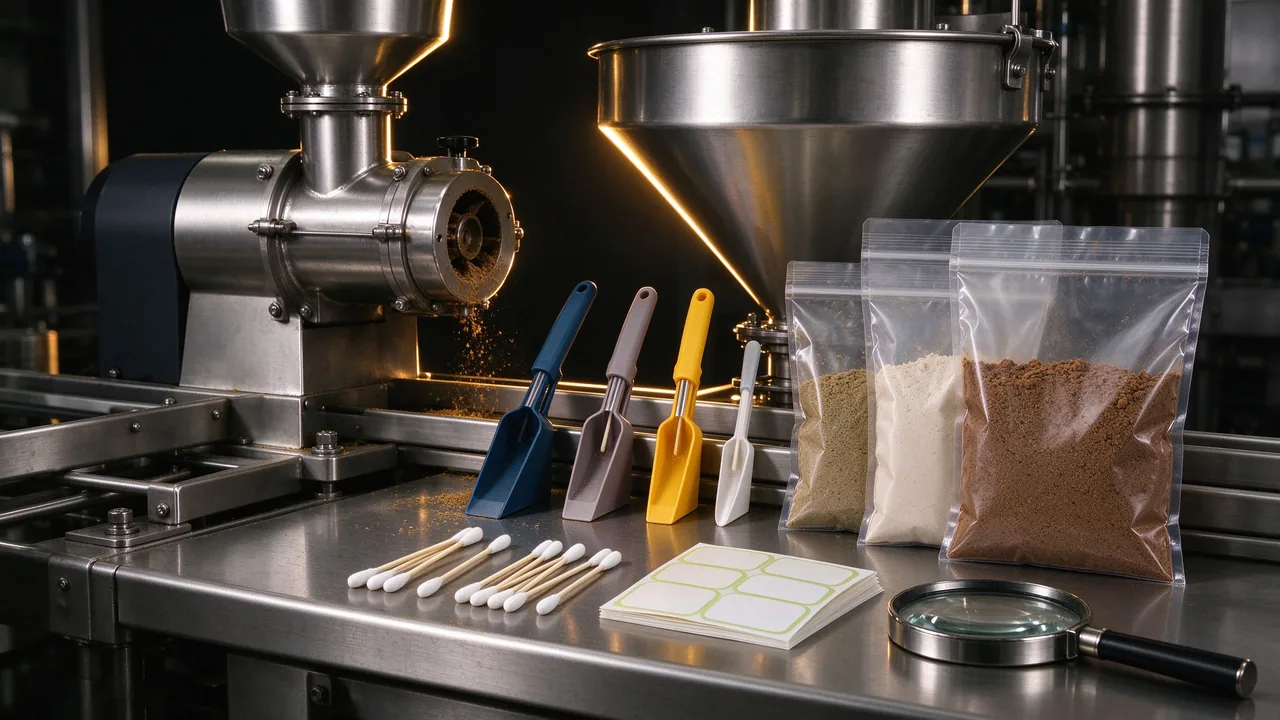
- Color coding. Different allergen categories get different colors of scoops, totes and sampling bags, never shared. Color is easier to follow than text when the line is busy.
- Physical separation. Allergen-containing materials sit apart from allergen-free materials, with a physical divider or enough distance to prevent cross-contact from dust or damaged bags.
- Line sequencing. On a shared line, run from none to some, and from low to high: allergen-free products first, then products containing the allergen, and the strongest allergen last, followed immediately by verification.
Sequencing looks like a scheduling trick but is the cheapest allergen control measure available. It does not replace verification, but it sharply reduces failure rates.
4. Changeover verification: which method, which sampling points
Verification answers one question: has the previous allergen dropped to an acceptable level on equipment surfaces, piping, screens and hoppers?
Visually, only visible residue is detectable. ATP swabs reflect total organic matter, not protein type. What demonstrates that chicken protein is gone is a specific protein assay, such as ELISA. Use three layers: visual plus ATP for daily rapid judgment, and specific testing at a frequency set by product-change frequency.
Sampling points must cover dead zones, not just tabletops. Prioritize the mill chamber and screen, mixer paddles and discharge, extruder die and cutter, drying tray edges, conveyor scrapers and the packaging hopper. Number each point and record sampling time, method, result and limit.
What happens when verification fails? "Clean again" is not an answer. Record the cause, whether the cleaning method was insufficient, the equipment has a dead zone, or the sequence was wrong. Correct, then verify again, and keep both records. In a customer audit, that record carries more weight than a certificate.
5. On-pack statements: say it only if you can prove it
Allergen information on a label usually takes one of three forms: listing the allergens present, declaring "may contain" a category, or saying nothing.
The third is the riskiest. On a shared line without verification data, silence leaves the brand exposed when a complaint arrives. "May contain" is not a universal shield either. It should rest on a risk assessment: shared-line conditions, verification results, residue levels and the detection limit for that allergen in the finished product.
Two common misunderstandings are worth clearing up:
- Grain-free means no grains, not free of chicken, beef, fish, dairy, egg or soy. Allergen control for grain-free products is a separate job.
- Single-protein is a formula-level description. To hold, it also needs line segregation and verification. A single-protein formula on an unsegregated line can still test positive for other proteins.
6. Rework: the most overlooked carry-over path
Rework is a cost tool and an allergen risk at the same time. Returning defective product from a chicken batch into the next duck formula, even at a low rate, can invalidate a single-protein claim.
Keep a rework ledger: source batch, allergens present, maximum inclusion rate and which SKUs may receive it. Rework containing a major allergen should not go into products declared single-protein or free of that allergen.
7. Six audit questions
1. Can you pull the allergen matrix for this SKU right now?
2. Where is the verification record for the last changeover from chicken to duck?
3. Does the sampling point list include the mill screen and extruder die?
4. What is the limit for specific testing, and what is it based on?
5. Which batches were reused as rework in the past three months?
6. Can you provide the risk assessment behind the "may contain" statement?
None of these is hard to answer. What is hard is producing the records on the spot. Allergen control is judged not by slogans but by whether the evidence chain can be assembled in half an hour.
Before taking single-protein or grain-free orders, Mixiaoqi pet food OEM/ODM confirms the formula matrix and line sequence, then schedules changeover verification and only releases production after it passes. The brand receives an auditable record rather than a claim that "we have done this before."
FAQ
**Q1: Can a shared line make single-protein products?**
Yes, with three requirements: line sequencing, dedicated tooling and changeover verification. The data and residue limits must support the claim; otherwise keep single-protein off the main visual.
**Q2: How often should allergen testing be done?**
Set it by changeover frequency. Lines with frequent switches should run a specific assay quarterly, with visual and ATP checks daily. A new formula, supplier or piece of equipment requires testing before startup.
**Q3: A client wants a "free from" claim. How does the plant support it?**
First confirm whether the formula and line can actually deliver it, then discuss the claim. If yes, provide test reports and verification records. If not, propose "not added" or adjust the formula rather than print "free from.
Developing a fresh pet food product?
Share your target market, product direction, format and expected volume — we will help structure a project plan.
Submit a project brief