
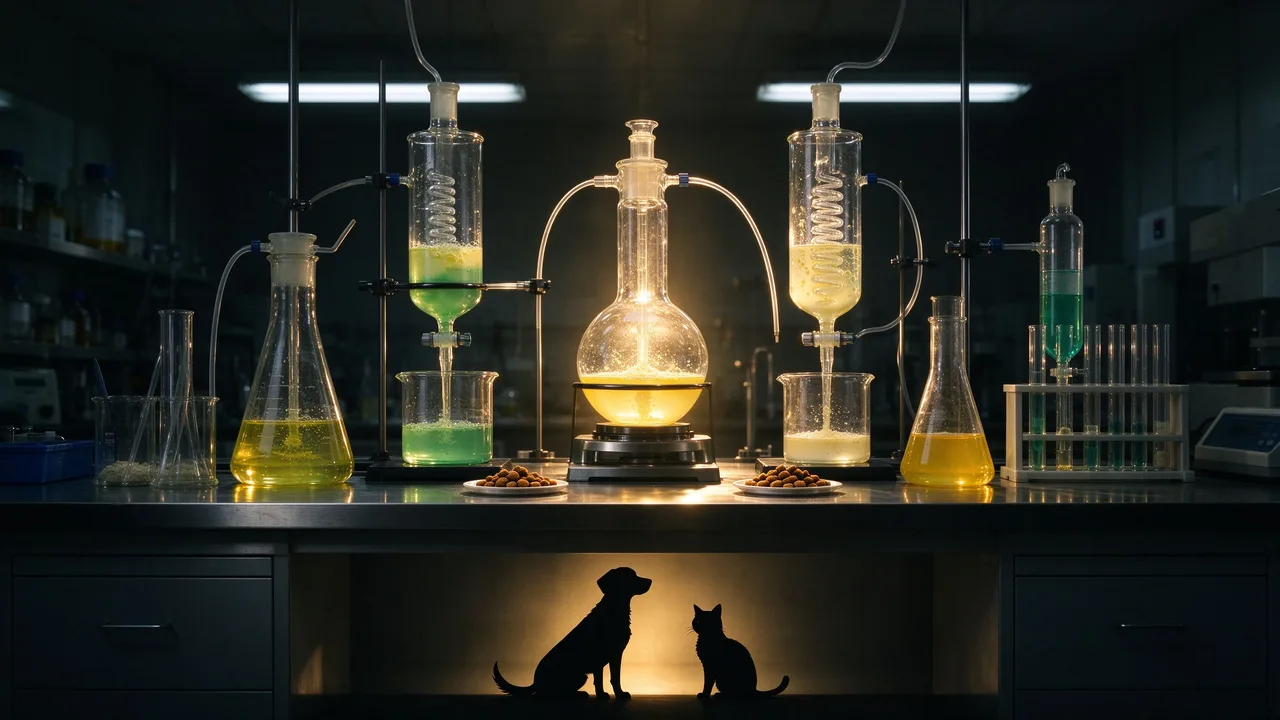
# Pet Food Digestibility Testing: In Vitro vs In Vivo
When selecting a co-packer, brands often ask: "What is the digestibility of this formula?" The co-packer may give a 90% or 85% number. But how was it measured? In vitro? In vivo? How much do they differ? This guide covers digestibility testing.
Why Digestibility Matters
Digestibility is a core nutritional metric:
- Higher protein digestibility = more absorbed protein = less stool volume;
- Higher metabolizable energy = less food needed per body weight;
- Consumers increasingly value "less stool, better stool."
Per a September 2026 Beijing News report, digestibility has become a core criterion for domestic cat food buyers.
Two Testing Methods
Method 1: In Vitro Simulation
Principle: simulate the GI tract in test tubes —
- Step 1: gastric phase (pH 2, 39°C, pepsin);
- Step 2: intestinal phase (pH 6-7, pancreatin);
- Measure undigested residue weight.
Pros:
- Fast (days);
- Cheap (a few thousand yuan per sample);
- Good for formula screening.
Cons:
- In vitro digestibility is typically **higher than** in vivo (JAST 2026 showed in vitro DM/OM/CP/CF/EE significantly higher than in vivo, p<0.05);
- Cannot reflect individual variation, gut microbiome, feeding behavior.
Method 2: In Vivo Animal Trial
Principle: feed dogs/cats in metabolic cages, collect all feces —
- Feed known intake;
- Collect 5-7 days of feces;
- Measure fecal nutrients, calculate "intake - feces = digestion."
Pros:
- Closest to real conditions;
- AAFCO-recognized animal feeding trial.
Cons:
- Slow (2-4 weeks);
- Expensive (tens of thousands to hundreds of thousands per formula);
- Affected by individual animal variation.
How Much Do In Vitro and In Vivo Differ?
A 2026 JAST study compared two-step in vitro and in vivo digestibility across life stages in mixed-breed dogs:
| Metric | In vitro vs In vivo |
|---|---|
| Dry matter (DM) | In vitro significantly higher |
| Organic matter (OM) | In vitro significantly higher |
| Crude protein (CP) | In vitro significantly higher |
| Ether extract (EE) | In vitro significantly higher |
| Gross energy (GE) | In vitro higher except puppies |
**Key takeaway: in vitro numbers run several percentage points above actual in vivo.** A co-packer's 90% in vitro may be 85%-87% in vivo.
How to Read Co-Packer Data
1. Ask Which Method
- "Is this in vitro or in vivo?"
- If in vitro: "Do you have corresponding in vivo validation?"
2. Look at Conditions
- In vitro: how many steps? Pepsin/pancreatin dose? Temperature? Time?
- In vivo: how many dogs/cats? What breeds? How many days?
3. Look for Third-Party Reports
- Co-packer in-house lab data should be discounted;
- CMA/CNAS-accredited third-party reports are more credible;
- AAFCO animal feeding trial reports are the gold standard.
4. Don't Just Look at One Number
- 90% crude protein digestibility looks good, but if fat digestibility is 80%, something is off;
- Look at the full panel (DM, OM, CP, EE, GE), not just protein.
Practical Recommendations
| Stage | Recommended Test |
|---|---|
| Formula screening | In vitro, quickly filter low-digestibility formulas |
| Prototype validation | In vitro + small in vivo (10-20 animals) |
| Pre-launch finalization | AAFCO animal feeding trial, formal report |
| Per-batch outgoing | Routine nutrition only, no digestibility |
Bottom Line
Digestibility is not one number — it is a testing system. When a co-packer says 90%, ask: in vitro or in vivo? Under what conditions? Third-party or in-house? Use different methods at different stages, and don't let an in vitro number mislead consumers.
For brands needing digestibility validation, **Mixiaoqi pet food OEM/ODM** in Guangzhou supports in vitro simulation and small-batch animal trials from screening to finalization.
---
FAQ
**Q: How much do in vitro and in vivo differ?**
A: Typically 3-5 percentage points, with in vitro higher, varying by metric.
**Q: How long does an AAFCO trial take?**
A: Typically 6 months (dogs) or 10 months (cats), covering a life stage.
**Q: Is a co-packer's 90% credible?**
A: Depends on method and source. In vitro 90% ≈ in vivo 85%-87%.
Developing a fresh pet food product?
Share your target market, product direction, format and expected volume — we will help structure a project plan.
Submit a project brief