
# Configuring Foreign Material Control in Pet Food: Metal Detection, X-ray, AI Vision and Retention Traceability
In pet food contract manufacturing, foreign material complaints are among the most common claims and the most damaging to a customer relationship. Unlike a formula deviation that can be corrected by adjusting ratios, a consumer finding a metal fragment, bone chip or plastic shard in kibble usually means a batch recall and lost brand trust.
Many plants treat foreign material detection as "buy a metal detector." What auditors actually ask is: where are the control points, how were sensitivities set, how often are they verified, was the reject actually removed, and where are the records. This article follows the line from receiving to finished goods.
Where foreign material comes from: four sources
- Incoming materials: bone chips, grit, straw, packing twine, hard lumps from uneven drying.
- Equipment wear: broken screen wire, chipped blades, screw wear debris, loosened bolts.
- Packaging: liner fragments, seal strip remnants, printed trim offcuts.
- People and environment: glove pieces, hair, tools, maintenance leftovers.
Each source maps to a control method: supplier approval, equipment inspection, packaging receiving checks, and people and housekeeping. Relying on end-of-line detection alone pushes every earlier gap onto the last machine.
Six control points
| Point | Main method | Target | Required record |
| --- | --- | --- | --- |
| Raw material receiving | Magnetic bars, screens, visual sampling | Metal and hard objects in bulk materials | Receiving record, supplier score |
| Before feeding | Screens with integrity checks, magnetic separation | In-bag debris and lumps | Screen inspection, replacement log |
| Milling and sifting | Mesh management, magnetic separation | Abnormal particle size and wear debris | Screen replacement ledger |
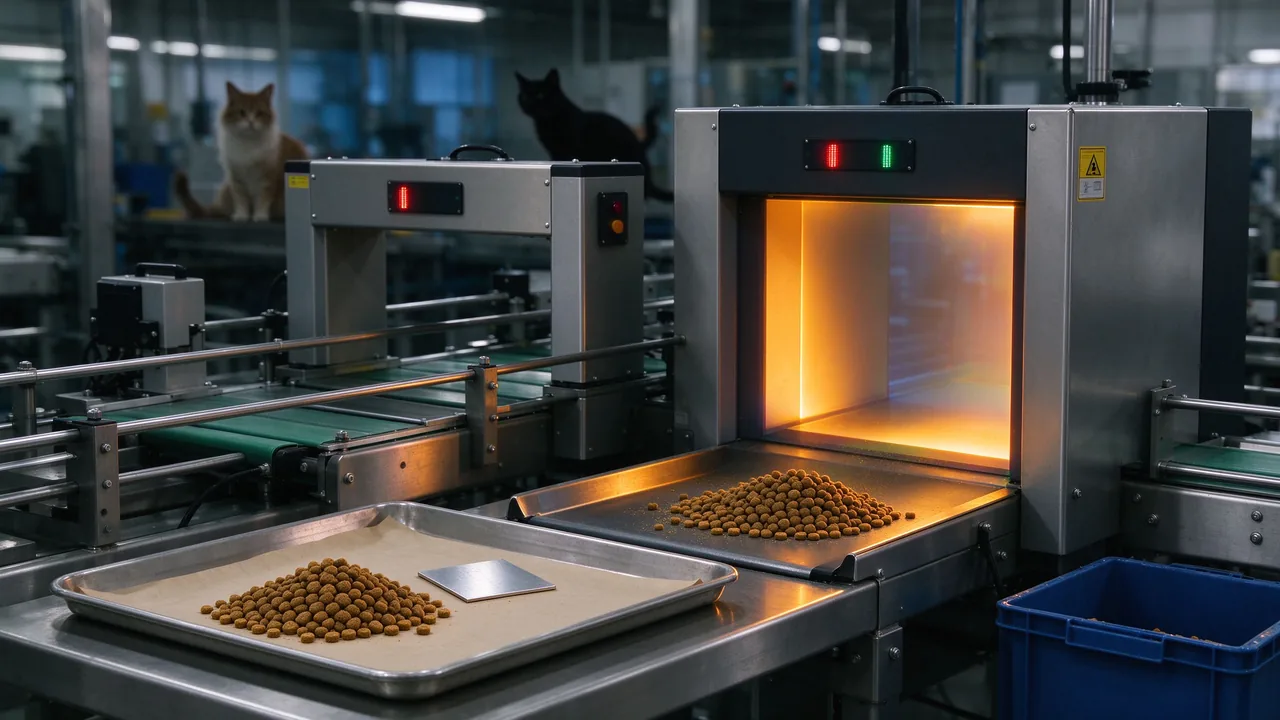
| After forming | Metal detection (Fe/Non-Fe/SS) | Metal contaminants | Sensitivity verification record |
| Before packing | X-ray or AI vision | Bone, glass, high-density plastic, misshapen pieces | Settings and reject records |
| Finished goods | Retention samples, batch traceability | Locate shift and material if a claim occurs | Retention ledger |
More points is not better. Each point needs a clear statement of what it stops and how you prove it is still working.
Setting and verifying sensitivity
Common reference values for metal detection are Fe 1.5mm, Non-Fe 2.0mm and SS 2.5mm, with real capability depending on product effect, packaging and aperture size. Three rules:
- Measure with test pieces; never copy a brochure. High-salt or high-moisture products substantially narrow usable sensitivity.
- Verify by shift: start-up, product changeover, hourly and end of shift, with test pieces passing through the detection zone and being rejected.
- Records must map to batches. Writing "inspected" is the same as not inspecting.
X-ray sees what metal detection cannot: bone chips, glass, high-density plastic, ceramic and some stone. It also has limits:
- Denser product and thicker packaging reduce image contrast.
- Foil pouches block signal, so the station may need relocation or a dual-energy system.
- Sensitivity must be verified with standard samples and thresholds set per product.
AI vision: surface and shape, not interior
AI vision excels at surface and shape anomalies: scorched kibble, color deviation, misshapen pieces, clumps, print defects. Its two key metrics are miss rate and false-reject rate, and they trade off directly:
- Tighten the threshold and false rejects rise, blowing good product into the waste bin and raising cost.
- Loosen it and misses rise, and foreign material reaches the customer.
A workable approach classifies defects into "confirmed reject," "suspect" and "normal" using a sample library, routes suspect pieces to a manual review station rather than releasing or rejecting them outright, and logs reject counts and review outcomes per shift to justify threshold changes with data.
Reject confirmation: the most overlooked step
Many plants own detection equipment but never confirm rejection. Typical failure modes:
- Air nozzle pressure too low: detected, not blown out.
- Flap timing late: the bad unit passes the station before the flap moves.
- Reject bin full and uncleared: later rejects fall back onto the main line.
- Alarm muted, discovered only at shift end.
Three corresponding actions: confirm immediately after reject (photoelectric or weight check), reconcile reject counts against production counts, and wire reject failure to an automatic alarm and line stop. Only then is the detection loop closed.
Retention and traceability
Retention samples are not paperwork. Keep two finished pouches per batch, labeled with batch, shift, raw material lot and inspection record number, and hold them for six months past shelf life. If a claim arrives, retention supports three things: confirming the product belongs to that batch, reproducing test conditions, and separating supplier responsibility from in-house processing.
Six questions auditors ask
- What is your metal detection sensitivity, when was it last verified, and can you pull the record?
- Do you reset thresholds at product changeover, and who is authorized to change parameters?
- How do you confirm the X-ray or AI vision reject mechanism actually removes every reject?
- How often are screens inspected, and how do you prevent wire fragments entering product after a break?
- After a foreign material claim, how fast can you trace it to a batch and a material supplier?
- Can you show the count and resolution of foreign material claims over the last 12 months as a trend?
Clear answers to these six usually mean the program is a system, not a prop.
The takeaway
Foreign material control has a strong return: metal detection plus reject confirmation costs far less than one recall. The hard part is not buying equipment but connecting control points, sensitivity, verification frequency, reject confirmation and retention into one auditable chain.
Mixiaoqi pet food OEM/ODM plans detection points together with reject confirmation at the line design stage, so a brand audit can pull sensitivity verification and reject records directly — not just an equipment list.
Developing a fresh pet food product?
Share your target market, product direction, format and expected volume — we will help structure a project plan.
Submit a project brief