
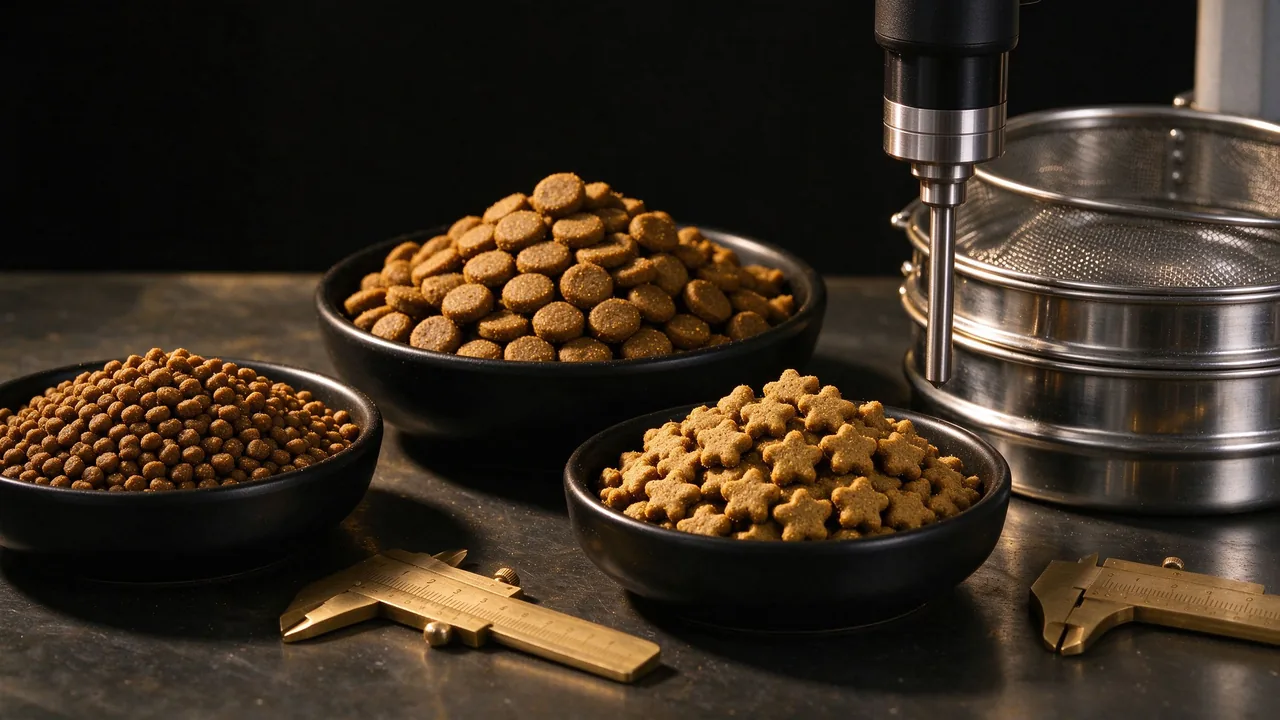
Kibble hardness is one of those specs that gets skipped in a quotation and shows up as a bag full of crumbs at the bottom of a pallet.
In pet food OEM, hardness is never an isolated number. It works with fines, bulk density and particle size distribution to decide three things: whether the product survives shipping, whether pets chew it comfortably, and whether the bag holds it properly. Set all four together, and acceptance means something.
What each of the four measures
- Hardness: the compressive resistance of a single kibble. It affects chew, tooth contact and breakage.
- Fines: the share of fine particles generated by tumbling, transport and pouring. It is the powder at the bottom of the bag.
- Bulk density: weight per unit volume. It drives bag format, fill volume, warehousing and freight cost.
- Particle size distribution: the share of oversize and undersize particles outside the target. It affects appearance consistency and the eating experience.
Hardness and fines are the pair most often confused. Hardness is whether the kibble resists compression; fines are whether it resists abrasion. A hard but brittle kibble can still generate heavy fines.
How to measure kibble hardness
Two common tools: a texture analyzer and a kibble hardness tester. The method is simple; the discipline is in sampling and conditions.
1. Sample from the start, middle and end of the run, not just the top of the bin.
2. Test 20 to 30 kibbles per sample and record mean, minimum and maximum.
3. Bring samples to room temperature; do not test right off the cooler or right after coating.
4. Compress in the same orientation and record the unit, grams or newtons, so only same-size kibbles are compared.
5. Record the instrument model, probe, speed and room temperature and humidity. Without them, the data cannot be reproduced.
For the same formula and same size, lot-to-lot hardness commonly stays within plus or minus 10 to 15 percent. Outside that band, check moisture, cooling and coating first, then the die and equipment.
Fines: the leading indicator of shipping damage
Fines are usually measured by a tumbling or rotation test: weigh a sample, tumble it for a fixed time at a fixed speed, then weigh the fraction passing a specified sieve. Some plants use a transport simulator for a closer match to real handling.
- Internal limits commonly run at no more than 1 to 2 percent, depending on shape, coating level and packaging.
- Shaped kibble, thin walls and heavy coating tend to generate more fines.
- When fines rise, check cooling, post-coating rest time and bag cushioning.
- Fines are among the easiest complaint metrics to quantify, so keep a record for every lot.
Bulk density and particle size: bag, bite and equipment
Bulk density commonly falls between 300 and 450 grams per liter, depending on formula, expansion and shape. A higher density puts the same weight in a smaller bag, saving freight and storage; a lower density looks fuller but takes more volume.
Particle size commonly ranges from 1.5 to 15 millimeters, smaller for cats and larger for dogs, with smaller sizes for puppies and kittens. Size is not a free choice:
- Too small: more surface area per gram, which makes coating and oxidation control harder.
- Too large: puppies and small breeds struggle to chew, and breakage rises.
- Size changes alter die open area and throughput, so confirm it with the quotation.
- Set upper and lower sieves and record both oversize and undersize fractions.
How formula and processing change hardness
The same formula on a different line can produce a completely different kibble. Six variables matter:
1. Starch gelatinization: more complete gelatinization gives a denser structure.
2. In-barrel moisture: higher moisture gives a softer kibble and raises drying energy.
3. Protein and fiber ratio: more fiber gives a looser structure; more protein raises hardness.
4. Die compression ratio and open area: higher compression gives a harder, denser kibble.
5. Cooling and drying curve: cooling too fast creates internal stress and cracking.
6. Fat coating: more surface fat improves lubrication, but does not necessarily change the internal structure.
That is why a new plant, a new line or a new die requires a new trial and a new signed sample. Copying the previous plant's hardness number onto a new factory is the most common source of acceptance disputes.
How to write acceptance
Replace "feel" with four executable lines.
- Sampling: different positions in the same lot, plus start, middle and end of the run.
- Specs: hardness mean and min-max range; a fines ceiling; a bulk density range; upper and lower sieves for size.
- Method: instrument model, probe, speed, sieve size and tumbling time, all written down.
- Decision: physical checks on site, chemical checks in the lab; out-of-spec lots go to concession, rework or downgrade with written approval.
- Golden sample: seal the first batch with date, lot, formula and process parameters for later comparison.
Acceptance is not "open a bag and look." It is the same method, same conditions and same record.
Three common mistakes
1. Harder is better. Too hard makes chewing difficult and can hurt acceptance. Set limits by species, age and size.
2. Mean only. A mean can pass while the extremes are already too soft or too hard. Read mean and extremes together.
3. Hand feel instead of instruments. Hand feel is useful for a quick check, not for lot disposition. Two people squeezing two bags rarely reach the same conclusion.
Kibble is the most visible part of the product and the easiest engineering to overlook. Write kibble hardness, fines, bulk density and size into acceptance, and later complaints drop. Mixiaoqi pet food OEM/ODM puts the four physical specs and the sampling method on the confirmation sheet before discussing formula and price.
FAQ
Q1: Is higher kibble hardness better?
A: No. Too hard can hurt chewing and acceptance; too soft raises breakage and fines. Set a range by species, size and positioning instead of chasing a single high value.
Q2: How are fines measured?
A: Commonly with a tumbling or rotation test that weighs the fraction passing a specified sieve, optionally combined with a transport simulation. Internal limits often run at 1 to 2 percent, depending on product and packaging.
Q3: Why re-confirm hardness when changing manufacturers?
A: Equipment, die compression, cooling and coating differ, so the same formula can produce different hardness. A new plant requires a new trial and a new signed sample.
Q4: Should acceptance use the mean or the extremes?
A: Both. The mean shows stability; the extremes show risk. Pair them with a golden sample and an on-site hand check.
Developing a fresh pet food product?
Share your target market, product direction, format and expected volume — we will help structure a project plan.
Submit a project brief