
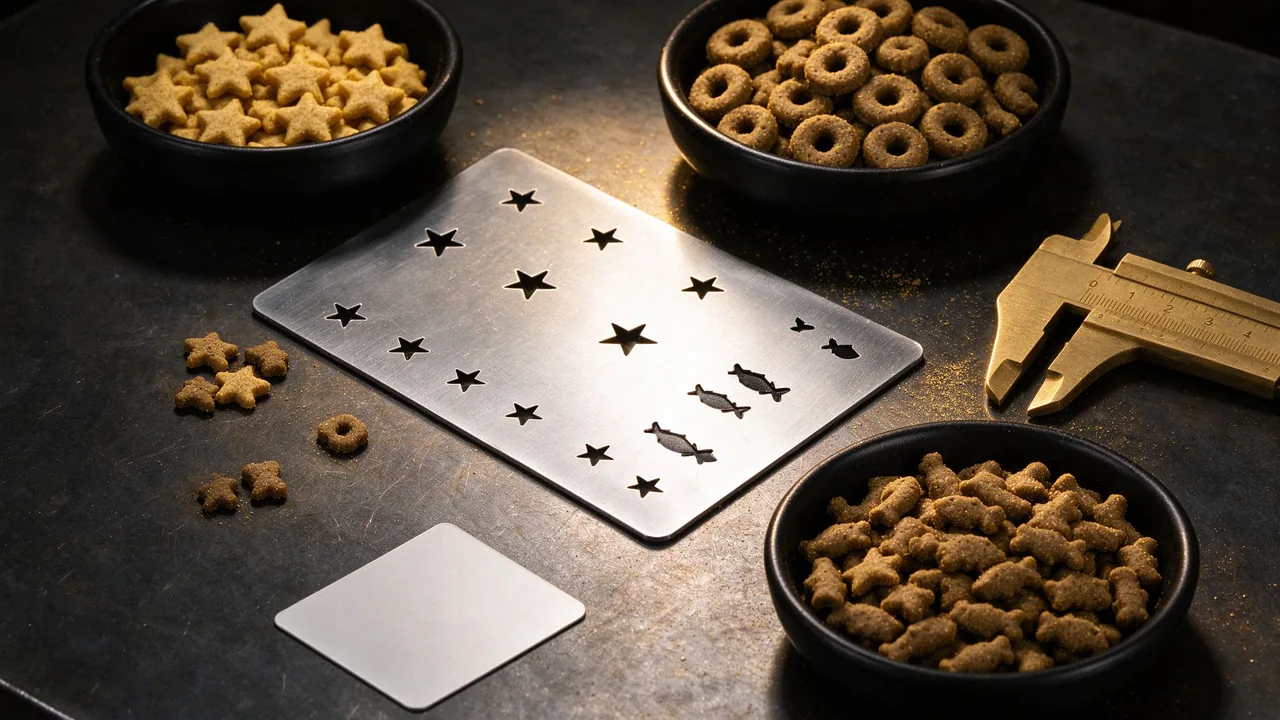
Brands often treat kibble shape as part of packaging design. A factory hears make it a star and thinks about three things: open area, changeover time and scrap rate. Shape is part of the product, but on the line it is first a question of the pet food die plate and the extruder settings.
How a shape is actually made
- The die plate: a perforated steel plate whose hole profile sets the cross-section of the kibble.
- Plate thickness and compression ratio: they set density, cooking and throughput.
- Open area: the wall between holes. Stars, hearts and fish profiles leave fewer holes in the same plate area, so open area falls.
- The consequence: on the same extruder, a custom shape usually runs below round-hole throughput, with higher energy use and more transition material.
Where the money goes in a pet food die plate
- Plate material and machining: drilling, wire cutting or electrical discharge machining; custom profiles need tighter tolerance.
- Heat treatment and surface treatment: the wear layer sets service life.
- Trial runs: mounting, parameter setting, sampling, checking dimensions and bulk density.
- Pricing basis: hole count, hole size, material and precision. Custom profiles usually price above round holes.
- Ownership: who pays, who owns the plate, and whether it may be replicated at a second factory. All three belong in the contract.
The trade between shape and throughput
- Small kibble: commonly 1.5–3 mm, used for kittens and puppies; lower output per hour and tighter hole tolerance.
- Large kibble: commonly 10–15 mm, harder to control for density and cooking.
- Thin-edged profiles: star points and fish tails wear faster and drive more frequent die changes.
- The conclusion: the more complex the shape, the more it needs an economic batch and a fixed production window, rather than one large order taken as a bet.
Changeover and the economic batch
A die change is not unscrewing a bolt. Removing the plate, mounting the new one, heating, setting parameters, first-piece approval and cleaning commonly take one to three hours depending on the line and the plate. Every change produces transition material; that is normal loss, but its ownership should be agreed. The economic batch should be derived backward from what one changeover costs: die depreciation, transition material, downtime hours and cleaning labor, divided by contribution per ton. A round number picked by feel usually lands in a loss.
What else the shape affects
- Coating adhesion: surface roughness and edge geometry change how evenly oil and powder attach.
- Appearance consistency: thin corners abrade in transit, so shelf appearance shifts more over time.
- Palatability testing: shape affects the first bite and chewing, but it does not replace a palatability test.
- Intellectual property: a distinctive shape may touch design rights. A search before cutting the plate is cheaper than a change afterward.
Five clauses to write into the contract
1. Die ownership and storage location.
2. Cloning limits: no replication of the same profile for a third party.
3. Wear criteria and replacement responsibility: after how many tons or how many changes, and who pays.
4. Trial count and acceptance criteria: dimensions, bulk density, appearance, yield.
5. Changeover time, transition material ownership and minimum batch.
Six steps for a first die
1. Fix the shape and dimensions, with a drawing that carries tolerances.
2. Quote the die by hole count and precision.
3. Approve a sample, checking the cross-section and edges first.
4. Run a trial on the line and measure throughput, density and transition material.
5. Sign the sample, lock the parameters and write them into the process card.
6. Schedule production and packaging together, so kibble does not arrive before bags do.
Shape is the easiest thing to promise and one of the easiest to underprice. The cost of a pet food die plate rarely sits on the first line of a quotation; it shows up in changeovers and throughput every day. Mixiaoqi pet food OEM/ODM gives a shape, throughput and minimum-batch comparison before quoting a custom kibble project, then settles who carries the die cost.
FAQ
Q1: Is a custom shape always more expensive than a round hole?
A: Usually on two fronts: the die costs more to make, and throughput falls because open area is lower and transition material rises. How much depends on hole count, hole size and profile.
Q2: Who normally pays for the pet food die plate?
A: Both models exist. The brand pays and owns the plate, or the factory pays and amortizes it. What matters is writing ownership and cloning limits down.
Q3: How long does a die change take?
A: One to three hours is common, including removal, mounting, heating, parameter setting and first-piece approval; longer with complex plates and strict cleaning.
Q4: Can a brand trial a shape in small volume?
A: Yes, but accept the changeover and transition cost. Combining the trial with the first small batch in one window is the cheapest route.
Developing a fresh pet food product?
Share your target market, product direction, format and expected volume — we will help structure a project plan.
Submit a project brief