
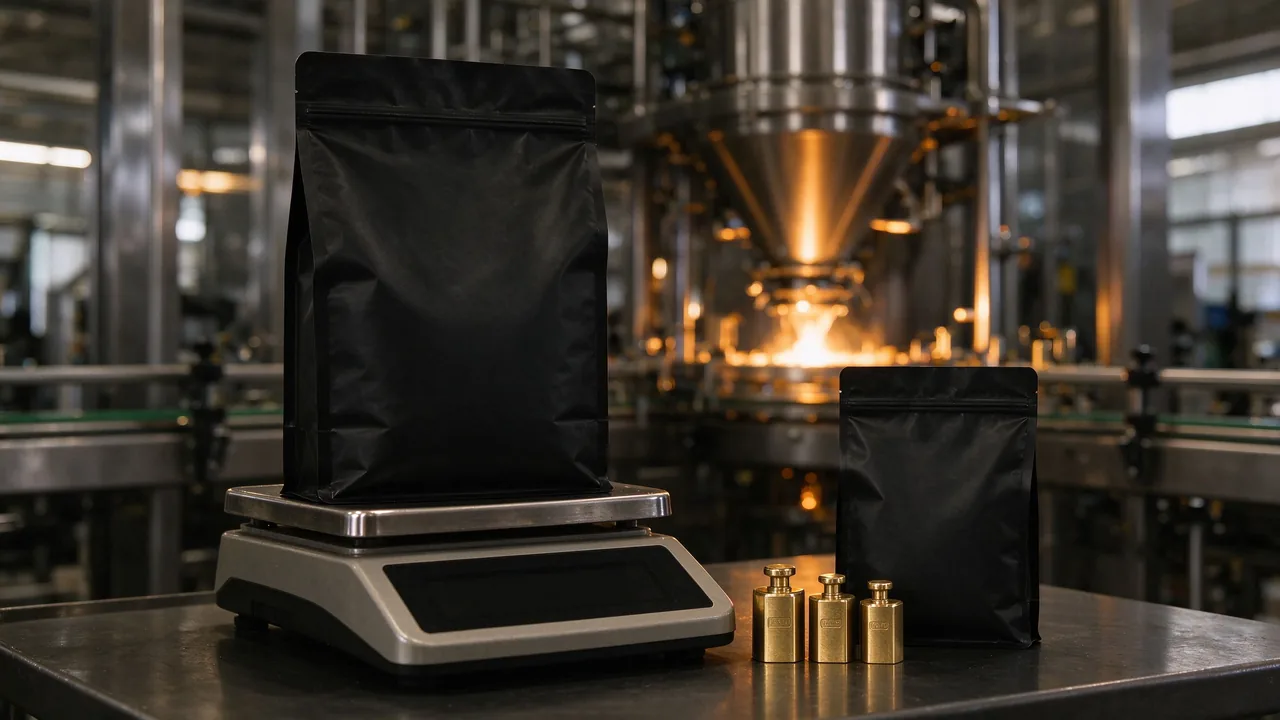
A bag labeled 2 kg of pet food weighs 1.97 kg. Is it acceptable? For that single bag, the answer sits inside the tolerable shortage. For the batch, average actual content and the number of T1 shortages also count. Pet food net weight is never a one-bag question. It is judged on three parameters together, and writing all three into OEM acceptance costs far less than fixing the problem after a complaint.
1. Three parameters decide a batch, not the average alone
- Average actual content: the batch average must not fall below the declared net weight. Under sampling, the sample average must meet the limit after the correction value is applied.
- T1 shortages: a unit below the declared net weight minus one tolerable shortage, but not yet below minus two, is a T1 shortage. The share of T1 units in a lot or batch may not exceed 2.5 percent, and a sampling plan sets the allowed count.
- T2 shortages: a unit below the declared net weight minus two tolerable shortages. Not one is allowed.
Take a 100 g bag with a tolerable shortage T of 4.5 g. A unit between 95.5 g and 100 g is normal variation. A unit below 95.5 g but at or above 91 g is a T1 shortage. A unit below 91 g is a T2 shortage. The consequences differ: the first two tiers are judged by share, the third fails the batch outright.
2. How to read the tolerable shortage for pet food net weight
Table 3 of JJF 1070-2023 sets T by declared net weight. For mass-labeled goods:
- 0 to 50 g: 9 percent of the declared net weight;
- 50 to 100 g: 4.5 g;
- 100 to 200 g: 4.5 percent;
- 200 to 300 g: 9 g;
- 300 to 500 g: 3 percent;
- 500 to 1000 g: 15 g;
- 1000 to 10000 g: 1.5 percent;
- 10000 to 15000 g: 150 g;
- 15000 to 50000 g: 1 percent.
With that table, the single-unit floor for common sizes is simple:
- 100 g: T is 4.5 g, so the floor is 95.5 g;
- 500 g: T is 15 g, so the floor is 485 g;
- 2 kg: T is 30 g, so the floor is 1970 g;
- 10 kg: T is 150 g, so the floor is 9850 g.
This table is the single-unit test. A batch also has to meet the average actual content and T1 count conditions. All three must pass.
3. Fill accuracy: three error types to separate
- Unit-to-unit variation: repeatability at one setting, read as the standard deviation of 30 consecutive bags.
- Batch drift: bulk density, granule flow, screw wear and hopper level shift the mean. Read it from first, middle and last samples in each shift.
- Tare error: film gram weight, seal width and bag format. Every new film lot needs a fresh empty-bag weight check.
Many plants set the internal target about 0.5 to 1.0 times T above the declared net weight to absorb variation with a positive bias. That is common practice, not a legal requirement. The offset should be validated against the filler's repeatability and the ingredient's behavior. Set it too high and give-away cost rises. Set it too low and T1 counts exceed the limit.
4. Sampling and batch judgement: sample size and correction factor
JJF 1070-2023 took effect on 12 October 2024. The sampling plan is looked up by batch size rather than fixed at one sample count. The regulator's own explainer gives two examples: a batch of 60 units calls for 35 samples with a correction factor of 0.30, while a batch of 600 to 100000 units calls for 98 samples with a factor of 0.26 and allows 5 T1 shortages.
Judgement has three parts: the sample average must clear the limit after the correction value, the T1 count must stay within the plan, and no T2 shortage may appear. The correction value allows for variation. It does not relax the standard.
Online practice can stay simple: weigh 5 bags every 30 minutes and log mean and range, weigh 5 bags at the start and end of each shift, and add one extra group after a formula change, a packaging change or a shift handover. Keep records by batch so a customer recheck can pull them straight away.
5. Scales and measuring instruments: calibration beats resolution
- Match the scale to the load. Do not weigh 100 g bags on a 30 kg platform scale.
- Daily check with a standard weight, logging zero and reading.
- Calibrate on the company metrology plan with an accredited body, and file certificates by asset number.
- Manage tare weight: check empty bags on a schedule and after every film lot change.
- Close the record loop: calibration certificate, daily check and tare record must point to the same asset and shift.
6. How to write pet food net weight into an OEM contract
- Basis: state that judgement follows JJF 1070-2023 and the prepackaged goods metrology rules. Export orders add the destination rule.
- Internal standard: target value, single-unit floor and batch T1 cap, usually tighter than the legal minimum, written as numbers.
- Sampling and recheck: sampling rate and the fate of a failed batch, whether 100 percent rework, downgrade or disposal. Pick one.
- Shortage settlement: either weight-based credit or bag-for-bag replacement. Choose one method, not both.
- Instruments: who calibrates, who keeps certificates and whether the customer may witness a recheck.
Most pet food net weight disputes come from an undefined basis. Mixiaoqi pet food OEM/ODM puts the tolerable shortage, the internal target and the recheck rule on one page of the acceptance protocol, with weighing records kept by batch, so no one has to rebuild evidence after a complaint.
FAQ
Q1: Is a bag below the declared net weight automatically a failure?
A: No. A unit inside the tolerable shortage is allowed. A unit below the declared weight minus one tolerable shortage, but not below minus two, is a T1 shortage and is capped by share or count. A unit below minus two is a T2 shortage, and not one is allowed.
Q2: What is the single-unit floor for a 2 kg bag of pet food net weight?
A: Under Table 3 of JJF 1070-2023, the 1000 g to 10000 g band allows 1.5 percent, which is 30 g for 2 kg. The floor is 1970 g, and anything below 1940 g is a T2 shortage.
Q3: How many bags should be sampled from a batch?
A: Look up the sampling plan by batch size. A batch of 600 to 100000 units calls for 98 samples, a correction factor of 0.26 and up to 5 T1 shortages. Smaller batches use different sample sizes and allowances.
Q4: Which clause matters most in an OEM contract?
A: Basis, internal target and the handling of a failed batch, written together. A clause that only says compliant with the national standard leaves both sides arguing after a problem.
Developing a fresh pet food product?
Share your target market, product direction, format and expected volume — we will help structure a project plan.
Submit a project brief