
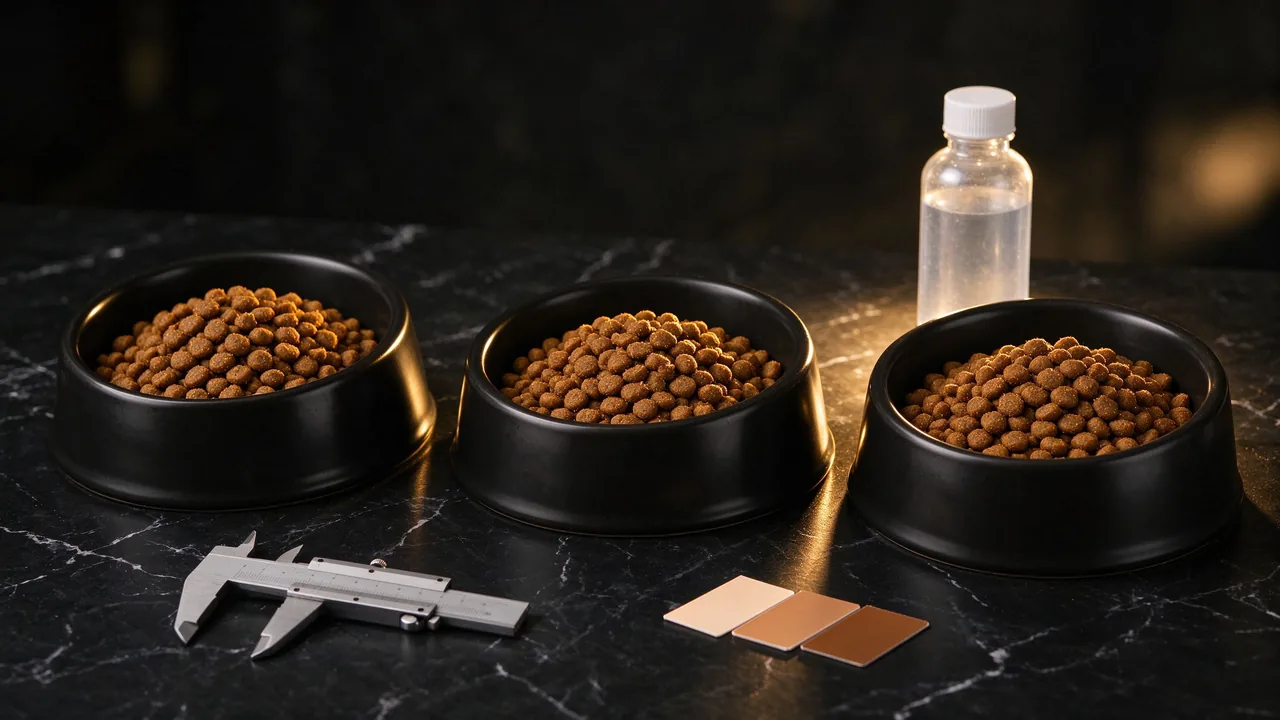
# Pet Food Batch Consistency: Setting Tolerances for Color, Kibble Size, Odor and Moisture
The first sample looks right. The tenth batch looks different. It is the most common complaint in contract manufacturing, and pet food batch consistency is exactly where it bites. The formula did not change and the equipment did not change. Variation comes from ingredient lots, moisture, die wear and parameter drift. To move from "looks about the same" to "measures the same", write the tolerances down.
First batch good, tenth batch different: the formula is usually not the cause
- **Ingredient lots.** Protein, fat, moisture and color vary between deliveries from the same supplier, and meat meal tone is especially visible.
- **Moisture.** A 0.5-point difference between mixing and drying shifts kibble size, hardness and bulk density.
- **Dies and knives.** Worn extruder die holes let diameter and length creep up, and after ten batches it is visible to the eye.
- **Parameter drift.** Temperature, screw speed and residence time that are not locked will drift between shifts.
- **Mixing order.** The sequence and time for micro-ingredients affect color uniformity and localized speckling.
Of these five, only ingredient lots are bought. The other four can be locked inside the plant.
Five pet food batch consistency tolerances you can measure
The values below are common starting points that both parties should confirm by category, equipment and market. They are not an industry standard and do not replace regulation.
1. **Kibble size.** Diameter ±0.5 mm, length ±1.0 mm, measured against the golden sample.
2. **Bulk density.** ±5%, compared on the same formula and the same moisture basis.
3. **Moisture.** ±0.5 percentage point, with one release-testing basis.
4. **Color.** ΔE ≤ 2 against the golden sample; the threshold where the eye just begins to notice a difference is usually ΔE 2 to 3.
5. **Odor and acceptance.** A subjective item, scored by a three-person blind panel, not used as the sole reason to reject a batch.
Fix the methods at the same time: calipers on 30 kibbles averaged; one cup and one tapping method for bulk density; one instrument and one temperature for moisture; one light source and one colorimeter for color. Without common methods, the numbers are not comparable.
First-piece approval and the golden sample
- Retain 200 g from the first piece of every batch, signed by both parties, stored cold and away from light.
- Update the golden sample every six months, and immediately after a major formula, ingredient or equipment change. Seal the old sample; it cannot remain the reference.
- Bind the golden sample to the batch record: batch number, production date, shift, ingredient lots and key process parameters on one page.
The golden sample is not the best-looking bag. It is the bag both parties signed. Its job is to serve as a decision reference, not a display sample.
Out of tolerance: concession, rework or downgrade
- **Minor deviation.** Appearance or kibble size inside the secondary tolerance: concession acceptance, recorded and discounted.
- **Packaging or dosing impact.** Oversized kibble that destabilizes fill weight: rework by screening.
- **Label guarantee impact.** Moisture or protein outside the declared tolerance: no concession; downgrade or scrap.
- **Timing.** Judge before release, not after the goods reach the customer's warehouse.
Concession acceptance needs a written record and a discount rule. Otherwise "we let it go this time" becomes "we always let it go".
Four clauses for the contract
1. The tolerance table as an annex, with values, test methods and sample sizes.
2. How the golden sample is made, signed, stored and updated.
3. Who judges a deviation, how it is handled and who pays.
4. What happens after three consecutive batches fail the same item: root-cause analysis, correction deadline and suspension conditions.
These clauses look administrative, but they decide whether a batch is negotiable or returnable.
A 30-minute shop-floor comparison
1. Take 30 kibbles from the current batch and the golden sample; measure diameter and length with calipers.
2. Measure bulk density with the same cup.
3. Measure moisture on the same instrument at the same temperature.
4. Measure ΔE with the same light source.
5. Run a three-person blind odor and acceptance check.
Write all five results on one sheet and sign it. That sheet is worth more than any verbal promise, and it becomes the starting point for the next batch.
Pet food batch consistency is not about doing better work. It is about measuring it, writing it down and judging it the same way every time. Before the first production run, Mixiaoqi pet food OEM/ODM signs that tolerance sheet with the customer; every batch after that is judged against the same page, not against memory and not against "looks about right".
FAQ
**Q1: Who should set the tolerance table?**
Both parties. For pet food batch consistency, the factory brings equipment capability and historical data; the customer brings market and labeling requirements. Both sign.
**Q2: What does a color ΔE of 2 mean?**
It is roughly where the human eye begins to notice a difference. Tighter limits add sorting and rework cost; looser limits let shoppers see batch variation on shelf.
**Q3: How often should the golden sample be replaced?**
Every six months is a reasonable default, and immediately after a major formula, ingredient or equipment change. Seal the old sample so it cannot be used as the reference.
**Q4: What if the customer asks for zero variation?**
Translate zero variation into measurable tolerances and decision rules, and write down how deviations are handled and who pays. A promise that cannot be measured becomes a dispute later.
Pet food batch consistency is a document before it is a capability.
Developing a fresh pet food product?
Share your target market, product direction, format and expected volume — we will help structure a project plan.
Submit a project brief