
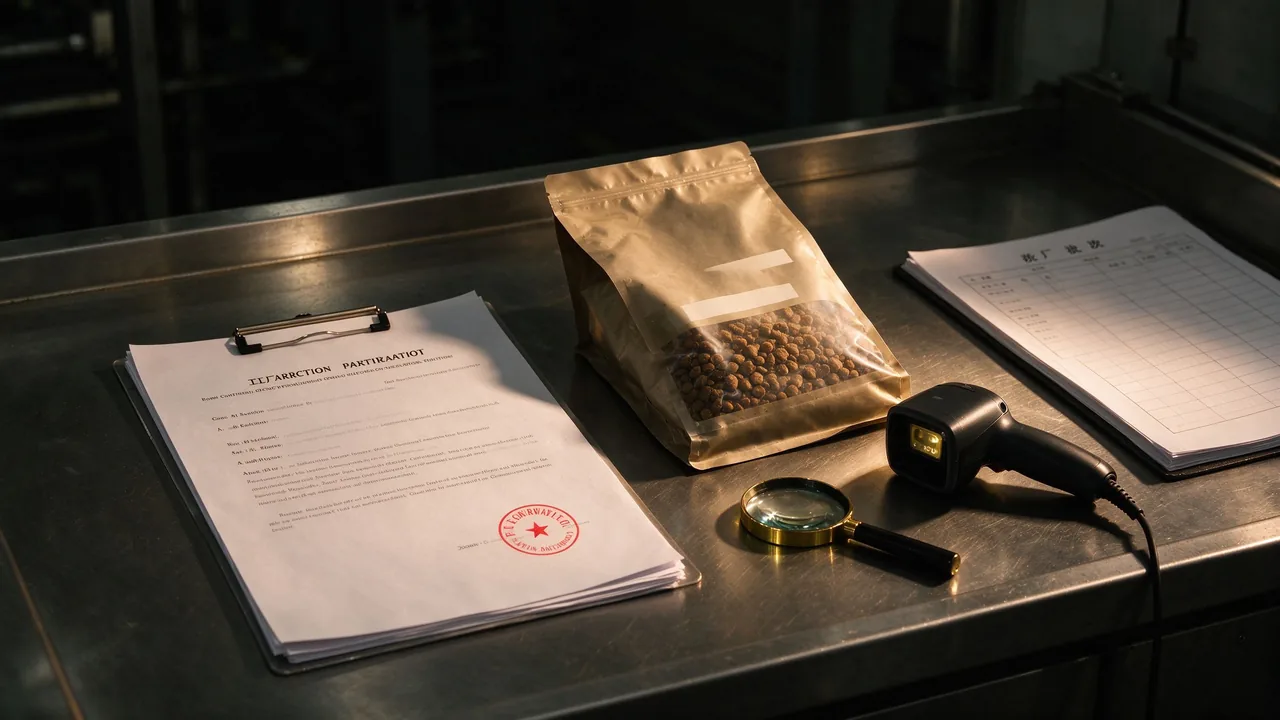
# Factory Verification: How to Confirm Your Pet Food Was Actually Made There
"It is made by that big plant."
That sentence appears about as often in pet food as the words "high fresh meat." It is far less verifiable than a nutrition number. Industry discussion has even produced a term for the problem: factory verification, the question of which line actually produced the bag.
For buyers and brands, this is not a trust issue. It is a process issue. Trust runs on relationships; process runs on evidence.
1. Why "name-only co-packing" happens
Three common patterns:
1. The brand genuinely ran an early batch at one plant, moved to a cheaper plant as volume grew, and never updated the story.
2. The plant had no capacity, subcontracted to a sister facility, and the packaging kept the original plant's details.
3. The brand turned "the formula came from that plant" into "the product was made at that plant." Those are different claims.
In all three, the channel absorbs the damage: when something goes wrong, there is no production entity to hold accountable.
2. Five documents that can be checked
**1. Manufacturing agreement and authorization letter**: legal entity, product list, validity period. The plant name on the letter must match the manufacturer information on the pack.
**2. Coding rule statement**: plant codes usually include production date, line number and shift; brand-assigned codes often carry only a date and serial. Ask the plant to explain the code in writing.
**3. Release test report**: issued by the plant or its commissioned lab, with the batch number on it. A report from the brand's own lab does not prove who made the product.
**4. Audit records**: date, auditor, findings and closure. Certificates alone prove a system; records prove this run.
**5. Line-sharing disclosure**: whether the same line runs other brands, and whether allergen or formula changeover cleaning was validated.
3. Three actions that turn documents into evidence
**Action one: spot-check two batches.** Pick two lots from retail and ask the plant to pull the matching production records and test reports. If they can produce them and they line up, the claim holds.
**Action two: watch the coding at the line.** Stand at the end of the line and see what the coder actually prints, then compare it with the written rule. This single look eliminates most paper-only claims.
**Action three: compare origin labeling.** Check origin, manufacturer and address on the pack against the entities in the contract and the reports. If one of the three does not match, ask why.
4. Two clauses that belong in the contract
**Notice of production site change**: any factory, line or subcontract change requires written notice in advance plus fresh audit and testing documents. Without this clause, a brand can switch producers without your knowledge.
**Traceability and liability basis**: how long batch records are kept, who owns recall responsibility, and the plant's duty to cooperate in an investigation. Written terms beat mutual blame afterward.
5. A note for brands
Saying "made by that plant" is a selling point only while it stays verifiable. One mismatch damages the credibility of an entire line. Conversely, packaging the five documents into a queryable page or attachment turns the sentence from marketing copy into a trust asset.
When clients audit, Mixiaoqi pet food OEM/ODM hands over the coding rules, the batch cross-reference and the line-sharing disclosure together. Verification is better answered before it is asked.
FAQ
**Q1: A brand says a well-known plant makes its food. How do I verify that?**
Start with the manufacturing agreement and the authorization letter to confirm the same legal entity, then request a release test report that maps to a batch. The report should be issued by the plant, not by the brand's own lab.
**Q2: The batch code is on the bag. How does it match the report?**
Look at the coding rule. Plant codes usually carry date, line and shift; brand-assigned codes often carry only date and serial. Ask for a batch-to-report cross-reference and spot-check two or three batches.
**Q3: Should a factory switch be disclosed to the channel?**
Put it in the contract: written notice in advance of any change in the actual production site, with new audit and testing documents. Origin labeling and traceability wording must be updated at the same time.
Developing a fresh pet food product?
Share your target market, product direction, format and expected volume — we will help structure a project plan.
Submit a project brief