
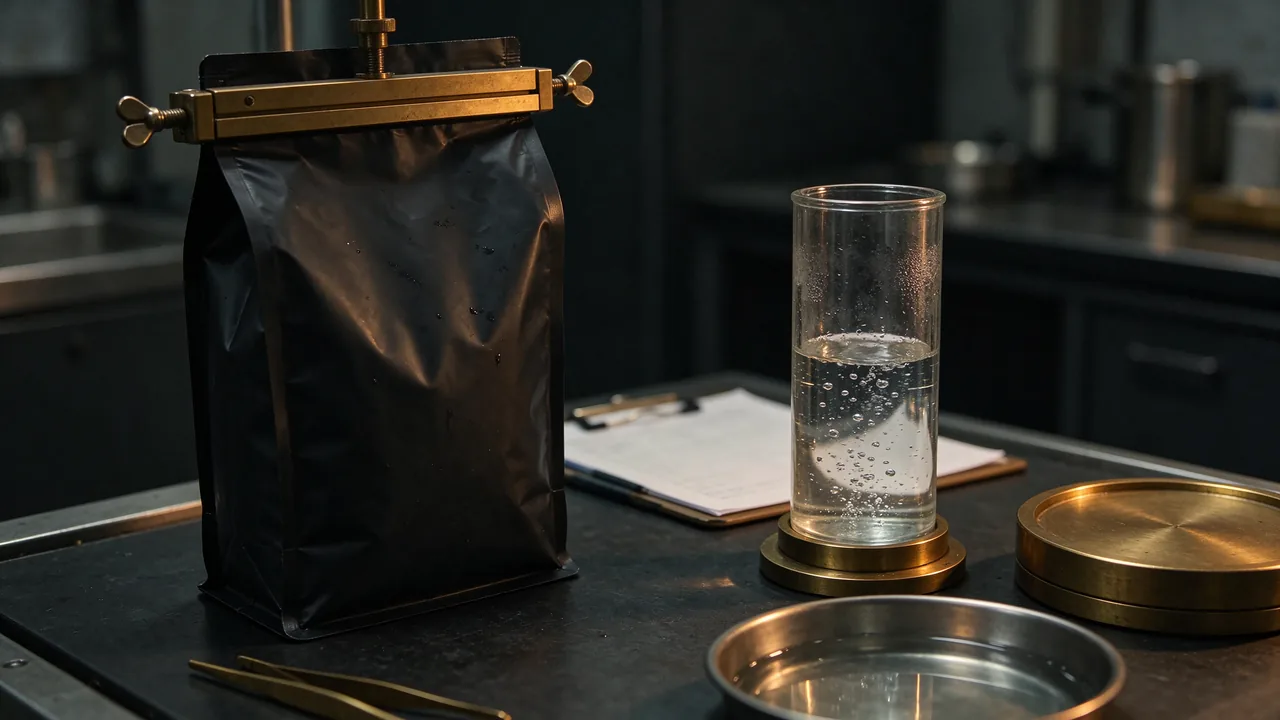
Packaging is often the least-verified step in contract manufacturing. Formulation, kibble quality and microbiological indicators all get attention, while sealing temperature can run an entire shift without a second check. When pet food packaging seal integrity fails, the complaints do not start on the shelf. They start in the warehouse: leakers, swelling bags, cartons that split before they ship.
This article is not about choosing a film structure. It is about how to test seal integrity and residual oxygen, how to set internal limits, and what to write into the supply agreement.
1. Three failure modes, three causes
- Channel leaks in the seal. Temperature, pressure and dwell time are mismatched, or powder and oil land on the sealing surface and leave a narrow channel.
- Pinholes in the film. Incoming film defects, delamination between layers, or scratches from a sharp edge during web handling.
- Bag rupture. Insufficient compression strength, drop impact or overstacking, usually at the seal root and the bottom fold.
Each failure needs a different test. Bubble emission will miss most pinholes, and residual oxygen alone will not tell you whether a channel is large or small. Acceptance has to combine methods rather than rely on one number.
2. Five test methods and where each one stops
- Bubble emission (ASTM D3078). Submerge the sample in water inside a transparent vacuum chamber and watch for a continuous bubble stream. Suited to flexible packages with headspace gas, and mainly catches gross leaks.
- Internal pressurization bubble test (ASTM F2096). Inflate the package, then submerge it and look for a steady stream. Useful for seal strength and bag body integrity.
- Pressure decay (ASTM F2095) and vacuum decay (ASTM F2338). Non-destructive, suited to in-line sampling and batch screening.
- Dye penetration (ASTM F1929 and F3039). Apply dye at the seal edge and look for penetration. Good for locating a channel, weak as a standalone pass or fail rule.
- Oxygen headspace analysis (ASTM F2714, fluorescence decay). Measures headspace oxygen to confirm nitrogen flushing.
Every method has a boundary. Bubble emission cannot find a leak plugged by product. Pressure decay on a soft pouch needs restraining plates to reach useful sensitivity. Dye methods produce false positives on porous materials. Writing "tested to the standard" in a contract is not enough; the method, sample size and decision threshold all need to be named.
3. Pet food packaging seal integrity and residual oxygen
- Common internal limits: no more than 2 percent residual oxygen; high-fat formulas often tighten to 1 percent.
- What high residual oxygen does: lipid oxidation, flavor deterioration and darker color, most visible at the end of shelf life.
- Lower is not always better. Film permeability, flushing capability and negative pressure inside the bag all impose limits, and chasing a very low number can cost line speed.
- Sampling points: first piece of each batch, hourly checks, after a film roll change, and after a restart.
Residual oxygen only makes sense next to shelf-life validation. Testing the day of production without accelerated storage testing verifies half the story.
4. Three sealing parameters and the first-piece check
Seal quality rests on three variables: temperature, pressure and dwell time. Set them against the film structure, including thickness and sealant layer, and run a parameter window study to find the lower and upper limits instead of recording a single setting that happens to work.
A workable first-piece routine:
1. Log the roll lot number, thickness, width and incoming inspection result for every film roll.
2. Run bubble emission plus residual oxygen on the first piece; release only when both pass.
3. Repeat the first-piece check after a roll change, a format change, a stoppage longer than 30 minutes, or any parameter adjustment.
4. Keep first-piece and last-piece samples with the shift parameter record.
5. Transit validation: do not stop at the factory gate
In-plant checks do not predict transit damage. Stacking, drops and vibration are what break bags.
- Stacking: use the real pallet height and inspect the bottom fold.
- Drop: use the packed carton weight and drop height, then inspect the seal root.
- Vibration: simulate long-haul transport and check whether seal channels open up.
Write the target as a measurable figure, such as bags damaged per 10-bag carton, instead of "no damage in transit". A number is what makes it enforceable.
6. How to write acceptance into the contract
- Sampling: full inspection on the first piece; agreed sample size for running lots; attribute sampling for appearance and seals, variable sampling for residual oxygen.
- Decision rules: a continuous bubble stream fails the unit; residual oxygen above the internal limit fails the unit; seal width and position are compared with the golden sample.
- Responsibility split: incoming film belongs to the packaging supplier, sealing parameters and line speed belong to the manufacturer, transit belongs to logistics and carton design.
- Records: retain first piece, last piece, parameter logs and raw oxygen readings for at least the shelf life of the product.
With those three sections written down, a complaint does not turn into guesswork. Mixiaoqi pet food OEM/ODM runs a two-gate check on pet food packaging seal integrity, first piece plus in-process inspection, and puts the oxygen limit, bubble test rule and damage-rate target into the manufacturing confirmation sheet.
FAQ
Q1: What is the most common pet food packaging seal integrity failure?
A: Channel leaks in the seal, followed by bottom-fold rupture and film pinholes. Channels usually come from mismatched temperature, pressure and dwell time, or powder sitting on the sealing surface.
Q2: How small a leak can bubble emission detect?
A: ASTM D3078 bubble emission under vacuum mainly catches gross leaks. Very small openings can be blocked by product or masked by viscoelastic effects, which is why it works for first pieces and sampling but not as the only method.
Q3: What residual oxygen level should we target?
A: Nitrogen-flushed bags commonly target no more than 2 percent, with high-fat formulas often tightened to 1 percent. The actual number depends on the formula, film permeability and shelf-life validation, so it should not be copied from another project.
Q4: Do we need a new first-piece check after a film change or a stoppage?
A: Yes. After a roll change, a format change, a stoppage over 30 minutes, or any sealing parameter adjustment, repeat the first-piece check with both bubble emission and residual oxygen before restarting.
Developing a fresh pet food product?
Share your target market, product direction, format and expected volume — we will help structure a project plan.
Submit a project brief