
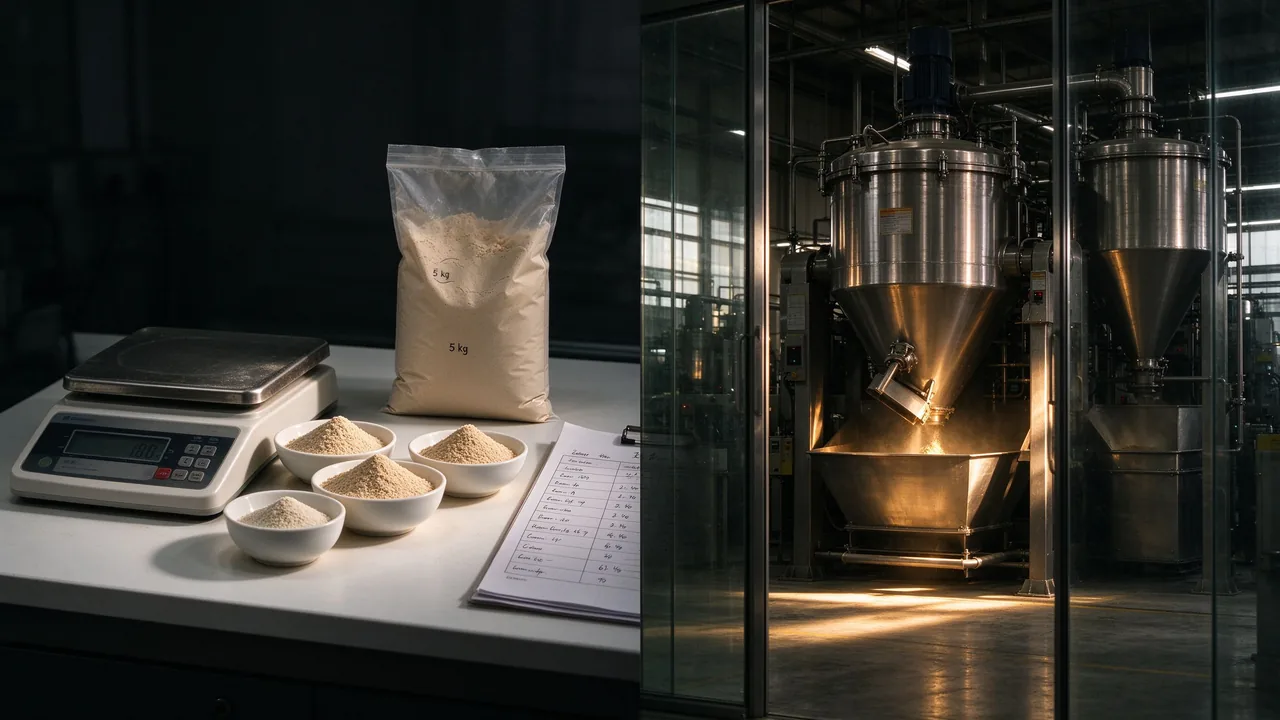
# Why Pet Food Changes on Scale-Up: From a 5 kg Sample to a 5 Ton Run
A successful sample and a failed production run is one of the oldest complaints in co-packing. The 5 kg lab sample looks even, smells right and the cat eats it. The 5 ton run comes out dense, pale, faint in aroma and high in fines. The brand's first reaction is usually that the plant cut corners. Most of the time, the problem is scale-up itself.
1. Scale changes three physical variables
1. Surface-to-volume ratio. A thin lab sample loses heat quickly. A deep production bed has a large temperature difference between center and edge.
2. Heat transfer mode. A lab oven uses static hot air. A production dryer uses a continuous belt, with different airflow, bed depth and residence time.
3. Shear and residence time. A lab extruder has short residence time and high shear. An industrial machine runs high throughput with longer residence time, which changes gelatinization and protein denaturation.
Change those three and the same formula, run with parameters that "look the same," produces something different.
2. Parameter transfer: lock product targets first, then tune the machine
The correct order is the reverse of what most teams do. Do not copy lab parameters onto the production line. Define the finished-product targets first, then find the parameters that hit them on the line.
Five targets usually need to be locked: moisture, bulk density, starch gelatinization, pellet appearance including length, diameter and surface, and coating ratio. Once these are fixed, equipment settings have a direction.
| Item | 5 kg sample | 5 ton run |
| --- | --- | --- |
| Mixing | Small mixer, uniformity from time | Large mixer, uniformity must be validated |
| Extrusion | Lab machine, finely adjustable | Industrial machine, throughput first, narrower window |
| Drying | Static oven | Continuous belt, bed depth drives moisture gradient |
| Coating | Manual or small drum | Continuous coater, oil and flavor ratios drift easily |
| Judgment | Mostly sensory | Sensory plus lab tests, retain samples per batch |
3. Run three batches, not one
For the first production run, make three consecutive batches and sample three points in each: after startup stabilizes, mid-run and before shutdown. Test moisture, bulk density and gelatinization, and run a blind sensory comparison against the sample. Consistent data across three batches means the scale-up worked. One good batch only means it is not stable yet.
4. Five common failures
1. Mixing uniformity never validated: micronutrients such as vitamins, amino acids and probiotics distribute unevenly in a large mixer, so lab results swing batch to batch.
2. Bed depth changed without adjusting drying time: the outside dries too much while the core stays damp, and fines increase.
3. Coating ratio drifts: production equipment runs high flow, so actual flavor and oil attachment is lower than in the lab, and aroma fades.
4. Die and cutter mismatch: pellet length and cut quality change, affecting appearance and packaging.
5. Insufficient cooling: a short cooling section leaves product too warm at bagging, causing condensation inside the bag and shorter shelf life.
5. What to write into the commercial terms
Scale-up risk should be allocated in the agreement: sampling fees by round, how first-run losses and downgraded product are counted, who pays for a second parameter adjustment, and how to exit if three consecutive batches fail. Writing this down beats arguing later about whether the formula was at fault.
Mixiaoqi pet food OEM/ODM provides the production-line parameter window at the sampling stage instead of handing over a single bag of samples. The client is not buying 5 kg from a lab. It is buying 5 tons that can be repeated.
FAQ
**Q1: Can the sample and the production run use the same formula?**
The formula can stay the same, but parameters cannot be copied. Lab and production equipment differ in shear, residence time and drying, so parameters must be re-established on the production line.
**Q2: How many batches confirm a successful scale-up?**
Run three consecutive batches, sampling after startup stabilizes, mid-run and before shutdown. Test moisture, bulk density and gelatinization, plus a blind sensory comparison. Only consistent results across three batches count as stable.
**Q3: Who pays when the first production batch misses spec?**
It depends on the cause. If plant parameters or equipment capability caused it, the plant usually reruns at its own cost. If the brand changed the formula or packaging at short notice, the brand pays. The agreement should define how this is judged and the maximum number of reruns.
Developing a fresh pet food product?
Share your target market, product direction, format and expected volume — we will help structure a project plan.
Submit a project brief