
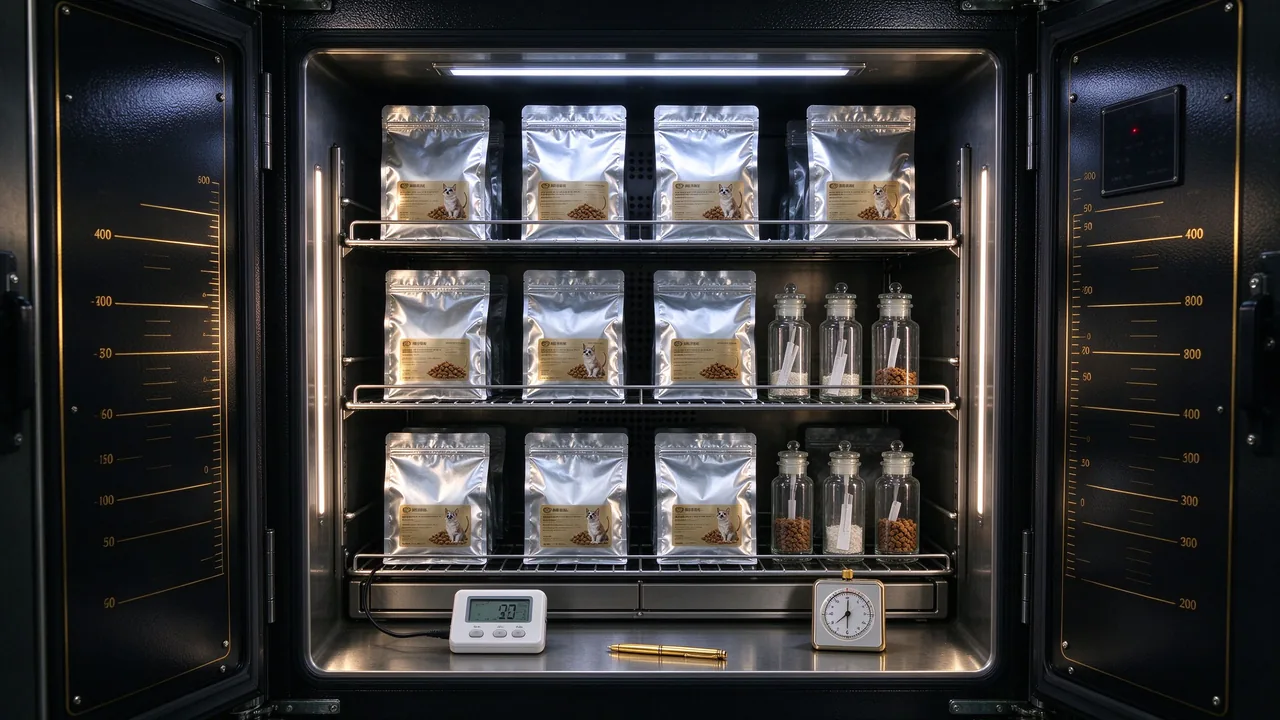
# How to Validate Pet Food Shelf Life: Accelerated Tests, Real-Time Samples and Packaging Barriers
In pet food co-packing, shelf life used to be a cleanup step after formulation: lock the recipe, fill the bags, print 12 or 18 months, and start selling. That approach is running out of room.
Three reasons. First, retailers now enforce remaining shelf life, and many brick-and-mortar and e-commerce channels require at least two-thirds of shelf life left on arrival. Second, export orders already spend 30 to 45 days in transit, and heat and humidity at sea accelerate quality change. Third, fresh food, low-temperature baked and freeze-dried products have shorter shelf lives, leaving less margin for error in formula and packaging.
Shelf-life validation is not about answering "how long can it sit." It is about answering "under what conditions, and which indicator fails first." Define the end point before discussing duration.
1. Set the end point before naming a shelf life
A shelf life is not a month picked by intuition. It is the time at which a key indicator crosses a limit. Four dimensions usually apply:
- Physicochemical: moisture, water activity, peroxide value, free fatty acids, protein solubility.
- Microbiological: total plate count, mold and yeast, set by product category.
- Sensory: color, odor, texture, palatability score.
- Packaging: seal strength, oxygen transmission rate, water vapor transmission rate, bag integrity.
Each needs a specific limit. Dry kibble, for example, is usually held below 0.6 water activity, while the peroxide value ceiling is set by the company based on fat content and category, commonly in the 10 to 20 meq/kg range. Do not copy numbers; confirm them against your formula, fat level and target market.
The more specific the end point, the easier the rest becomes. A standard that only says "normal sensory, no off-odor" lets anyone interpret the report, which means no standard at all.
2. Three test types, each with a distinct job
| Test type | Purpose | Typical conditions | What it cannot replace |
| --- | --- | --- | --- |
| Real-time | Evidence for the formal shelf life | Ambient storage matching target market | Cannot be replaced by accelerated data |
| Accelerated | Fast screening of formula and packaging | Elevated temperature and humidity, e.g. 40°C/75% RH | Cannot be extrapolated directly into a shelf life |
| Transport simulation | Validate tolerance to logistics | Temperature cycling, vibration, stacking | Cannot replace real-time storage data |
Real-time testing is the backbone. Sample at zero, one, three, six, nine, 12, 18 and 24 months, run the full panel at each point and retain sensory samples. For a 24-month target, plan roughly 27 months of work to leave time for reporting and correction.
Accelerated testing is a screening tool. Reaction rates roughly double for every 10°C increase, so a month at 40°C approximates a longer period at ambient. It can tell you a formula or film may not hold up. It cannot justify an on-pack claim. Use it for packaging decisions, not label declarations.
Transport simulation is the most neglected. A shipment spends 40 days at sea, passing through container heat, port sun and repeated handling, stresses a constant-climate chamber never reproduces. Run at least one temperature-cycling plus vibration round, especially for moisture-sensitive extruded kibble and high-fat baked products.
3. Choose indicators by the weakest link
Not every SKU needs the full panel. Identify where the product is most likely to fail:
- High-fat formulas: peroxide value, free fatty acids, odor. Fat oxidation usually fails first.
- High-moisture or semi-moist products: water activity, microbiology, seal strength.
- Freeze-dried and low-temperature baked: moisture gain, crispness, odor after rehydration.
- Products with probiotics or heat-sensitive ingredients: live counts, ingredient retention, plus oxygen and light barrier.
Make the weak-link indicator the high-frequency test and run the rest quarterly or semi-annually. That saves cost without weakening the conclusion.
4. Four pitfalls that break shelf-life claims
**Pitfall one: accelerated only, no real-time.** Accelerated data supports R&D decisions, but customer audits and export registrations ask for real-time data. Starting when the customer asks is too late.
**Pitfall two: using ingredient stability in place of finished-product validation.** An ingredient report describes the ingredient, not the product after extrusion, drying, coating and nitrogen flushing. The finished product must be validated separately.
**Pitfall three: retention samples kept in the lab, not in realistic storage.** A lab is climate-controlled; a warehouse may hit 40°C in summer and condense in winter. Keep samples close to real market storage and transport conditions, or the data looks good while the shelf life fails.
**Pitfall four: changing packaging supplier without revalidation.** Any shift in oxygen transmission, water vapor transmission or seal strength can cut months off shelf life. When film, bag or supplier changes, run at least one comparison and one accelerated round.
5. Write validation responsibility into the co-packing agreement
Shelf-life validation usually involves three parties: the brand sets the target shelf life and market, the plant makes samples and production runs, and a third-party lab issues reports. Who initiates, who pays, and who redoes failed work should be explicit.
A common split: the plant covers the first formula and packaging validation as part of development cost; repeat validation caused by client changes to formula or packaging is paid by the client; failures caused by plant process variation are redone by the plant. Writing this down beats arguing later about whose fault it was.
One more point is often missed: ownership of retention samples. How many per batch, how long, stored where, and whether a client audit can retrieve them belong in an annex to the quality agreement. Shelf-life disputes usually surface after the goods are sold, when samples and records are all you have.
Brands can ask a simple question when selecting a co-packer: how many time points did your last launch test in real time, and can I see the report? A plant that shows a full time-point dataset is usually more reliable than one that offers a single "passed" conclusion.
When Mixiaoqi pet food OEM/ODM takes on a new product, shelf-life validation is scheduled into the sampling stage: confirm end points and sampling intervals first, then lock the packaging structure, so nothing has to be backfilled after mass production.
FAQ
**Q1: Can the label claim a longer shelf life than the validation covers?**
Not advisable. The label needs data behind it. If a market sample fails within the claimed period, exceeding the validated window is hard to defend.
**Q2: Can one shelf-life dataset serve markets with different climates?**
Not directly. Hot and humid markets need separate transport simulation and storage validation, or differentiated storage conditions on the label. Exporting to Southeast Asia and to Northern Europe carry very different risks.
**Q3: Do small-batch launches need full validation?**
It can be staged. Run frequent testing from zero to three months plus one accelerated round to confirm there is no obvious weak link, then extend long-term points after mass production. The label shelf life must stay within the data already covered.
Developing a fresh pet food product?
Share your target market, product direction, format and expected volume — we will help structure a project plan.
Submit a project brief