
# Pet Goat Milk Powder and Milk Replacer OEM Guide: Low-Lactose Formula, Powder Process, Solubility, MOQ
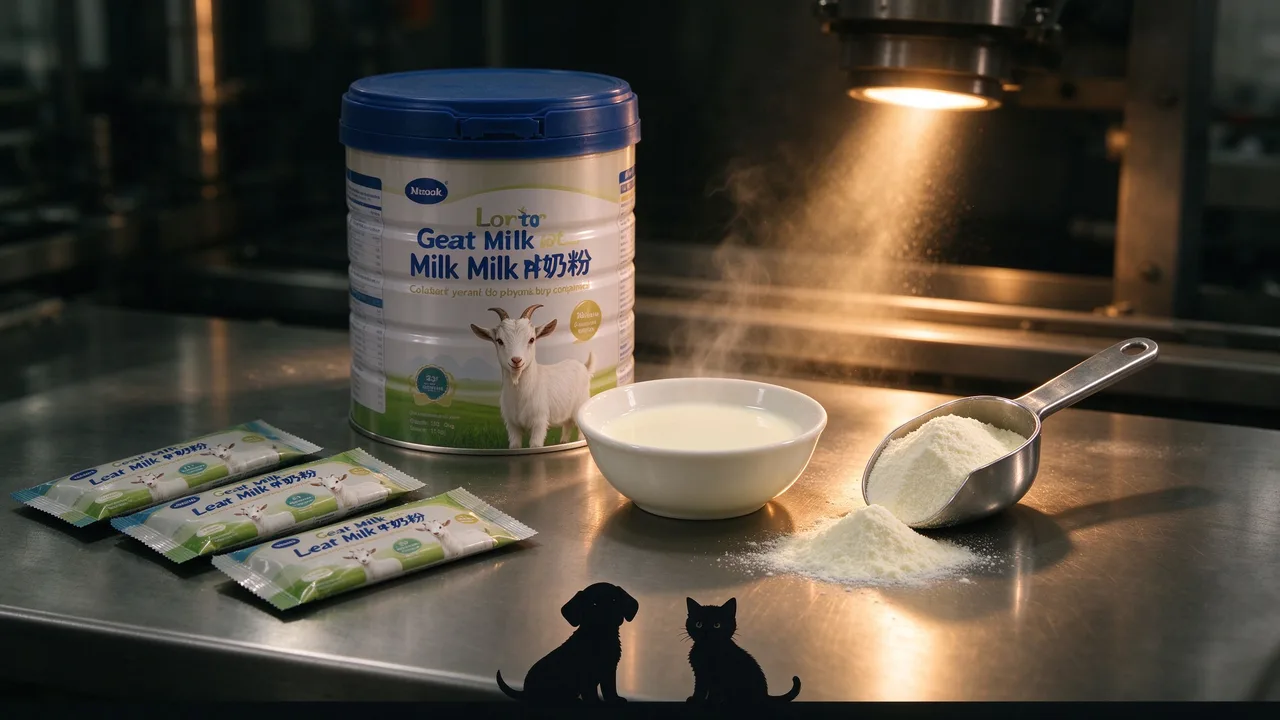
Pet goat milk powder and puppy/kitten milk replacer are powdered nutritional supplements, commonly in cans or independent sachets (such as 5g × 15/40 packs), built on goat milk powder with whey protein, fat, minerals, and optional prebiotic/probiotic ingredients. Unlike liquid milk, the core challenges are formula balance, powder drying, instant solubility, and reconstitution stability. This guide covers formula points, process controls, co-packer checklist, package specs, MOQ ranges, and label boundaries for brands planning a powder line.
Common Product Forms and Positioning
| Form | Package | Positioning |
|---|---|---|
| Daily goat milk powder supplement | Can (200-400g) or sachet combo | Daily mixing or reconstitution supplement for adult dogs and cats |
| Puppy/kitten milk replacer | 5g × N sachets or can | Nutrition reference during weaning transition; not a breast milk replacement |
| Low-lactose formula powder | Can/sachet | Low-lactose positioning with controlled lactose level |
| Food topper powder | Independent sachets | Food-mixing flavoring to support intake willingness |
Formula Controls
1. Milk Source and Lactose Level
Goat milk powder is the mainstream source; some formulas use bovine whey protein as base. Dogs and cats vary in lactose tolerance, and a low-lactose formula must control lactose sources and ratio at the formula stage, with the milk source type stated truthfully on the label.
2. Protein, Fat, and Mineral Balance
Replacer-direction formulas reference protein, fat, and calcium-phosphorus ranges for growth stages; targets differ by life stage (puppy/kitten/adult), and guarantees must match formula design.
3. Probiotic and Prebiotic Addition
Prebiotics and probiotics are daily-nutrition-level ingredients; inclusion level, strain carrier, and activity retention must be assessed within the powder process. Label wording stays at the daily nutrition level, with no disease or digestive-function claim.
4. Flavor and Solubility
Palatability of powders links to instant solubility: particle size, fat coating, and granulation/mixing process affect dispersion speed and caking during reconstitution. The target is even dispersion in warm water without obvious lumps.
Powder Process Steps
1. **Ingredient acceptance**: milk powder, protein, fat, minerals inspected and retained by batch;
2. **Weighing**: precise batching by formula; trace ingredients (minerals, optional probiotics) pre-mixed first;
3. **Mixing and homogenization**: multi-stage mixing for uniformity and to prevent separation;
4. **Drying/granulation**: spray drying or powder granulation per product process, controlling water activity and particle structure;
5. **Sieving and metal detection**: remove coarse particles, metal check before packing;
6. **Packaging**: can or sachet filling, with moisture- and oxygen-barrier packaging and humidity-controlled filling.
Milk Powder Co-Packer Checklist
1. **Powder experience**: records of mixing, drying, and solubility process for milk/protein powders;
2. **Formula capability**: flexibility across low-lactose, replacer-stage, and topper positions;
3. **Trace pre-mixing**: uniformity and activity retention for minerals and optional probiotics;
4. **Testing system**: moisture, protein, fat, calcium-phosphorus, microbiology, and particle size records;
5. **Packaging support**: can, sachet combo, and stick-pack filling and sealing;
6. **Moisture control**: filling humidity, packaging barrier, and shelf-life plan;
7. **Label compliance**: milk source, guarantees, applicable life stage, ingredient descending order, and supplement attribute;
8. **Flexible scheduling**: small-batch multi-spec trials, line-change cleaning, and batch management.
Common Package Specs and MOQ References (Industry Reference; Factory-Specific)
| Package form | Common spec | MOQ reference range | Influencing factors |
|---|---|---|---|
| Independent sachet | 5g×15, 5g×40/box | Hundreds to tens of thousands per spec | Film roll MOQ, sachet filling batch |
| Can | 200g, 300g, 400g | Hundreds to thousands of cans per formula | Can/label packaging MOQ, canning batch |
| Mixed specs | Sachet plus outer box | Per-spec MOQ then combined | Line-change cleaning, inner/outer packaging |
| Export order | Per destination label | Plus label and filing requirements | Label language, ingredient declaration, export documents |
Actual MOQ depends on net content, packaging MOQ, powder batch, and shelf-life plan; lock first-order specs, formula count, and lead time during sampling.
Label and Claim Boundaries
- Milk source stated truthfully (goat milk powder / bovine whey base), not mixed naming;
- Applicable animal and life stage declared; replacer noted as "weaning transition nutrition supplement," not a breast milk replacement;
- Ingredients in descending added weight; trace ingredients positioned to match inclusion level;
- Wording limited to daily nutrition and mixing/reconstitution, with no diarrhea, absorption, disease-prevention, or organ-function claim;
- Export products checked against destination label rules and ingredient declaration.
Common Misconceptions
1: Goat Milk Powder Equals "Low Lactose"
Low lactose is a formula adjustment result that must control lactose source at the design stage; whether it is low lactose depends on formula design and testing, not on the goat milk source alone.
2: Powder Only Needs Uniform Mixing
Powder products also control water activity, solubility, and moisture-barrier packaging; uneven mixing or caking directly affects reconstitution experience and shelf-life stability.
3: Replacer Can Replace Breast Milk
Replacer is a supplement reference during weaning transition; labels and copy must not present it as a breast milk replacement or a therapeutic feeding product.
Bottom Line
Goat milk powder and replacer OEM differentiation lies in low-lactose formula balance, powder uniformity and solubility, moisture-barrier packaging, and label attribute definition. When selecting a factory, first check powder process experience and testing records, then verify packaging capability, trace pre-mixing, and small-batch trial support. Start with one formula and fixed package spec, validating solubility, guarantees, and shelf life before expanding SKUs.
Brands needing milk powder or replacer sampling and cost modeling can work with **Mixiaoqi (Guangzhou) Pet Technology Co., Ltd. pet food OEM/ODM** on milk source and low-lactose formula development, powder process evaluation, sachet/can small-batch trials, and export label checklist coordination.
---
FAQ
**Q: What can be confirmed in milk powder OEM sampling?**
A: Reconstitution solubility, caking level, powder uniformity, scent and texture, and protein/fat/calcium-phosphorus guarantees; check item by item against a sample standard.
**Q: What stage is milk replacer for?**
A: Positioned as a nutrition supplement reference during weaning transition, with applicable life stage declared; it does not replace breast milk and carries no therapeutic feeding wording.
**Q: What determines powder shelf life?**
A: Water activity, packaging barrier, filling humidity, and powder process together; export orders also check destination label and shelf-life declaration rules.
Developing a fresh pet food product?
Share your target market, product direction, format and expected volume — we will help structure a project plan.
Submit a project brief