
# Pet Paste, Gel and Liquid Supplement OEM Guide: Emulsion Homogenization, Filling Specs, Shelf-Life Compliance
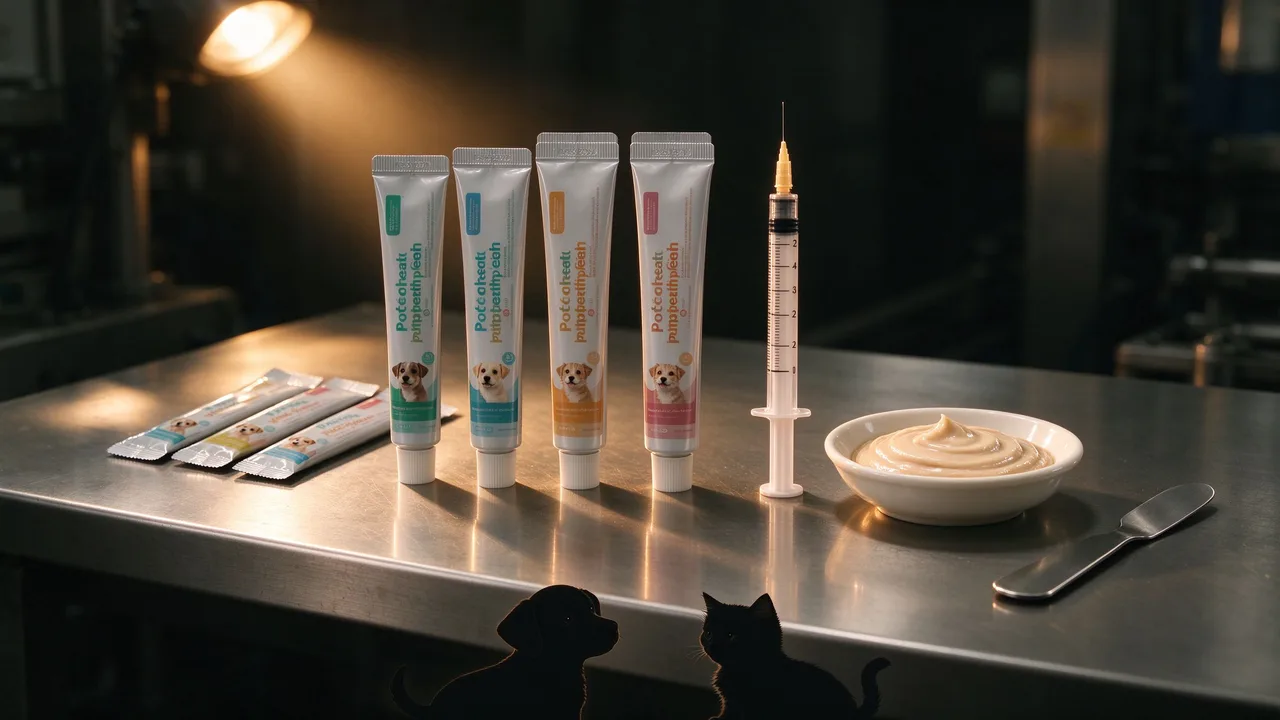
Beyond tablets, powders, and soft bites, paste nutrition gels and liquid supplements are common pet supplement formats suited to dose-squeezing, food mixing, or direct feeding. Unlike solid kibble, the core process challenges are emulsion uniformity, oil-water separation prevention, active-ingredient suspension stability, and filling precision. This guide covers formula composition, process flow, package specs, shelf-life control, label boundaries, and a co-packer checklist for brands planning a supplement line.
Product Forms and Positioning
| Form | Common package | Characteristics |
|---|---|---|
| Nutrition paste | Plastic or aluminum-plastic tube, dosing syringe, sachet | Semi-solid paste, squeezed by segment or dosed |
| Gel paste | Tube/cup | Thicker texture, different carrier and flavor system |
| Liquid supplement | Small bottle, dropper, liquid sachet | Needs suspension and oil-water separation control, poured by dose |
| Emulsified fish oil/fluid | Small bottle or sachet | Oil emulsified and dispersed, uniformity emphasized |
Under the Chinese group standard T/CFIAS 2002-2025, *General Requirements for Pet Nutritional Supplements (Paste)*, paste products are semi-solid additive premix feeds made from amino acids, vitamins, mineral trace elements, and suitable carriers through mixing, homogenization-emulsification, and filling. At project start, the brand should define the product as a supplement/additive premix attribute, distinct from complete staple food.
Formula Controls
1: Base and Nutrients
Pastes typically combine oils, syrup/colloid carriers, and a water system with amino acids, vitamins, and mineral trace elements; ratios by life stage and scenario are set by formula design, and guarantees must match the formula.
2: Emulsion and Suspension Uniformity
The most common quality issues in pastes and liquids are oil-water separation, active settling, or caking. Homogenization emulsification refines oil and powder particles to keep composition uniform from the first tube to the last and first pump to the last; trace vitamins and minerals are pre-mixed before entering the main system.
3: Flavor and Palatability
Pastes can use meat-source flavor carriers to support intake acceptance; flavor additions stay within permitted ingredients, positioned as daily taste improvement with no functional or disease wording.
4: Moisture and Stability
Pastes and liquids control water activity and system stability while matching ambient or chilled storage; oil oxidation and colloid syneresis are assessed in formula and packaging ahead of production.
Process Steps
1. **Ingredient acceptance**: oils, powders, vitamins/minerals inspected, batch retained, qualifications checked;
2. **Pre-mixing**: trace ingredients pre-mixed at small ratio first to avoid uneven dispersion;
3. **Mixing and emulsification**: feed by process order, homogenize to even texture with no obvious separation;
4. **Dose filling**: tube sealing, syringe dosing, or sachet filling with controlled net-weight deviation;
5. **Sealing and inspection**: seal integrity, visual check, and required metal/foreign-material detection;
6. **Packaging and storage**: light-protective, moisture-barrier packaging managed under labeled storage conditions.
Common Package Specs and MOQ References (Industry Reference; Factory-Specific)
| Package form | Common spec | MOQ reference range | Influencing factors |
|---|---|---|---|
| Tube | 60g, 100g, 120g/tube | Hundreds to thousands per formula | Tube/end-seal packaging MOQ, filling batch |
| Dosing syringe | 5g, 10g/unit | Hundreds upward | Syringe accessories, dose filling batch |
| Sachet/liquid strip | 5g, 10g, 15g/strip | Hundreds to thousands per spec | Film roll MOQ, sachet filling batch |
| Liquid bottle | 30ml, 50ml, 100ml | Hundreds to thousands per formula | Bottle/dropper packaging, filling batch |
Actual MOQ depends on net content, packaging MOQ, filling batch, and shelf-life plan; lock first-order specs, formula count, and lead time during sampling.
Co-Packer Checklist
1. **Paste/liquid experience**: records of mixing-emulsification and filling for gels, emulsified fluids, or oral liquids;
2. **Emulsion process**: whether homogenization equipment and parameters support anti-separation and anti-settling;
3. **Trace pre-mixing**: uniformity control for vitamins, minerals, and other trace ingredients;
4. **Filling precision**: dose filling and sealing for tubes, syringes, sachets, and bottles;
5. **Testing system**: guarantees, water activity, microbiology, net-weight deviation, and uniformity records;
6. **Packaging support**: tubes, syringes, sachets, bottles, and label compatibility;
7. **Label compliance**: supplement/premix attribute, ingredient descending order, guarantees, applicable animal, storage conditions;
8. **Flexible scheduling**: small-batch multi-formula trials, line-change cleaning, and batch traceability.
Label and Claim Boundaries
- State supplement/additive premix attribute, not a complete staple food;
- Ingredients in descending added weight; trace ingredients positioned to match inclusion level;
- Label net content, applicable animal, life stage, storage conditions, and shelf life;
- Wording limited to daily nutrition supplement and food-mixing feeding, with no disease prevention/treatment, organ-function, or immune claim;
- Export products checked against destination rules for supplements, additive ingredients, and labels.
Common Misconceptions
1: Paste Only Needs Thickening
Paste also needs emulsion stability, trace uniformity, and seal moisture protection; separation, settling, or seal leakage directly affects use experience and shelf life.
2: Vitamins and Minerals Can Be Added Freely to Liquids
Trace ingredients need pre-mixing, dose batching, and uniformity validation; guarantees must match formula design and test results.
3: Supplements Can Carry Functional Claims
Supplement labels and copy are limited to daily nutrition; disease, organ-function, or immune wording is a compliance red line.
Bottom Line
Paste, gel, and liquid supplement OEM differentiation lies in emulsion uniformity, suspension stability, dose filling, and supplement label compliance. When selecting a factory, first check paste/liquid process experience and filling-test records, then verify packaging compatibility, trace pre-mixing, and small-batch trial support. Start with one formula and fixed package spec, validating uniformity, guarantees, and shelf life before expanding SKUs.
Brands needing paste or liquid supplement sampling and cost modeling can work with **Mixiaoqi (Guangzhou) Pet Technology Co., Ltd. pet food OEM/ODM** on paste/liquid formula development, emulsion process evaluation, tube/sachet/bottle small-batch trials, and export label checklist coordination.
---
FAQ
**Q: What is checked in paste/liquid supplement sampling?**
A: Texture uniformity, separation or settling, filling net-weight deviation, scent and texture, and protein/fat/vitamin-mineral guarantees; check item by item against a sample standard.
**Q: What label attribute do these products carry?**
A: Generally supplement/additive premix attribute, distinct from complete staple food; label applicable animal, life stage, storage conditions, and shelf life.
**Q: What affects paste/liquid shelf life?**
A: Water activity, emulsion stability, packaging barrier and light protection, seal integrity, and storage conditions together; export orders also follow destination supplement label rules.
Developing a fresh pet food product?
Share your target market, product direction, format and expected volume — we will help structure a project plan.
Submit a project brief