
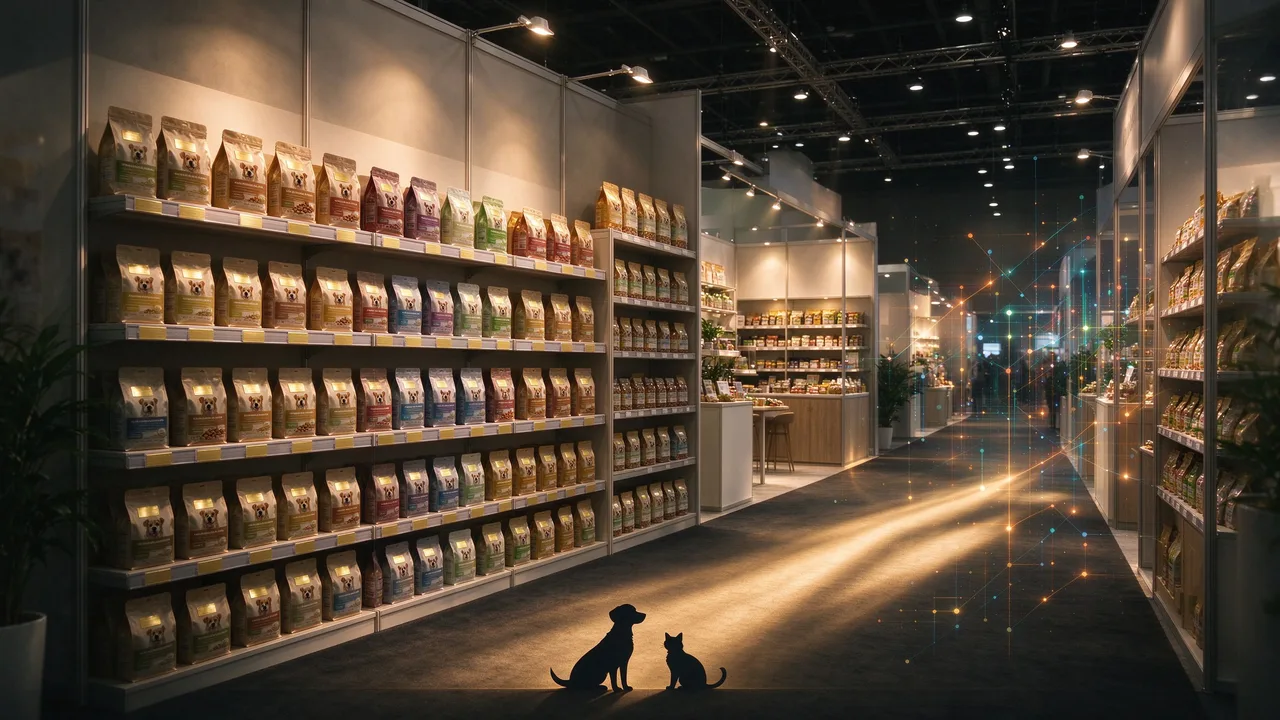
# PLMA 2026: Why Private-Label Pet Food Is the Next Wave for Chinese Co-Packers
In November 2026, PLMA's Private Label Trade Show wrapped up in Chicago. The booth signal plus ADM's 2026 Private Label Pet Market Report is clear: **private label/store-brand pet food in the US and Europe is moving from "cheap" to "premium"** — a steadier opportunity for Chinese pet food co-packers than chasing branded exports.
The Numbers: Private Label Is No Longer a Side Role
PLMA data shows:
- Nearly **1 in 5 pet care units sold in the US** now carries a store-brand name (unit share 18.1%, dollar share 17.2%);
- 2026 exhibitor count in pet care hit a record, focused on animal wellness, functional treats and chews;
- ADM calls this **"value-forward premiumization"** — shoppers no longer pay for a logo, but will pay for visible ingredients, transparent processes and fair prices.
Why Now? Three Drivers
1. Post-Inflation Shoppers Calculate More
After 2023-2025 inflation, US pet parents recalculate "cost per ounce of protein." Chewy's Get Real fresh line and Kaufland's K-Carinura Naturals both deliver near-premium formulas at lower prices. **Retailers need co-packers who supply consistently, flex formulas and cost less.**
2. Retailers Need Differentiation
Amazon, Costco, Petco and Walmart are all expanding private label. They do not lack factories — they lack **partners who do small batches, fast formula changes, and human-grade/functional treats.** That is exactly what the Pearl River Delta and Shandong supply chains have built over two years.
3. China's Cost and Flexibility Edge
Thai Betagro, Qingdao Linsen and Ningbo Kechong are all chasing the same orders. China's edge: **sample-to-mass production in 2-4 weeks (vs 6-8 in Southeast Asia), fast SKU switches, and multi-process lines (fresh, baked, freeze-dried).**
What Chinese Co-Packers Still Lack
| Dimension | Current state | Retailer ask |
|---|---|---|
| Certification | Most have BRCGS/SQF | Increasingly require FDA registration + FCE/SID |
| Formula | Mostly toll processing | Co-development with claim support |
| Small batch | 500 kg MOQ | 100-300 kg trials common |
| Compliance | Outgoing test only | Third-party per batch + traceability |
| Sustainability | Rare | Recyclable packaging, carbon footprint reports coming |
Recommendations
1. **Stop being only a toll processor** — retailers want co-developers; a 3-5 person nutrition/formula team pays off;
2. **Get FDA registration and FCE/SID first** — the ticket into US retailer supply chains;
3. **Build flexible small-batch lines** — 100-300 kg trial capability is a bid advantage;
4. **Move on packaging sustainability** — recyclable soft pack and soy inks become standard in 2027;
5. **Watch Southeast Asian rivals** — Thailand wins on labor cost, China wins on lead time and SKU flexibility.
Bottom Line
PLMA 2026 and ADM's report say one thing clearly: **growth in Western pet food is shifting from brand-driven to retailer-private-label-driven.** For Chinese co-packers, this is not about launching your own brand — it is about becoming the invisible supplier behind the retailer: flexible, certified and small-batch capable.
If your clients are asking "can you do private label for overseas retailers," or you are a co-packer looking to enter this line, **Mixiaoqi pet food OEM/ODM** in Guangzhou runs multi-process lines (fresh-steamed, baked, freeze-dried, air-dried, soft chews) ready for co-development and small-batch trials with overseas retailers.
---
FAQ
**Q: What is private label pet food?**
A: Product designed by retailers (Costco, Petco, Amazon, etc.) but manufactured by a third-party plant under the retailer's brand.
**Q: What certifications do Chinese co-packers need for private label?**
A: US line needs FDA registration + FCE/SID; EU line needs BRCGS + EU pet food registration; most retailers also require SQF or IFS audits.
**Q: Is private label margin better than brand clients?**
A: Unit price is slightly lower, but orders are stable and predictable — ideal for filling flexible capacity.
Developing a fresh pet food product?
Share your target market, product direction, format and expected volume — we will help structure a project plan.
Submit a project brief