
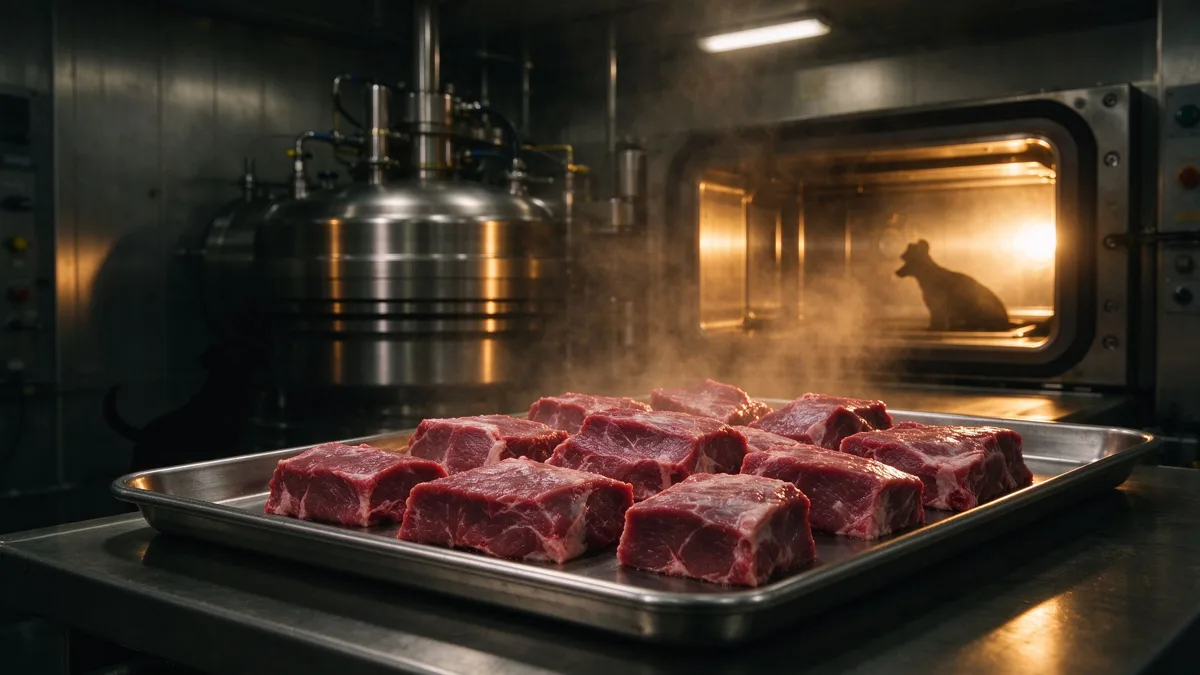
# Why Raw Pet Food Co-Manufacturing Is Hard: HPP and Cold Chain Are the Real Barriers
One of the clearest patterns in pet food is that kibble is stuck in a price war, while raw, fresh and frozen formats keep growing at independent pet retailers. PetfoodIndustry's October roundup put raw growth at roughly 55% and frozen fresh food at about 53% at independent retail.
Many new brands look at those numbers and want in. But when they start calling **raw pet food manufacturers**, they find far fewer qualified partners than kibble co-mans. The bottleneck is not the meat—it is process and supply chain.
1. "Raw" Is Not "Chop Fresh Meat and Bag It"
Raw selling points depend on minimal processing, which paradoxically demands the strictest production environment:
- Meat must be portioned and trimmed in a low-temperature room, not left at ambient temperature;
- Bins, knives and cutting tables must be separated by species and process;
- Because there is no terminal heat treatment, raw ingredient hygiene directly determines finished-product safety.
This is why more factories are adopting **HPP (High Pressure Processing)**—using ultra-high pressure without heat to suppress common pathogens in raw material, preserving the raw state while lowering risk. HPP equipment is capital-intensive and batch costs are high, so not every co-man has it.
2. Cold Chain Is the Hidden Barrier
Unlike freeze-dried food, raw must stay frozen or chilled end-to-end. That means:
- The factory needs a dedicated freezer;
- Shipping must run through cold-chain logistics;
- The end customer needs frozen storage at home.
New brands routinely underestimate this. Before launching, map the cold-chain route and realistic per-shipment volume—otherwise you can make product you cannot deliver.
3. MOQs Are Higher Than Kibble
A kibble line can produce tons a day. Raw capacity is limited by low-temperature rooms, HPP throughput and frozen warehousing. Small new brands face awkward lead times and unit costs.
Practical paths:
- Start with a small-batch pilot to lock formula and cold chain before scaling;
- Or enter through freeze-dried raw—a shelf-stable format with lower logistics barriers.
4. Labels: No Disease Claims
Raw is one of the most heavily scrutinized label categories. Both China and export markets require:
- Ingredient list in descending order of weight;
- Storage conditions (frozen/chilled);
- Feeding guidance (thawing method, long-term feeding recommendations).
Crucially: labels and marketing cannot claim disease prevention or treatment. Raw is a diet format, not medicine.
Closing
**Raw pet food co-packing** looks simple but is all hard craft. HPP, cold rooms, cold chain and label compliance each determine whether product reaches the customer safely. Before entering this category, work through these four items.
> If you want to enter via frozen fresh, raw or freeze-dried formats, we can prepare a small-batch pilot based on your channel and cold-chain setup.
Developing a fresh pet food product?
Share your target market, product direction, format and expected volume — we will help structure a project plan.
Submit a project brief