
# Rabbit Meat Not Detected in Russian Cat Wet Food: Ingredient Authenticity Checks for Export Pet Brands
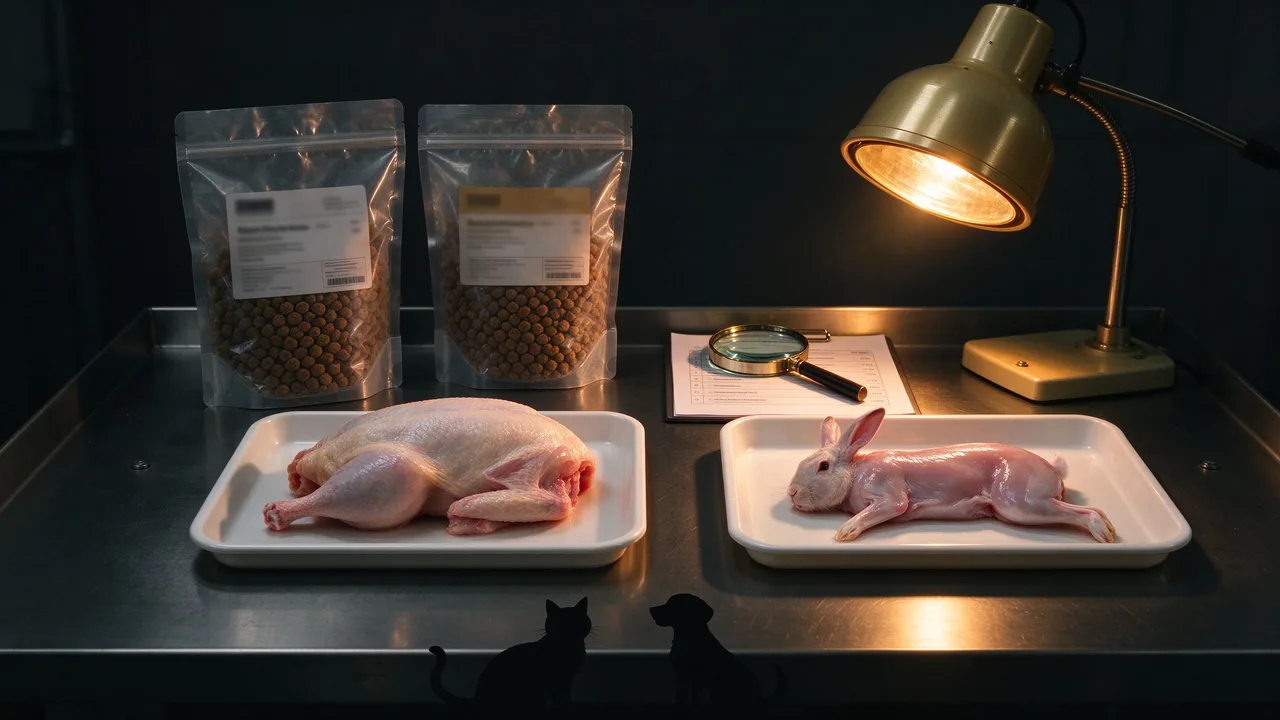
In early November 2026, Russia's plant and animal health regulator (Rosselkhoznadzor) reported enhanced laboratory control over Woow brand cat wet food "turkey with rabbit, fillet in jelly," produced by Rusresurs LLC in the Leningrad region. Samples collected at the production site did not contain the declared rabbit meat, and the company is listed in the exporter register and the Customs Union. The regulator noted that repeated nonconformity under enhanced control could lead to suspended exports. The case is a practical sample for examining meat-source species authenticity and label composition compliance in pet food.
Core Facts
- **Product**: Woow cat wet food, labeled "turkey with rabbit, fillet in jelly";
- **Producer**: Rusresurs LLC, Leningrad region, listed in the exporter register;
- **Result**: production-site samples showed no declared rabbit meat;
- **Measures**: enhanced laboratory control; repeat nonconformity may trigger an export suspension review;
- **Regulator view**: packaging must carry complete and truthful composition; undeclared ingredients used to cut cost raise risks of unknown, unrecorded, expired, or improperly produced raw materials.
What Meat-Source Species Authenticity Means
Species authenticity verification confirms that the animal proteins actually used match the label declaration, through raw-material records, formula batching logs, and species identification testing. It differs from nutritional testing: crude protein measures total protein only and cannot tell chicken, turkey, rabbit, or another animal source apart; species identification typically relies on protein- or DNA-level comparison.
1: Why Crude Protein Passing Does Not Prove Real Meat Source
Passing crude protein shows only total nitrogen within guarantee range; it does not prove the labeled rabbit is present. A cheaper protein can replace an expensive one while total protein stays compliant, but species composition no longer matches the label.
2: Common Nonconformity Patterns
- Declared expensive source (rabbit, lamb, duck) filled with cheaper meat;
- Single-animal-protein label mixed with other animal ingredients;
- Offal and meat-meal ratios inconsistent with label description;
- Batching records cannot be matched to formula and label by batch.
3: Verification Chain
Procurement evidence → incoming acceptance and batch retention → formula batching records → production batch traceability → finished-product species identification sampling → label composition check. A broken link at any stage may leave no defense when regulators sample.
Label Composition Compliance Boundaries
1: Ingredients Declared by Weight Descending
Ingredients list from highest to lowest added weight; an expensive source listed near the front needs corresponding batching support. Wording such as "rabbit formula" or "with rabbit" must match actual inclusion, avoiding conceptual claims.
2: Single-Protein and Hypoallergenic Wording Needs Evidence
A single-animal-protein label requires line cross-contamination control and batching records; export products also follow destination-country wording rules.
3: Fresh Meat, Meal, and Animal By-Products Differ
"Fresh chicken," "chicken meal," and "animal by-product" are distinct ingredient forms and cannot be written interchangeably; label wording updates when ingredient form changes.
Brand and Co-Packer Responsibility Split
| Stage | Brand | Co-packer |
|---|---|---|
| Formula and label claim | Set formula direction, review label copy and claim boundaries | Confirm formula feasibility, guarantees, and species composition |
| Raw material sourcing | Define meat source specs and acceptance standards | Incoming acceptance, source evidence, batch retention |
| Batching | Audit batch-to-formula consistency | Batch to formula, retain batching and traceability records |
| Finished testing | Arrange species identification sampling or third-party testing | Support sampling, provide retention samples and production records |
| Export compliance | Check destination label rules and registration requirements | Support export filing, certificates, and inspection documents |
Under contract manufacturing, the label represents the brand; consumers and regulators face the brand first, while the factory's batching records and retention samples are the basis for self-defense. The OEM agreement should specify species authenticity responsibility, sampling arrangements, and nonconforming batch handling.
Six Recommendations for Export and Domestic Brands
1. **Separate files for expensive-source SKUs**: keep complete procurement and batching evidence for rabbit, lamb, duck, and similar categories;
2. **Batch traceability**: each finished batch traces back to ingredient batch, batching record, and retention sample;
3. **Periodic species identification sampling**: beyond crude protein, schedule species testing by risk level;
4. **Label and formula review**: brand and factory double-check ingredient list, meat wording, and guarantees before launch;
5. **Cross-contamination control**: record line-change cleaning and cross-prevention when multiple sources share a line;
6. **Export registration compliance**: complete registration required by target markets and retain compliance documents.
Bottom Line
The Russian case shows meat-source authenticity is an independent regulatory dimension; passing protein and fat guarantees does not replace species composition verification. For export and domestic brands alike, label claims must be supported by ingredient evidence, batching records, and sampling results: the brand owns claims and label review, the factory owns batching traceability and retention support, and a connected chain provides the defense when regulators sample.
Brands planning multi-source or expensive-source lines can work with **Mixiaoqi pet food OEM/ODM** in Guangzhou on ingredient specs, batch batching traceability, species identification sampling coordination, and label composition review, building the authenticity file from formula sampling onward.
---
FAQ
**Q: Does passing crude protein prove the labeled meat source is real?**
A: No. Crude protein reflects total protein without distinguishing animal source; authenticity needs species identification methods plus batching records.
**Q: Does the co-packer bear label authenticity responsibility?**
A: The label represents the brand, which carries primary claim responsibility; the factory must batch to formula and retain records, with sampling, retention, and nonconforming handling split in the OEM agreement.
**Q: What should be prepared before launching an expensive-source product?**
A: Retain meat procurement evidence, set batching ratio and label wording, establish batch traceability and retention, arrange species identification sampling, and check destination label rules.
Developing a fresh pet food product?
Share your target market, product direction, format and expected volume — we will help structure a project plan.
Submit a project brief