
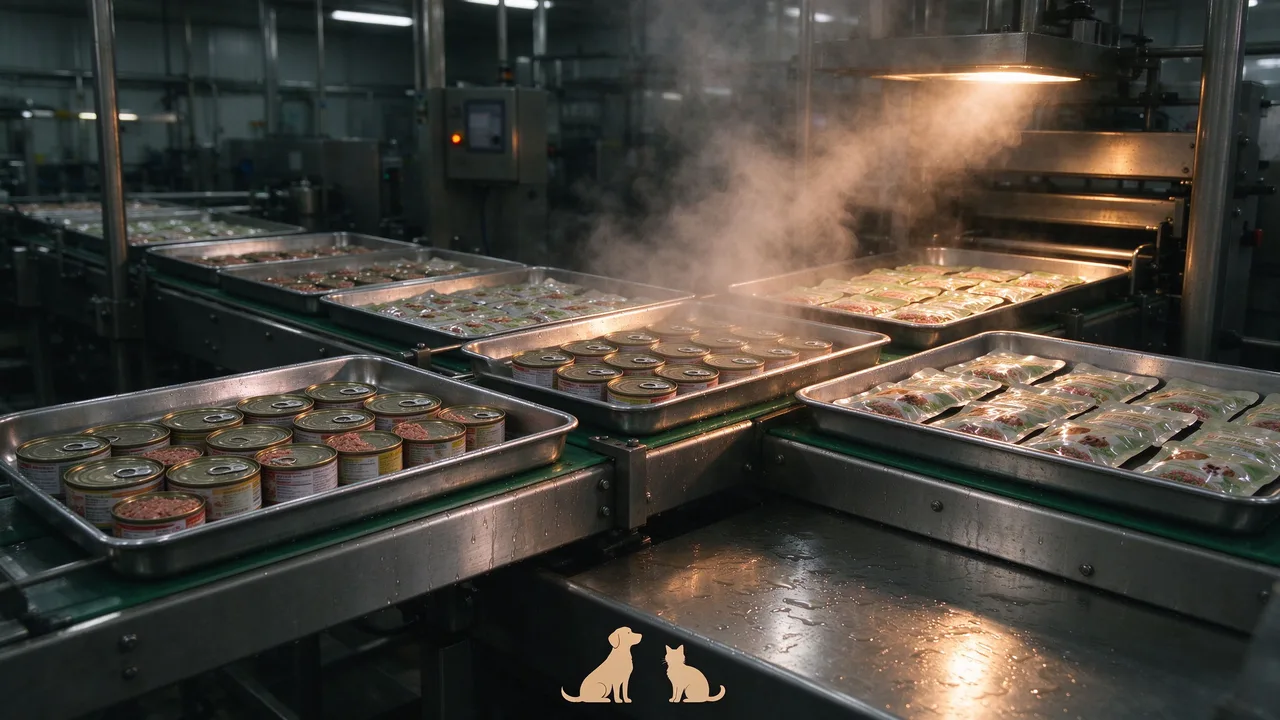
# Wet Pet Food OEM Guide: Pâté, Shreds, Gravy Chunks Process, Controls, and MOQ
The manufacturing difficulty of staple wet food (dog and cat cans, pouches, trays) goes beyond meat source and formula; it lies in texture forming and sterilization. The same chicken recipe, made into a smooth pâté, pulled shreds, or gravy chunks, places very different demands on ingredient particle size, forming, filling, and retort sterilization. This guide compares common wet textures, covering formula and process points, co-packer checks, and MOQ ranges for brands planning a wet line.
Four Common Wet Textures and Process Differences
| Texture | Typical form | Formula and forming points | Packaging and sterilization |
|---|---|---|---|
| Pâté / mousse | Uniform smooth loaf, sliceable | Ingredients refined and homogenized; stable moisture/fat ratio; setting via binder and cooking | Can/pouch, high-temperature secondary sterilization |
| Gravy chunks | Whole chunks plus gravy | Chunks pre-cooked and set separately; gravy mixed separately; meat/gravy layered during filling | Can/tray common; chunks stay intact after sterilization |
| Shredded fillets | Pulled shreds or thin slices | Meat fiber direction controlled; shreds coated with gravy or sauce | Pouch/small tray common; fines rate tracked |
| Ragout | Meat chunks, vegetables, gravy | Ingredients pre-processed separately; uniform particle size; stable gravy binding ratio | Can/pouch; more flavor combinations |
Key Formula and Process Controls
1. Ingredient Particle Size and Homogenization
Pâté needs full refinement with homogenization defining smoothness; chunk products must retain fiber form, with pre-cooking to prevent breaking apart after sterilization. These cannot run on the same parameters.
2. Moisture, Fat, and Binder Balance
Wet guarantees (crude protein, crude fat, moisture) tie to texture: pâté relies on binder and cooking setting, while gravy chunks maintain solids-liquid ratio through the gravy formula. Formula changes must account for both nutrition guarantees and form stability.
3. Filling and Solids Ratio
Chunk and shred products must declare solids content; filling controls meat-to-gravy ratio deviation. Pouch fill weight and seal integrity are outgoing inspection focus points.
4. Secondary Sterilization
Wet food relies on high-temperature secondary sterilization for commercial sterility; the temperature-time curve affects chunk integrity, palatability, and shelf life. Heat penetration differs by packaging format (can, tray, soft pouch), and parameters must be validated separately per package.
5. Barrier Packaging and Storage
Pouches, trays, and metal cans differ in barrier performance and seal/rim process; opened-product storage instructions must match the package format.
Wet Co-Packer Checklist
1. **Texture experience**: can it produce target samples for each texture (pâté, chunks, shreds);
2. **Sterilization capability**: secondary retort equipment and parameter records, heat validation per packaging format;
3. **Formula development**: flexibility on meat source, binder, and gravy recipes, with guarantee-value calculation;
4. **Ingredient traceability**: animal-origin evidence and batch test records;
5. **Packaging support**: can, pouch, and tray material sourcing and filling coordination;
6. **Label compliance**: catalog ordering, solids declaration, applicable species and life-stage review;
7. **Flexible scheduling**: multi-SKU small-batch mixed runs, line-change cleaning records.
Common MOQ Ranges (Industry Reference; Factory-Specific)
| Product type | Common MOQ reference | Influencing factors |
|---|---|---|
| Pâté/mousse can, single flavor | 8,000-10,000 cans per formula | Filling line capacity, packaging MOQ |
| Gravy chunk pouch, single flavor | 8,000-10,000 pouches per formula | Pouch film roll MOQ, sterilization batch |
| Shredded fillet tray | Quoted by tray format and spec | Forming molds, sauce process |
| Multi-flavor combo | Per-flavor MOQ | Line-change cleaning, ingredient batches |
New brands should sample first to lock texture and palatability, then size the first production run by packaging spec and shelf life. Packaging materials usually carry a separate MOQ, calculated apart from food materials.
Common Misconceptions
1: Wet Formulas Can Be Ported Directly From Kibble
Kibble is extruded or baked; wet food is homogenized, filled, and sterilized. Ingredient form, moisture system, and forming logic differ, so kibble formulas cannot be reused directly.
2: Only Meat Ratio Matters, Not Solids Content
Chunk gravy experience depends heavily on solids ratio and chunk integrity; brands should contractually define solids ratio and fines standard.
3: Small Batches Share Large-Capacity Scheduling
Wet sterilization runs in batches; small orders absorb batch sterilization costs. MOQ and lead time should be agreed during sampling.
Bottom Line
Wet OEM differentiation lies in texture forming and sterilization. When selecting a factory, first verify it can produce the target texture sample, then check sterilization validation, solids control, and label compliance. Start with one texture and one flavor, then expand SKUs after palatability, guarantees, and packaging are validated.
Brands needing wet multi-texture sampling or cost modeling can work with **Mixiaoqi (Guangzhou) Pet Technology Co., Ltd. pet food OEM/ODM** on pâté, chunk, and shred formula development, sterilization process evaluation, and small-batch trial production, online or on site.
---
FAQ
**Q: Can wet OEM sampling precede production orders?**
A: Yes; sample first to confirm texture, palatability, and guarantees, then lock production packaging specs and MOQ.
**Q: How are gravy chunks kept intact after sterilization?**
A: Chunk pre-cooking, separate gravy preparation, and packaging-specific sterilization curves are the factory-side controls; samples and batch records can be reviewed during factory audit.
**Q: Is wet MOQ higher than dry?**
A: Wet food is affected by sterilization batches and packaging MOQ; single flavor commonly sits in the 8,000-10,000 can/pouch range, subject to factory packaging quotes.
Developing a fresh pet food product?
Share your target market, product direction, format and expected volume — we will help structure a project plan.
Submit a project brief