
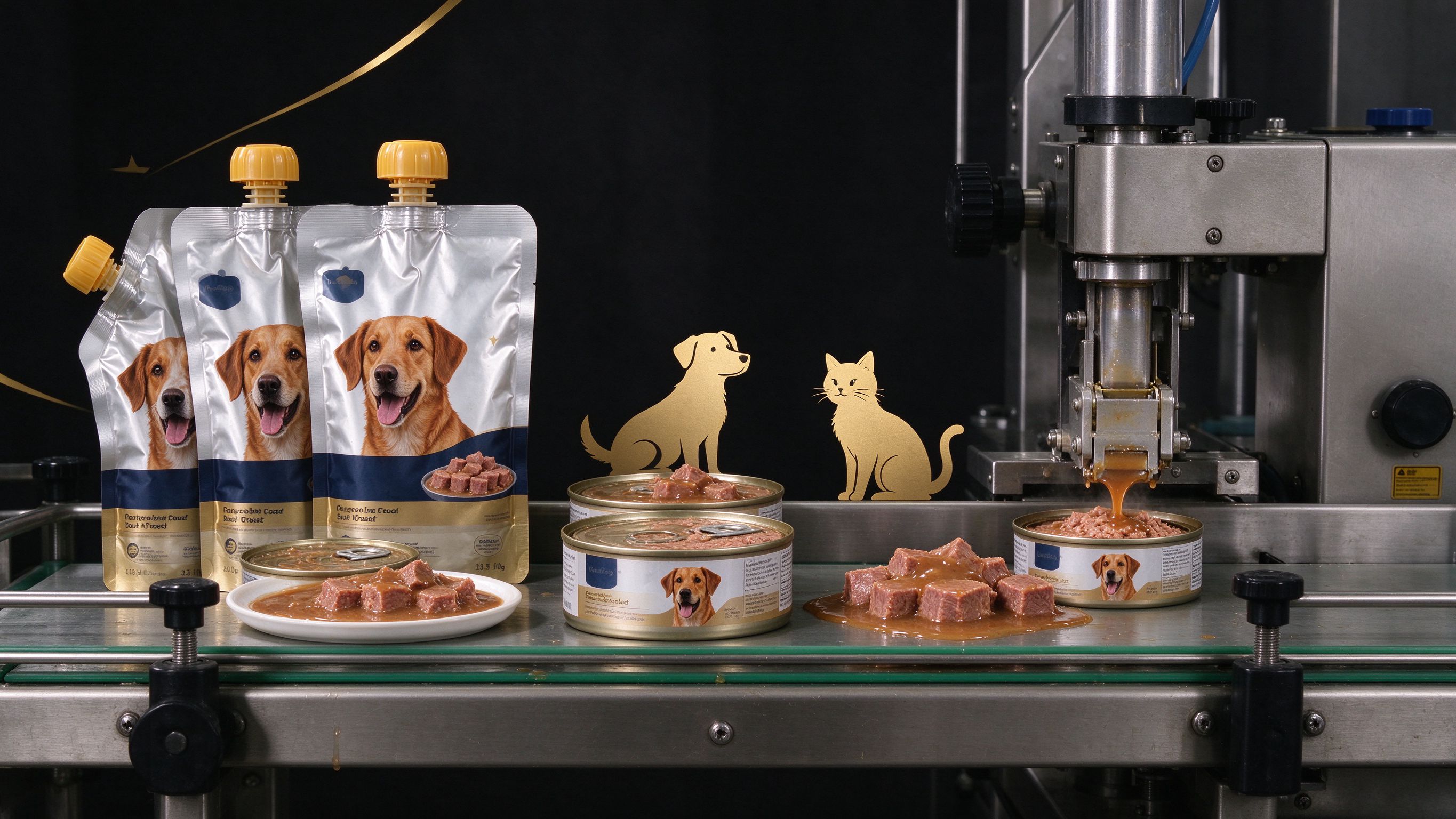
# Wet Pet Food Manufacturing Guide
Wet food is one of the fastest-growing categories. But wet food production lines are completely different from dry food.
Wet food formats
| Format | Packaging | Shelf life | Cost |
|--------|-----------|------------|------|
| Pouch | Foil bag | 12-24 months | Low |
| Can | Steel can | 24-36 months | Medium |
| Cup | Plastic cup | 12-18 months | Medium |
| Tetra | Carton | 9-12 months | Medium-high |
Pouch vs can
Pouch pros
- Lightweight, low shipping cost
- Easy to open and squeeze out
- Low material cost
- Good for small portions (70-150g)
Pouch cons
- Can tear
- Cannot hold large meat chunks
- Shorter shelf life
Can pros
- Long shelf life
- Whole meat chunks
- Premium feel
Can cons
- Heavy and expensive to ship
- Needs opener
- Higher material cost
The process
1. Prep meat and broth
2. Automatic filling
3. Vacuum sealing
4. Retort sterilization
5. Cool, label, pack
Choosing a co-packer
1. Do they have dedicated wet food lines?
2. Can they control broth viscosity and chunk size?
3. What pouch/can sizes are available?
4. How do they monitor seal strength and micro levels?
MOQ and cost
- Pouch: 5,000-10,000 per SKU
- Can: 10,000-30,000 per SKU
- Sampling: $420-$1,400
- Lead time: 25-40 days
Common pitfalls
1. Using a dry food factory for wet food
2. Not testing seal integrity
3. Ignoring palatability trials
4. Underestimating retort time
If you want to add wet food to your line but are unsure whether to start with pouches or cans, Mixiaoqi pet food OEM/ODM supports both pouch and small can sampling.
FAQ
Which is better, pouch or can?
Pouches are cheaper and lighter; cans have longer shelf life.
What is the MOQ?
5,000 pouches or 10,000 cans.
Are cat and dog wet food formulas different?
Yes. Cats need more taurine and animal protein.
Frequently asked questions
餐包和罐头哪个好?
餐包轻成本低,罐头保质期长。湿粮起订量多少?
Developing a fresh pet food product?
Share your target market, product direction, format and expected volume — we will help structure a project plan.
Submit a project brief